
Warm Wound
We have art in order not to die of the truth.
— Nietzsche
I want to write a story about a love whose ending is not like Hollywood's commercial endings;
at the very least, it should have a window to the light in this world under the reign of darkness, and…
On the front lines of the Iran-Iraq war, there was a term: "warm wound." When a soldier was hit by shrapnel or a bullet, they wouldn't feel the pain for a while; we would say the wound is still warm. The pain came later—even the pain of a severed hand or leg.
After the slaughter and butchery of "Black January," we Iranians have been wounded. And now, as we hold ceremonies marking the fortieth day of the death of our bravest people, we are gradually beginning to feel the pain of the wound. But the agony of the wound will send us out from our homes and once again into the streets, this time toward specific destinations. Everyone has the addresses of the executioners.
I want to write a story with a character like Zorba the Greek…
Let the The Great Leader of the Executioners and his mercenaries worry over our mourning and our wound. What did they expect?They believed that massive and deliberate slaughter would suppress and silence the protesters.
It didn't work. Rejecting Islamic traditions, people clapped and danced at burial ceremonies. And they began to chant slogans against the executioners. The people have cast off the superstitions of Islamic mourning; instead of black, the mourners came clad in white white, white.
In the long history of the war for Iran’s freedom against the Arab invasion, we have had "Black-Clad," "Red-Clad," and "White-Clad" movements opposing the "Umayyad" and "Abbasid" caliphates—each was a stench worse than the other, and both better than the current caliphate in Iran.
I want to write a story about a tree like the story of The Giving Tree, whose author I envy…
There is a shopkeeper who hasn’t lifted his store's shutters for a long time. The morning after the nightly slaughter, when he went to open his grocery, he found brains and bits of hair with splashes of blood on those shutters.
I want to write a story like The Little Prince and his universe…
The imagination of evil has no end. The imagination of goodness or, more precisely, of beauty, sometimes falls short.
I have no desire to write another Animal Farm. It is perfect for all times…
Einstein famously noted that "Two things are infinite: the universe and human stupidity; and I'm not sure about the universe." In light of this recent slaughter of the Iranian people, I propose that there are actually three infinities. There is also the vileness of the pigs who walk on two legs.
I want to write a story about the executioners' frame of mind, to describe their unremitting terror of retribution following the slaughter of their own people. It is at their doorsteps.
I want to write a story about the story…
Chekhov has a story called "Enemies." One of its themes is that people's grief distances them from each other or—worse—incites them to enmity. In this time of shared grief, the Iranian nation, mourning the slain, has been united.
I wish I could write like the author of Zorba but in Iran, people who have lost their dearest have begun dancing like him.
The Supreme leader of Iran (our Führer) planned the slaughter of tens of thousands more—simply in order to stay in power a while longer. The result would have been even more terrible than the Tiananmen Square massacre in China in 1989.
Yet, despite his demonic intentions, Iranians have discarded the funeral superstitions of Islam and in their mourning, they have given rise to pre-Islamic ceremonies: instead of grieving and lamentation, they clap their hands; they dance. It is a dance of mourning, a ritual of preparation for vengeance. To their earlier slogans, the mourners have added a menacing refrain: "I will kill, I will kill, who have killed my brother and sister!”
In war there are three kinds of wounded. There are the ones who cry out to God and his saints. There are those who scream the name of a woman, a mother, or a lover. And then there are those who stay silent. These are the terrifying ones. Anger and hatred for the enemy keeps their wounds warm. The slaughtered nation of Iran is like these wounded.
Their silent cries, aimed at the Tower of Babel inhabited by the Great Executioner, carry one message: "For every one who has been killed, stand a thousand more..."
Rereading Heart of Darkness evokes a feeling for which there is no name. Without having crossed any sea, we Iranians have reached the very heart of darkness; what follows is our own Apocalypse Now:
War!
I don’t want to write a story like Hemingway's The Old Man and the Sea...
In Iran, the millions already know that: "A man can be destroyed but not defeated…"
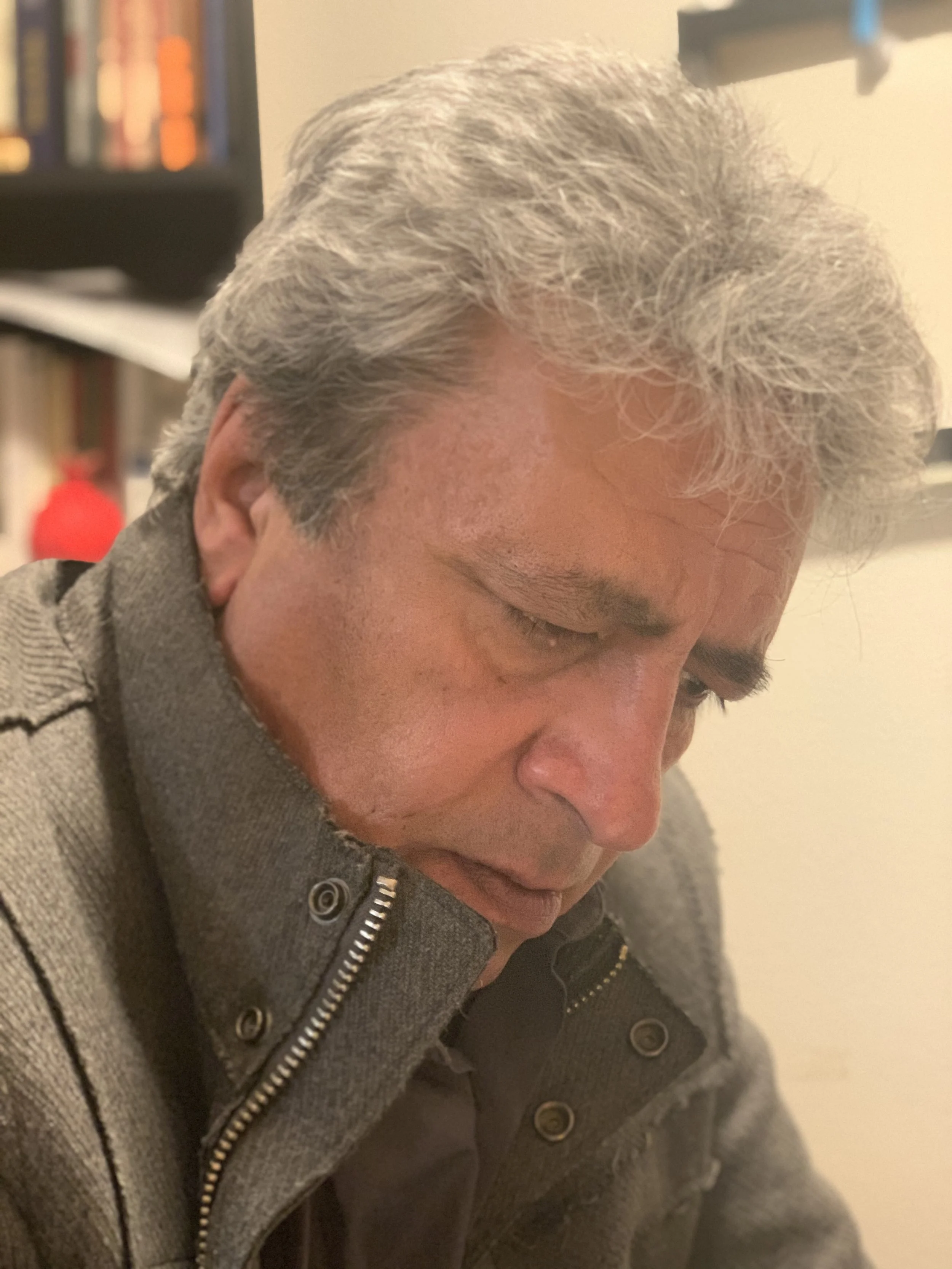
Photo by Danial Mondanaipour
Shahriar Mandanipour (Mondanipour) is the author of nine volumes of fiction, one nonfiction book, and more than 100 essays on literary theory, literature and art criticism, creative writing, censorship, and social commentary. From 1999 until 2007, he was Editor-in-Chief of Asr-e Panjshanbeh (Thursday Evening), a monthly literary journal published in Shiraz that, after 9 years of publishing, was banned. His short works have been published in France, Germany, Denmark, and in languages such Arabic, Turkish, and Kurdish. Mandanipour’s first novel to appear in English, Censoring an Iranian Love Story (Knopf, 2009) was translated by Sara Khalili, and named a New Yorker reviewers’ favorites, and named by NPR as one of the best debut novels of the year. It has been published in 11 other languages and in 13 countries. Mandanipour’s second novel to appear in English, Moon Brow, was translated by Sara Khalili and published by Restless Books in 2018. Seasons of Purgatory, his short story collection, longlisted for the National Book Award, was published by Bellevue Literary Press in 2022.