
The Geography of Everyday Life
Land, to be sure, there was, and air, and ocean,
But land on which no man could stand, and water
No man could swim in, air no man could breathe,
Air without light, substance forever changing,
Forever at war…
— Ovid
Metamorphosis
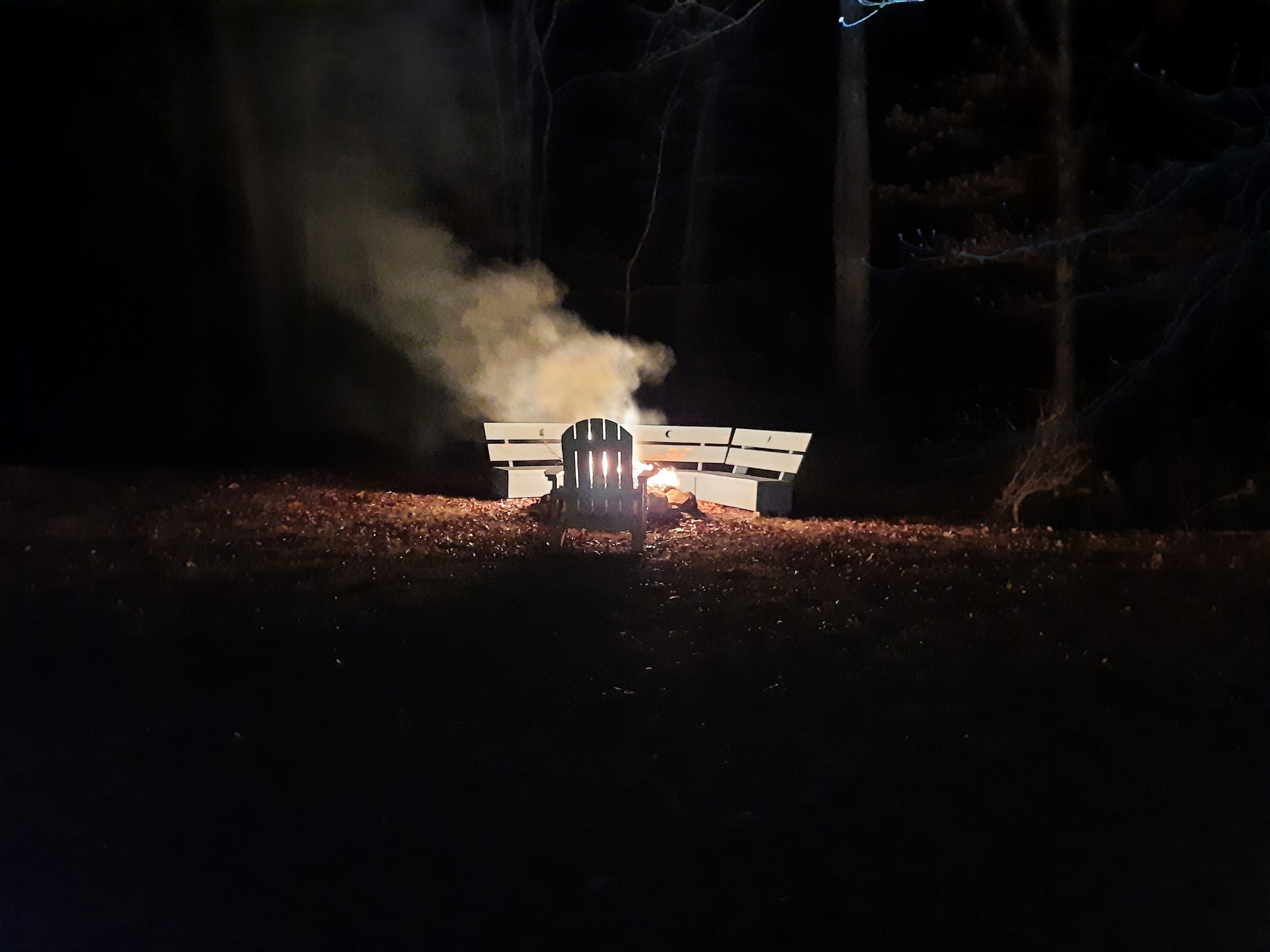
I’m sitting in my backyard beside the unlit firepit, in a fair approximation of darkness, listening to the geese clamoring in the sky above me. It’s October and the leaves have begun to turn, but the tree canopy is still thick, making it impossible to see these birds who seem to be in a state of rapture, though I suppose they’re up to something more mundane than that. In the light of day they race over the treetops, their inverted Vs fracturing and reforming as they follow instinct and each other to more suitable climates. But I like them best on a dark and moonless night, when they are an ethereal, invisible cacophony of hoots and honks. I can hear them coming from far away. Sometimes their flight path is not to my advantage and the noise fades. Sometimes they fly overhead, louder and louder, nearer and nearer, until it seems I can hear not just their calls but the flapping of their wings, if not their actual heartbeats. Then I slip into formation alongside these feathered pilgrims and, for a moment, join them as they trumpet their way through the starless void.
I’m pretty sure this is the entire point of backyards: they are a means of eluding geography, a stage set suggesting a landscape not entirely absent but that here, by the firepit, exists mostly as trace, as suggestion, as desire. It’s not that the natural world has been erased, far from it. Even when we try to blot it out with asphalt and cinderblock, it sneaks in through each nook and cranny. When I lived in New York on the ground floor of a brownstone, I would sit in its courtyard and, much like I do here, note the passersby: catbirds and cardinals, wasps and dirt daubers, squirrels making merry in the treetops. I would note them because they were notable, so easy to not see. But no mountain redoubt, no lakeside cabin, no beachfront bungalow needs a backyard. Just look out the window, open the door, and there it sits, as if its only purpose were to awe us as we sip our morning coffee. “Fat girl, terrestrial,” Wallace Stevens called it, “…the more than natural distortion.”
Here, in nature’s purlieus, I need this patch of dirt, Wallace’s “fiction that results from feeling.” Here I cultivate an idea of nature, of my place in a world otherwise glassy and blue-lit, hardpacked and stinking of bitumen and exhaust, so often careless and cruel. Soon the geese will bed down for the night. On the far side of the woods, the cars will rumble and hiss through hours small and large. I light a fire. I close my eyes and listen to the acorns pop, the wet wood whistle and steam. Insects hum beyond the tree line, late-singing birds call from the tops of oak and pine and maple trees, and I fall in with the geese. Then, I’m no longer here. Or, rather, my here is transposed, transfigured. The land around has gone from minor to major key, from flesh to spirit.
—
My earliest spatial memories are like those maps from our collective history, their borders haunted by leviathan and dragon, the original outer space, stygian and silent. I grew up an hour’s drive northwest of Savannah, Georgia, in a tumbledown ranch across the street from a railroad track. Outside the dining room window stood an ancient live oak canted so sharply a kid could run, hands-free, up the trunk all the way to its crotch. In my mind, in my memory, I can still walk that lot. I can smell the muscadines overripe on the arbor and hear the creaking of the roof on the aluminum shed, shaped like an aircraft carrier, on top of which we climbed and bounced and leapt. I see and smell the pen in which we kept a succession of dogs—Smokey, Rocky, Max—who lived dirty, solitary lives, loved as puppies, abided in the years after. While they bark, I play baseball in the side yard, climb the dogwood, swing from a rope someone has tied high up in the live oak.
Later, for my entire adult life really, I’ll return to this hardscrabble acre, to the town and woods surrounding it. I’ll visit, if not weekly then certainly monthly, though for a decade now only in thought. I don’t know if we all do this, return again and again to our earliest geographies. I don’t even know if my memories are accurate. If I travelled there, to this low country once submerged beneath a shallow sea, now strewed with fossilized clam and mollusk, long-extinct ammonoids whose remnants medieval Europeans called “snakestones” after the legends of Saint Patrick and Hilda of Whitby, later carpeted with light-stippled savannahs of wiregrass and longleaf pine, both mown down during “sawmill bonanza” of the late-19th and early-20th centuries—would I find the land I remember? With little changed except the size of the parking lots and the names on the storefronts? Or would I feel like I did as a high school kid, when I revisited my elementary school, astonished by the size of the diminutive monkey bars and jungle gym?
—
Behind the shed I played inside and atop was a field, most years fallow, a pecan tree at its center. Behind the field, a woods and then a pond owned by my grandfather and then more woods and lesser knowns, unknowns, the fraying edges of the map. Sitting here, forty years and a thousand miles away, I believe I could draw the outline of every house, chart every block, the serpentine drainage ditch running through town, which we clambered and raced through, the long-unused jail we’d inch up to but never too close and never entered, though a hole in its roof beckoned us.
My father’s parents lived across town in a redbrick house with green and white awnings and, before my grandfather removed it, a magnolia tree in which we’d climb like sailors up to its swaying crow’s nest. My mother’s mother lived three blocks away, in a small clapboard house on a side street. When we were very young there was a drugstore in town that sold ice cream, candy, a few necessities and toys but not pharmaceuticals. I believe I could walk back into that store today—if it still existed—and in an instant locate the bread aisle, the toiletries, the toy shelf. As I sit here in New England, I could in my mind walk to the elementary school I have not entered in almost four decades. I could walk home, taking the railroad tracks for part of the way. I know which houses keep dogs chained up out front, which streets to avoid. If I don’t have my key, I know that the door to the utility room seldom locks correctly and can usually be forced open. Failing that, there’s always at least one unlatched window sash. I can feel the spindly branches of the azalea bushes scratch against my skin as I try one window after another and then feel my knees press against the sharp sill as I tumble inside.
—
Jen and I like to say that we bought this house for the yard and the woods backing up to the yard. The tract is just shy of an acre and a half, the house the kind of ranch home you find everywhere in the country. Ours was built in the late 1960s, after the style had peaked in popularity and then been distilled into the budget-friendly, shoebox-shaped structures ubiquitous today. The yard is a hodgepodge of dandelion-infested grass, poorly-maintained flower beds, weed patches and, just off the deck, a rambling butterfly garden that doubles as staging ground for the birds flitting to and from our feeders. The woods are nothing to get lost in, but we know from our trail camera that they are well-travelled by deer and coyote, raccoon and opossum, fox, bobcat, fisher. We record them for the thrill of seeing what would otherwise be unseen, but also, I think, as proof of our proximity to a more fundamental existence. I suppose this is also why I record on my phone the birds I see at the feeders or perched near one of our growing number of birdhouses: crows and chickadees, titmice and nuthatches, sparrows, gray catbirds, osprey deep in the blue sky, an occasional owl, downy and red-breasted woodpeckers, mourning doves, blue jays and red-winged blackbirds, more robins than we can count, creepers and wrens and yellow-throated vireos who, with their bright plumage, are almost as good as the geese for abetting my escape. In the spring groundhogs mate and multiply; rabbits and squirrels and chipmunks come and go in feast-famine cycles that must be predictable but always surprise me.
Such an easy trick to sit here in this suburban yard, ignoring the traffic, waiting for the geese to save me from the streetlights and houselights, their honks to prevail over the opening and closing of doors. Then I drift like a mastless boat from the known world into the uncharted, the less-charted, the chartless, into that cardinal backyard we call nature or wilderness, the boonies from which we emerged 300,000 years ago, the hinterland we have, ever since, longed for and ravaged in equal measure.
—
I can see the living room with its shag carpet and the quarter-sized spot where something gummy once fell and was never entirely removed. A couch sits beneath the street-facing window. Across from the television set encased in its wooden cabinet, sits my father’s recliner. Even after he no longer lives with us, the chair remains, a cracked-vinyl testament to his absence. My mother’s chair sits in a far corner, near her church pamphlets and sewing basket, both of which, for a time, meant a great deal to her and then, later, almost nothing at all. Here’s the bedroom I shared with my younger brother. In the closet is a wooden toybox and behind it, obscured by shirts hanging from the rod, the shotgun I with which I hunted squirrels and, occasionally, dove or rabbit. A hallway leads to the bathroom, the kitchen, the living room, my parents’ bedroom. I can open the door to the linen closet and almost count the towels stacked on the shelves, the washcloths, the threadbare sheets. If I turn my back to the wall, I face my parents’ room. Then I can hear and see them arguing, see my father standing at the chest-of-drawers shoving underwear and t-shirts into a brown-paper grocery bag. My mother does not let up about whatever it is the two of them are fighting over. She never lets up. They hate each other; I cannot remember a time when they didn’t. Today my father is leaving, not for the first time but, finally, for the last time.
Later that day I sat with my mother on the couch beside the street-facing window, watchful I suppose, dry-eyed but emptied out, numb, unsure what would come next. Out the window was our screened porch. On its swing I would sit with my favorite cat, Tom. A white cat with blue eyes, born deaf, I sat with him for hours and told him my sorrows, whispered them aloud to him, and Tom seemed to understand. One day he wandered off. He wandered off many times, but on this day he wandered off for the last time, only to turn up near my grandparents’ house, his body stiff but unmarred. We thought poison because there’s room on every map for small-scale murderers, homeowners protecting their grassy domains from all comers, four-legged and otherwise. Who would kill a white cat with blue eyes? Maybe one of the quiet folk who we never saw at church, one of the childless adults whose yards were as pristine as English gardens, the rare stranger in a meticulously known land.
In the decades since, lying in bed at night, in a long train of rented apartments, on the subway heading to work, during a long car drive, I have returned to that town and to those years so many times, plowed the field of memories so often the furrows are as deep as trenches. But I never wanted to return, not from the day I drove myself to college some 160 miles away, by roads lost to memory as quickly as they were learned. Before he died, my father would occasionally ask me when—not if—I would move back home. It was important to him for reasons I did not then understand, or refused to acknowledge. When he asked, his eyes would mist over and his voice quaver. I would equivocate and shrug. I could have lied and said, “I don’t know, maybe one day,” or told the truth and said, “Never in a thousand lifetimes.” Or I could have tried to explain that I could not return because I had never entirely left.
—
The train ran a stone’s throw from my backyard, three times a day, carrying coal, gravel, timber, and I-don’t-know-what hidden in the boxcars. When one passed at night, the window beside my bed would vibrate and, during the day, if you stood near the tracks, your bones would quake with the rumble of the slow-moving cars. My friends and I often played on the tracks, balancing on the rails like apprentice aerialists. Occasionally we walked down the tracks, out of sight of the houses back in town. I don’t know why we didn’t do this more often. In my memory these excursions were infrequent, surreptitious even, though as children of the Eighties we had few rules about where we could roam and the tracks were not explicitly off-limits.
Within a half mile the rail line curved to the east before continuing into the surrounding countryside. Just beyond the turn, the track bed cut into a low hillock, creating a miniature ravine with a wall of exposed red clay on one side and, on the other, an incline studded with pine trees and carpeted with straw. Beyond that first turn, you passed into an area not quite off the map but very much at its border. I would hear stories about older kids going even farther down the tracks, but my friends and I always stopped at Clay Hill, where we’d scale the embankment as if it were the Low Country’s answer to Kilimanjaro. Or we’d scramble on all fours up the straw-strewn slope, then slide back down, slaloming from tree trunk to tree trunk.
This pocket of geography comes up often in conversations with my brothers. We all went there, separately, our ages far enough apart that our friend groups didn’t overlap. And we all think of it as a place just beyond the known world. My younger brother claims to have gone as far as the truss bridge another half mile east, where he says he camped out and drank cheap beer and Boone’s Farm with his friends. Every time he tells me this story, I become excited and jealous, a little incredulous, as if he were telling me that if I’d had a little more courage and kept walking, I would have found cigarette trees and lemonade springs. Why did my adventures stop at Clay Hill while his continued down the tracks? My friends and I knew of the bridge, we spoke of the bridge, we often planned to visit the bridge, but we never did.
During my middle-school years, now in thrall to both biology and imagination, I would lay in bed concocting my own dubious adventures. Usually the Soviets had invaded, by landing craft and parachute. I would grab my shotgun and rifle, my “Rambo knife,” snacks from the cupboard, and flee down the tracks to Clay Hill, where, from the tops of its embankments, I awaited the enemy. This would have been a solitary watch except that I always incorporated my first crush into the reverie, a freckled, bird-chested girl who joined our school in fifth grade and for years was the primary object of my nighttime reveries. Now the pine needles were bedding of a different sort and if there were no communists to distract us, we would hide in some hollow and stalk another, more intimate death. That was Clay Hill, stronghold, love nest, a slate on which to sketch daydreams and delusions.
—
Clay Hill was one of the earliest places that meant away but it was not the first. I had an aunt, my father’s older sister, Carolyn, who joined the army in her twenties, became a nurse, and then settled outside of Atlanta in a large, modern house with carpeted stairs and a two-car garage, an organ in a second-floor music room, a grandfather clock in the foyer—a foyer—and a working fireplace in the den. She wasn’t rich but she was childless, gainfully employed and generous with her nieces and nephews in the way childless aunts and uncles often are. She never missed birthdays, paid for my piano lessons and who knows what other expenses my parents couldn’t afford. Christmases she loaded the bed of her cherry-red Toyota pickup with presents stacked three and four deep. The evening she was due to arrive, my younger brother and I would go to my grandparents’ house to watch Hee Haw and Wheel of Fortune, but mostly to listen for the sound of her truck pulling into the driveway. We were there to welcome her but really we were there to unload the presents, to weigh and shake, to anticipate. Sometimes I would record myself playing piano and Carolyn and I would sit together in her car, put the cassette in the tape deck, and listen as I fumbled my way through hymns, Christmas carols, Camptown Races, maybe the folk song where Liza tells Henry he can mend his own damn bucket. When I was ten she took me to Washington, D.C., to see the pandas at the National Zoo, the metal giant awakening from its grassy grave, the Capitol, all those pharaonic monuments testifying in marble that, though our individual lives may be small and brief, the nation’s is large and long-lived.
I didn’t know anyone else quite like Carolyn. My grandparents—her parents—were also generous. They had a long, happy marriage, maintained a peaceful home and even today symbolize for me the pinnacle of domestic partnership. Not long ago, a therapist asked me what place in my memory made me feel most safe. My grandparents’ living room, I answered, without hesitation. But Carolyn was something else, something that even now I can’t quite explain. Perhaps that’s because, being a child, I never truly knew her. She was at once both foreign and proximate, suggesting a different kind of life that, maybe, wasn’t entirely out of reach. She too was monumental, hinting to the adolescent me that there were adventures beyond Clay Hill, beyond even the truss bridge.
Then, two weeks after my thirteenth birthday, I woke to the sound of my father and mother talking in a near-whisper. It wasn’t unusual for my parents’ voices to wake me, but I’m not sure I’d ever heard them talk so softly, not to each other. By now my father had been living with my grandparents for more than a year. Maybe he had called before showing up, I don’t know. I couldn’t understand anything they were saying but soon he came into our bedroom, gathered us to him, me in the top bunk, my younger brother in the bottom, and told us that our Aunt Carolyn was dead, the words forced out so clumsily that, for a moment, I thought I had misunderstood. Then, as he spoke, as he tried to speak, his body began to heave, to revolt against the news he himself must have heard only a few hours earlier. His sister, our aunt, had been stopped at an intersection when a car, travelling at high speed, slammed into her rear bumper. She died instantly.
My father loved Carolyn deeply. Everyone in our family did, but perhaps he loved her most of all, being the youngest of four children, the least successful in love and money. She must have also meant escape to him—from the judgement of his two older, more successful brothers; from the embarrassment of being a grown man living in his childhood bedroom; from the interminable challenge of making a living in a region already shedding its industries and jobs. Or maybe she was no symbol at all but merely sister, someone he had loved his entire life. Grief eats the world, devours us whole, and while in its belly we cannot imagine that anything will ever feel familiar again. I’m not even sure that I grieved for Carolyn, not then, but my father had woken into a nightmare, as had my grandparents and their other children. I had awoken into another kind dream, one in which, for the first and only time in my life, my parents could be seen holding hands. They were kind to each other. Once or twice my father slept over, maybe even in the same bed as my mother. Briefly, provisionally, they were different people in a different kind of marriage, another gift from Carolyn, the rarest gift and also the most ephemeral. Within the year their divorce would be finalized and the two of them would move on to new relationships, new marriages, new divorces. My mother would remarry and move us out of the ramshackle ranch into a cinderblock three-bedroom twenty-five miles away in the next county over. Then high school and my first kiss, first love, first heartbreak, college and a new love, new heartbreak, and through it all I kept asking myself, What if Carolyn had lived? What if she had not vanished all of a sudden that winter evening? How much would life have been different if she had remained—aunt, sister, daughter, loadstar?
—
Landscapes return as dreamscapes, chiaroscuros of dread and desire, loss and longing. In one dream I’m in high school and can’t remember the combination to my locker. In another I’m turned around in some impossibly confusing neighborhood and for the life of me cannot figure out how to use my phone. Sometimes I dream of the dogs I had as a kid, and always what I dream is that I’ve forgotten to feed them. At least once or twice a year I wake exhausted from yet another demoralizing night waiting tables, though it’s been twenty years since I worked in the service industry. Or I’m back at the university I attended in the foothills of northeast Georgia, among the maple and elm, the dogwood and oak, the faux-Greek temples and redbrick monoliths.
Even awake, those years seem almost a dream. I had arrived on campus already looking around the bend at law school. In fact I had been on that trajectory since ninth grade, when I joined the drama club and debate team, the only after-school activities that weren’t sports- or farm-related. I loved debate in particular, which meant leaving school early on Fridays to travel to meets. My friend and I stared out the bus window at the blur of pine trees, not open canopies of longleaf but jungle-thick rows of slash and loblolly pine. I went to debate camp and fell in love with a girl who lived two-hundred-fifty miles away in northwest Georgia, in another solar system it seemed, my trajectory and hers aligned only for a brief eight months. Four years in a row my high school debate team made it to states, twice taking second place. In college I joined the student judiciary as a student defender. A year later I ran for chief defender and won. I wanted desperately to escape the poverty and dysfunction of my childhood, and if you had met me during those years, huffing it across campus in khakis, paisley tie, navy blazer, defending potheads and plagiarists before the student judiciary, you would have thought me a young man with a bright and profitable future.
But already during my sophomore year something had begun to change, a change that began with a girl I met at a concert downtown. I don’t remember the band or even the venue, but when all the bars finally closed, we went back to my dorm room together, the two of us stinking of cigarettes and yeasty beer. By the end of the quarter we were reciting poetry to each other—our own but also Doolittle, Bukowski, Eliot, Pound—and a slate of contemporary Southern writers who slayed us with their humor, their pathos, their hot and humid geographies, stinking of pig and cow and pine forest, which we’d known our entire lives but were now seeing anew. This wasn’t the first time I had fallen in love, but it was the first time that love itself felt like a revelation, as if each time we undressed we also peeled back a layer of ourselves to discover new selves we had not known were there. I registered for creative writing workshops, began writing poems and short stories, developed a powerful crush on the poet who ran the university’s writing program. There, then, life felt most pregnant, the paths forward so diverse, so numerous, one could hardly make a wrong turn. There I fell in love with books, with ideas, with mid-afternoon naps, fall nights and spring transfigurations. There I decided not to be a lawyer but a writer. And now, when I return to that campus in dreams, I am always lost, always late for registration, for a class in some far away building, or I’m driving home for the weekend, and every road out of town circles back on itself.
—
In the Deep South during the late-80s and early-90s there was little for teenagers to do with their leisure time. The skating rinks and arcades had closed, the musty, single-screen movie theaters had yet to be replaced by multiplexes. And so mostly we drove, in whorls and figure eights around downtown streets; in larger, less-defined loops outside of town; between towns; on dirt and paved roads; for hours and hours and for no better reason than there wasn’t much else to do. We waved at girls piled into their own cars and trucks, also driving aimlessly through the night. We listened to music. We drank beer. We smoked cigarette after cigarette, thumped still-burning butts out the window and watched their embers spark in the rearview mirror as we passed into the darkness between streetlamps, into the greater darkness between towns. And then, when we ran out of anything else to do and could not bear to sit another minute in the parking lot of some strip mall long since shuttered for the night, we set ourselves to the task of getting lost.
It took some effort. So much was familiar, so little foreign. After all, we’d spent our entire lives in these one-redlight towns, among the pine farms and tobacco fields. Dirt roads were easiest. They spiderwebbed across the mostly rural counties, were never lit, and if the roads had names, those names were seldom posted. On a dark-enough night you might flick off your headlights and lose yourself in space and time, in the adrenaline rush of your momentary blindness, in the intimacy of an unlit interior. But only a fool, or an asshole, would leave their headlights off for more than a second. The real challenge was to take turn after turn, avoiding rhyme and rhythm, to achieve a sort of deliberate inattention, an unmindfulness, until you reached a place, a moment, where you truly had no idea where you were.
You were lost, but never for long—not how you might lose yourself in a wilderness or a foreign land or in a great many places before the advent of smartphones and GPS. Eventually you’d come to a road you recognized. There in the distance would be a gas station you frequented, a street sign giving the game away, the very intersection at which you began this campaign in the first place. But for a moment, a minute, a dozen minutes, you were blissfully off the map, every road the same road, no turn a better choice than the other.
I continued a version of this game through most of my twenties and thirties, moving from one city to another, neighborhood to neighborhood. But now it was not a game. It was a life, or the beginning of a life, and I had ideas about how to live it and also an uneasy feeling that those ideas could very well be wrong. I was in search of something foreign, something that might remain unfamiliar for more than a few minutes or days. I had been reading Henry Miller and Paul Bowles and had this sense that the new me, the writerly me, only needed to find the right geography to finally and fully become himself. “Security is a false god,” Bowles wrote. “Begin making sacrifices to it and you are lost.” And so right after college I moved to New York for graduate school, then five months later fled to El Paso and eventually Juárez, where mornings I bicycled north across the border to wait tables and, evenings, returned south to live with the roaches and dust in a city so thoroughly and unrelentingly foreign that, like Miller’s Paris and Bowles’ Tangier, it could not help but turn me into a writer. And write I did, in prose and verse even more purple than the words I write now, believing entirely in my talent, in the upward trajectory of my life, and then, in the span of a breath, believing I had made all the wrong choices and that my life, henceforth, would be cinderblock apartment buildings, sandstorms, the desert’s dry and blistering heat.
During those same years I dreamt often of Carolyn. I would be at my grandparents’ house, in the den with the side-by-side recliners facing the television, when Carolyn would walk in. These dreams weren’t set in the deep past, in the time before her death. Nor were they set in an alternative present where she had never died. They were stranger than that. Even as Carolyn sat in my grandparents’ living room, on the cream-colored couch that had been hers when she was alive, we all knew she was dead. Or rather, we knew that she had died, which is maybe not the same thing. Yet here she was, looking not a bit pale, neither ghost nor vampire nor zombie, just an erstwhile deceased aunt visiting with her family, her presence no stranger a fact than if she’d shown up with a new haircut.
Sometimes I woke from these dreams becalmed, much like I felt during her real-life visits. She had returned; she had never left. But mostly I woke in tears, remembering as the dream dissolved that she really had died, really was dead and very much beyond reach. Then I would mourn her, sometimes for minutes, sometimes hours, sometimes an entire day. Already by college, and more so as the years passed, I felt myself hacking about in the undergrowth of my own history, of my own tangled personality. Carolyn might have been a guide, a compass. That’s how I felt waking from those dreams. Then I grieved, for Carolyn but also for the other me, an alternate-universe me who went to law school, married in his late twenties, children soon after, who was only ever lost in the literal sense and hardly then, who now, at the age at which I write these words, would have grandchildren, a sensible retirement fund. But that other me did not perish in college. I carried him with me everywhere I went, stuffed in a gunnysack on my shoulders. Stooped under his weight, I stumbled forward as best I could, looking back, seeing only the burlap bag in which my past had been stuffed.
Space and our memory of it suffer from the same entropy that one day will wipe clean the cosmic slate. Those lands marred by pain and hurt and grief cannot resist these forces forever. Time and tectonics will turn the last nail to rust, the buckled roads to bramble and briar, every brick to rubble and dust. We’ll forget what we’ve lost, what we left behind, what we once longed for. Or perhaps not. Perhaps we’ll always hold these places, these landscapes and timescapes, in our bodies, in our tissue, in our lungs and tendons and bones. Some we can turn to at will; some return of their own freewill, in dreams or daytime flashes or as leaden weights bearing down on our ribcages and shoulders. Maybe we don’t want to forget. Maybe I don’t want to forget. Maybe my curse is not that I habitually return to the past but that the past habitually returns to me, that I make my parents’ mistakes, suffer year after year from a malaise not all that different from the dysfunction I fled.
How do you escape the past? How do you cultivate new geographies to replace and displace the old? I go to therapy. I practice breathing from deep in my stomach. I reluctantly join the gym and even attend it three, four times a week, though there are few spaces that feel more alien to me than a room full of dumbbells and treadmills. Year after year I pull the bittersweet from the trees along the property line, fill the holes the dogs have dug, toss grass seed at the lawn, build fences and birdhouses, wondering what ails the apple trees out back but not enough to save them from the slow-creeping blight that every summer brings us fewer and fewer apples. I make lists of the chores that need attending to, haul away the deadwood from the orchard, evict the squirrels from the owl box, the sparrows from the bluebird house, the groundhogs from their earthen bunkers. I walk the dogs. I teach them to sit and fetch and try to convince them to one day, please god, stop barking at the neighbors. I have a cat again, a giant black feline who I often converse with, though less about my worries than about his own adventures and misadventures. I rubberneck the For Sale signs, covertly search for undeveloped land in Vermont or New Hampshire, where I might build a little cabin and impress my wife with my carpentry skills and moxie. Or I’ll sit down with my son and look through all those photos my mother saved from my childhood. Here is your grandfather, who you never met, holding up the head of the deer he just killed, looking as proud of himself as ever he did. There is your great-grandmother and great-grandfather at their fiftieth wedding anniversary. They look old to you but not so much to me, who knows they still have another twenty years ahead of them. Here’s a portrait of my parents, my brothers and me in a church directory my mother saved. We look dour, frustrated, aggrieved. And there is Tom, the white cat with blue eyes, still a kitten. There’s Rocky, the female lab my dad bought me, thinking we’d train her to retrieve though we did not even train her to walk on a leash. And there I am, in my mid-twenties, standing between my grandparents in their matching recliners. Now they are old, even to my eyes, but I look like a child—waifish, shaggy-headed, in designer jeans and a threadbare t-shirt, in town for a visit before heading out again—to New York, I suppose, to an existence that, any moment now, would surely coalesce into a life, maybe not the one I had imagined but something close, a fair approximation.
Here, in New England, I return the trail camera to the woods, where mostly it captures hours and hours of squirrels hamming it up for god knows what reason except their own amusement. An opossum passes by, looking glum and inquisitive. The foxes are still out there, a little larger than last year. My son and I have tried to find their den, thinking we’d place the camera nearby, capture whatever miracles tumble from that stronghold, but it’s too well-hidden and we never do find it. The deer return to snack on the few apples our trees produce, though the coyotes have abandoned us for now. “The mind, full of curiosity and analysis, disassembles a landscape and then reassembles the pieces … trying to fathom its geography,” Barry Lopez wrote. “At the same time the mind is trying to find its place within the land, to discover a way to dispel its own sense of estrangement.” What effort it takes to dispel the estrangement and how much more effort to see, to know, that which has become familiar, to be at home, not lost, to see every bird as it flits by, every bobcat slinking alongside the stone wall separating yard from woods. Those woods, the world, are like the notes we pin to refrigerators, apt to vanish if we don’t attend to them right away.
I hope the coyotes return. They wake me from my stupor. I suppose bears or wolves would be better but I’m fine with the coyotes, who come mostly at night, alert, foreign, fast-moving through the briars, into shadow and darkness and then back into the camera’s peculiar infrared light. They seem so perfectly at home. They’re not lost, and when they look back over their haunches at an unexpected sound, they seem quizzical, calm, impudent. They’ll flee in a moment, but only after considering their options. If I stumble upon them during the day, without the trail cam’s mediation, whatever thoughts I had been gnawing on vanish. My heartrate goes up. For a moment I am also animal, at the border of something like panic but on the good side of that border, not fleeing but present, alert, happy to be here on this partly-wooded lot, with the ones I love, the ones I am forever trying to love better. Not that the coyotes care. Like the geese, they have their own paths to travel. They’re not here for me but they are here, on my map as much as theirs.
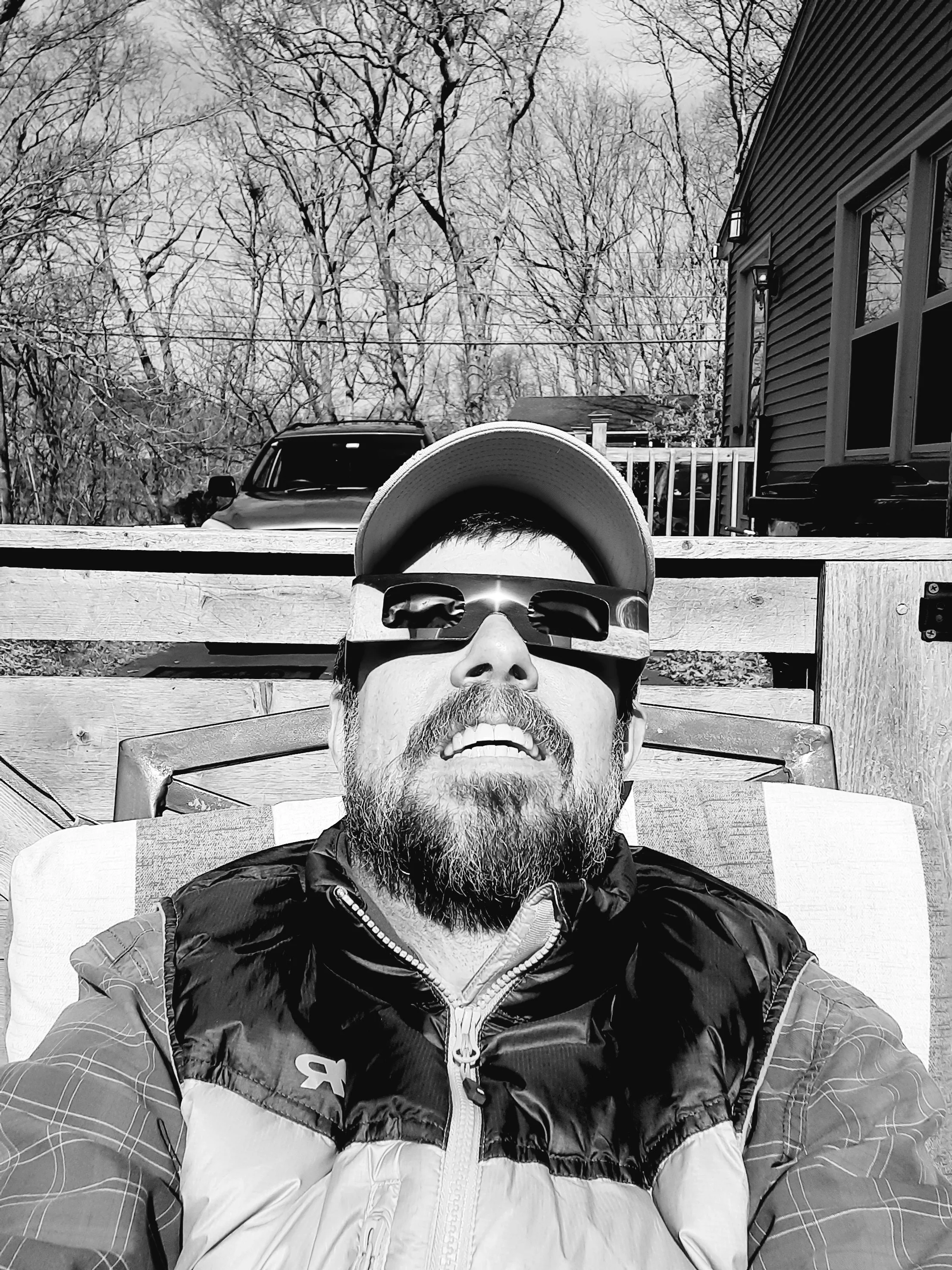
Josh McCall's fiction and nonfiction have appeared in Witness, Southern Humanities Review, The Southern Review, Mayborn Magazine, Story Collider, the Guardian, and the Dallas Morning News. He lives in Rhode Island with his wife, son, two dogs and cat.