
The End of El Dorado
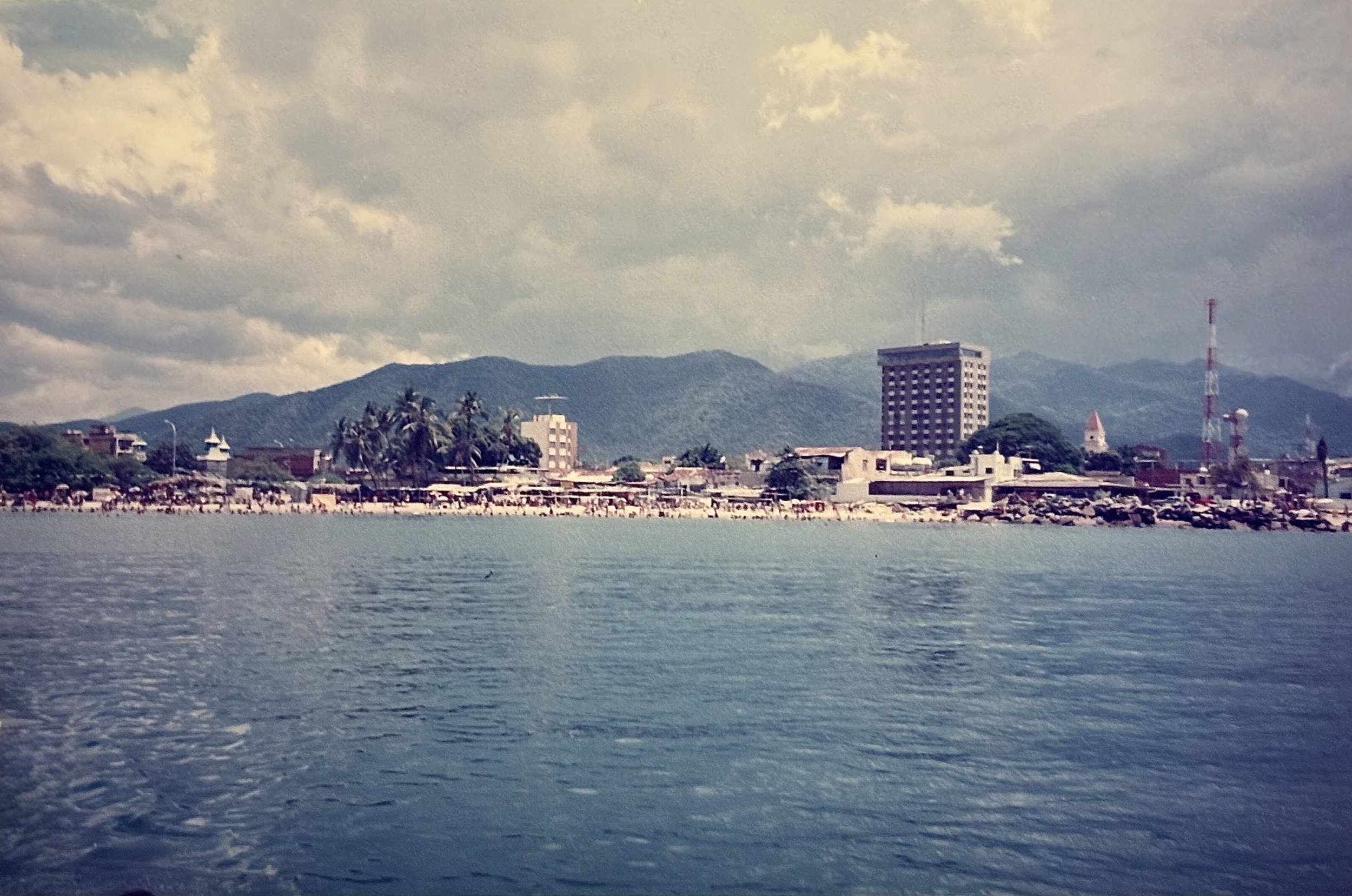
Puerto Cabello, Venezuela taken from the sea in 1995
I was fourteen in 1983. I cared nothing about the news. Maybe teens in cities of other countries listened and watched. Or perhaps my classmate Tibisay Romero (future award-winning journalist, likable teacher’s pet), maybe she paid attention. Reports of war, of scarcity and violence, fluttered in another dimension. They faded into the white walls of my home, absorbed by the lived history of my family.
We’d moved to Venezuela in 1977, partly for economic reasons, and partly because my father had worried about the growth and spread of communism in Italy. But almost five years had passed, and his doomsday prophecies about my birth country had not come to pass. The Marxism he’d tried to outrun by moving, began to dwindle the moment we left. But he wouldn’t admit it, and he sifted through the news to prove his point.
Papá read El Universal, a newspaper he combed cover to cover every morning on the toilet. He spent what seemed hours in the bathroom, emerging all-knowing of the world at large. He was owner of the present, of international economies and trade agreements. He knew where sketchy politics would take us if we weren’t careful. In our dining room, the TV stayed tuned to the news on Venevisión, the channel he preferred over Radio Caracas Televisión.
I think he was trying to justify having displaced us, to show us how he’d saved our family. Financial ambition was not a good-enough excuse to bring us here. We’d had a decent life in Rome. Avoiding a political catastrophe would have been the only acceptable explanation for transplanting us out of the Eternal City into a port town across the ocean. Without his dreaded communism, Papá had disrupted our lives for no redeemable purpose.
It would be impossible to imagine my old home without his discarded newsprint. Daily pages transformed into garbage and became obsolete the moment my father exited the bathroom. The papers were an endless supply of absorbent material for under the bird’s cage, or combustible matter to burn leaves. The stuff for cleaning windows, a receptacle for the unending mango decay in our kitchen.
As if in opposition, my mother sought wisdom from the past. She’d read enough books to stock a small library wing. Hundreds of historical novels were sorted and stacked inside her antique bookcase with carved spiral columns. She was particularly well versed in the history of aristocrats in Western Europe. The British Crown could have traced their entire genealogy within her collections. Their love affairs were displayed side by side behind glass, next to Tolkien’s high fantasy.
Yet no amount of reading would have prevented the shock of February 18th, 1983. I was in my third year of high school when all students walked in disbelief through this darkest of days. The Venezuelan Viernes Negro: the date marking the end of our long-standing exchange rate to the only thing that mattered, the U.S. dollar. At the colegio that morning, we had yet to learn the full meaning of the news. Of course, my classmate Tibisay Romero was trying to explain how this day might affect us. We would no longer go to Miami and buy more than we needed. America would no longer be ridiculously cheap compared to our Venezuelan prices. We could no longer say, Ta’ barato dame dos, or easily afford summer camp in Maine.
Viernes Negro, the end of a dream, my family’s dream. The end of Venezuela as a modern El Dorado. Next to communism, economic opportunity was the only tangible reason we’d left Rome. We’d flown towards financial freedom. My father had promised it would only take four years. Building wealth in that length of time seemed doable in 1977. Many people we knew had done it—circular migration. They’d gone from Europe to Venezuela, built something valuable, and earned many bolívares. And then they’d left. It was a pilfering formula draining the country’s capital. Of the immigrants who stayed in Venezuela, many made their investments abroad. They bought second homes in Europe, or condos in Bonaventure, Florida. My parents did too, a one bedroom apartment in a new section of Northwest Rome. A dream like that couldn’t last. The country only seemed to have unending funds from selling crude oil, the most wanted resource on our planet. Then purchasing what industrialized countries had to offer in clothes, entertainment, and hair products.
I’m oversimplifying here, but as oil prices dropped, public debt rose. The economic crash of 1983 appeared to arrive all at once, but it had been brewing for years. Even then, Venezuela’s riches were too vulnerable. Also savings were sent overseas. Because of corruption, currency overvaluation, and excessive foreign debt, our banks could not be trusted. My family knew this because as early as 1981, one of our acquaintances came close to losing their savings in Bandagro (Banco de Desarrollo Agropecuario). This, above all, had increased my father’s fears; his need to control and foresee. He was right to worry. Our next-door neighbor would one day lose much of his retirement in the fraud-driven collapse of Banco Latino.
Viernes Negro—how it changed us. From the early sixties until February 1983, four Bolívares and thirty cents had bought us one American dollar, and with that dollar, we’d purchased almost everything from the rest of the world. Except beer of course. Everyone said we had the best cerveza and produced more per capita than any other country, even Germany.
The blow from the crash was like a hurricane that comes with ample warning, whose consequences aren’t clear until the surge has come and gone, leaving behind a world that may partially look unharmed but behaves differently, is irreversibly altered. We still had two cars parked in our driveway. We still lived in the same beautiful home. But we could no longer afford a world outside Venezuela, and our plans for a return to Italy were quickly evaporating, at least for now.
It was the end of El Dorado, and my father recalibrated his watchful eye over the news. He was preparing for the worst, feeding the needed foresight to assemble another escape route, this time out of Venezuela. You can never be too careful, I heard him say to his friends when they discussed the Cold War, or the Middle East, or post-war Germany. Or when he professed the righteousness of U. S. foreign interventions. And that’s all they ever seemed to do, the grown-ups, talk of doomsday predictions while clasping their crystal glasses, ice cubes dissolving their evening moods into Black Label Johnnie Walker.
My father had already gotten his dream. By the time Viernes Negro hit, we were living in a two-story quinta, and he was managing four movie houses, a restaurant, and a lucrative real estate firm. One could say that if we’d left when promised, two years before the economic collapse, he could have cashed out unencumbered. But this would have been the equivalent of leaving the craps table while ahead. It would have taken much foresight and diligence, even self-control, to say “no” to ordinary greed. To say: I have enough money, I can stop worrying. Not to mention the deliberate giving up of ambition. He’d recently been appointed an “Honorary Diplomat,” the Italian Vice Consul of our town, and was eventually awarded the title of Cavaliere della Repubblica.
If we’d left Venezuela in 1981 as promised, four years after leaving Rome, I would have been twelve when we returned home, and the rest of this story would never have happened. But we didn’t leave, and February 1983 transformed my family’s options. We were circular émigrés, but we could no longer easily return to an economically booming Italy. The tables had turned. My parents’ money was worth less with each passing day. On television, we watched reports of money-arrows pointing down. Obviously, we could have taken a chance and started over. But Papá stood frozen. Fear encases like a dense fog.
Being that I was a teen, I worried about teen things. Michael Jackson’s “Thriller” was topping the charts and I spent hours practicing those dance moves in front of the mirror. The idea of controlling the flight of Venezuelan money overseas was, to me, unintelligible data. All I knew was that Luis Herrera Campins was the Venezuelan President, and that he was a corrupt thief on top of being extremely ugly. According to everyone, what made him worse than previous presidents was that he stole only for himself and left nothing for others. Unlike Carlos Andrés Pérez, who had also stolen, but left money on the table for others to do the same.
The term Control de Cambio was now more jargon emerging daily from the bathroom with my father. I heard the syllables thrown around like a volleyball, always in the air, always over my head. I only understood we could no longer buy the dollars we wanted, and that people were planning to leave, to join their savings abroad. Most of my friends’ parents had, over the years, shipped their wealth elsewhere—to Miami, Italy or Spain. Their money was awaiting their planned repatriation. Others, like my parents, hoped for the best.
I am not sure why our human mind is so often delusional and nostalgic, always hoping for a return to the way things were. I sometimes catch myself doing the same thing today, refusing the truth of what I see and hoping for a return to used-to-bes.
Which is to say, my parents decided to ride it out. Also, my father had not sent a single cent anywhere. I knew this because my mother reproached him daily. She must have seen herself as the unfortunate wife of the only unsuccessful husband. Here we were, living in the modern El Dorado and they’d just run out of gold.
Not long after that cursed Friday, I was on my way to school and passed the two of them bickering in the living room. Math class could wait, and I stopped to eavesdrop by pretending to feed the fish. The alternator had gone out on the Jeep Wagoneer, and my father was asking for help to pay the mechanic.
“What did you do with your money?” my mother asked.
“Do you know how much I spend on trips?”
Papá was good at that, at responding with questions. I admired his skills. This answer was his standard one—why he never had money. It was the trips, the luxury we indulged in once or twice a year. We didn’t have savings because we traveled.
“Don’t give me that,” said my mother. She knew exactly how much each trip cost. It was likely we owed two years’ worth of plane tickets to my uncle’s travel agency.
“Look. If you’re going to be difficult, I’ll take the carrito.”
“Whatever. Here.” She handed him three brown bills showcasing Simón Bolívar’s face at one end, then checked the secret compartment in her wallet and counted those bills.
My father, still grunting, blew more accusations at my mother. How we all used his car, how hard he worked, how no one appreciated him. He itemized our belongings, including the two-story home and the two cars. He even threatened to fire the full-time housekeeper.
These were his resentments, his thoughts circling, like fast cylinders feeding new judgements, thoughts that slowed only in the evenings, when his crystal glass emerged, the Neapolitan cards were laid on the table, and the ritual of solitaire began. He’d disconnected, had even diminished his controlling ways. He still waited up whenever I was out with friends after dinner, but he couldn’t hide his lack of real concern. I’d get home and find him asleep on the sofa, which proved he couldn’t be that worried, and that he was in fact, exhausted.
Early one afternoon, he peeked into my room and asked me to go on one of his business runs in the city of Valencia. We hadn’t done anything just the two of us in a while, so I rushed out of bed and turned off the telenovela.
The streets were empty, and immediately Papá started his rant.
“You need to get out of this hellhole,” he said.
He was uncommonly angry at Puerto Cabello, something I didn’t mind at all.
I said, “I can study abroad?”
“You’ll go to America like everyone else.”
America had been a constant for my father; the only hope. Italy was too hard. Rent was too high, and I couldn’t move in with relatives. Their houses were too small. Everything worth anything could be found in the U.S., especially escape from leftist communists.
The real reason behind his resistance to Italy still eludes me. My going to America for college made very little sense. Even then, school in the U.S. was exponentially more expensive. Maybe he feared I would never return to Venezuela if I ended up in Rome. He was probably right. Or maybe it was a matter of immigrant dignity. For sure he felt intimidated. Returning to Italy not rich would’ve been too much for my father to swallow.
He decelerated, rolled the green Wagoneer past the alcabala and over two speed bumps. The guardias were under a siesta spell and barely looked up. It strikes me today that even then, this mere act of scrutiny by armed gators each time we left town was a step or two behind freedom. Let’s be honest—this was no real freedom. It was up to them to let us leave.
We flanked El Palito, which sat completely empty after the lunch rush. In the distance was the oil refinery where some of my classmates’ parents worked as engineers. The fresh coconut vendors were gone. I’d already had lunch, but my stomach grumbled as we drove by the strip of colorful restaurants famous for baby shark empanadas. In one of the diners, a lady wearing purple spandex was mopping the floor and letting her baby bathe in the mop bucket. He splashed away happily in the dirty water.
I looked at my father. I could have said anything. I had him all to myself. I wish I could have warned him, but I was too young, and no one could have predicted what would eventually happen: that Venezuela would not recover, but would instead turn into a failed state, and that he would be in his eighties and still be living here. Once again, countries would reposition themselves and the U.S. and Venezuela would cease to be allies. Like him, I too would be losing sleep and sacrificing countless hours just to keep up with the news. Papers, podcasts, social media, broadcasts. As if my own obsessive monitoring could veer history in a certain direction. Maybe if I had known all this, I would have been able to convince him—to lure him into leaving home before he got too old.
I live in Texas. I haven’t seen my father and mother in three years, and the last twelve months have been taxing. On the news are reports of covert military operations, rescue missions, seized oil tankers, and lethal strikes against alleged drug boats. But I remain hopeful. The U.S. embassy in Caracas has finally reopened, resumed operations for the first time in seven years. Today’s Venezuela is unrecognizable from the one I knew as a teen, but the words on the news are still the same: crude oil, capitalism, communism. As Nicolas Maduro sits behind bars indicted by the Southern District of New York, I continue to monitor the news and will history towards stability.
Elisabetta La Cava is a double immigrant born in Italy, raised in Venezuela, living in Austin, Texas. She is a current Ucross Fellow and Periplus Fellow, and was a 2025 Tennessee Williams Scholar at Sewanee Writers’ Conference. She earned her MFA in Fiction and Nonfiction at Bennington Writing Seminars and was the 2024 New Letters Literary Awards winner in nonfiction. In 2022, she received 2nd Place in Hispanic Culture Review's poetry competition, and was a Finalist in Cutthroat's 2021 Barry Lopez nonfiction contest. Her work has appeared in New Letters, Cleaver Magazine, Another Chicago Magazine, Stone Canoe, Hispanic Culture Review, The Pointed Circle, Texas Poetry Calendar, and other journals.