
The Charms of Trivial Bibliomancy: How to make the most of the company of books without even reading them
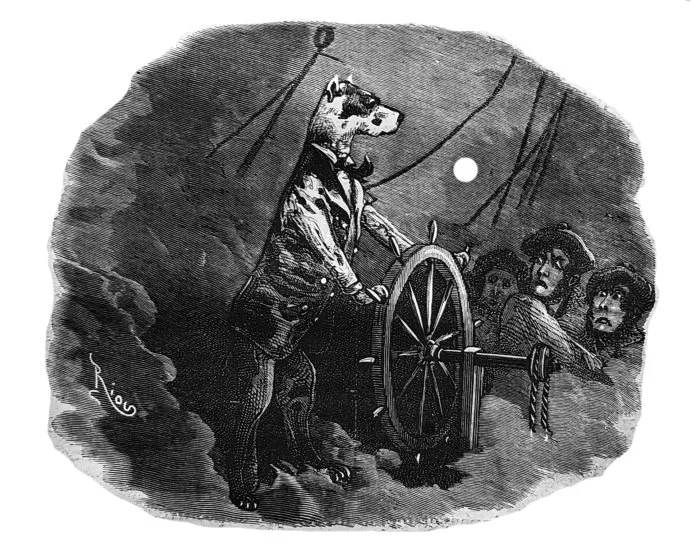
Les Aventures du capitaine Hatteras (Jules Verne),
Dry-point engraving by Jules Riou.
As far as I can remember, I’ve been surrounded by thousands of books. Enough books, actually, to discourage the reader in me before I even tried to decipher a headline. From a young age, I couldn’t help but envy those ‘honest men’ a few centuries before, who, spurred by their unquenchable curiosity, were able to marvel at, say, d’Alembert Encyclopaedia, with a decent chance of making sense of their own times, seeing the world as one, and thriving in many fields without being reduced to some sort of jack of all trades. As despaired as I already was, I recall my first, naive steps to gather information and separate it from fiction. Especially in a world before TV where even grainy black and white photographs were scarce. Every other morning, one would typically hear about rocket ships and satellites on the radio, and still remain unable to form an educated guess about how they looked or what their shape might be. And until any young person knew for sure, the imagination would picture all kinds of foolish hypotheses.
The first book over one hundred pages I read all by myself left me fuming like a volcano. At first glance, it looked boring enough to actually teach me something. Large print, thick volume, yellowish pulp paper and almost no illustrations. I checked my “Noddy” book from cover to cover nonetheless, in search of some hidden message. To this day, I’ve kept my solemn promise to never return to Enid Blyton. Though I obviously picked the wrong book, this endeavor left me blankly bewildered. Even my godfather’s kind efforts fell flat. No less than the head librarian at the French Senate, he was always showering me with classics, five, ten, even twenty years above my age. In any case, these were too beautifully bound and printed to get smeared by my sticky hands. I can still conjure the delicate sourness of their plastic jackets that I used to chew. And then I realized that most of the classics as we would access them, in the ubiquitous “Bibliothèque verte” selection for children, were actually brutally “adapted” (i.e. abridged and rewritten) in the most abstruse fashion. Not worth the assured headache, as one tried to untangle their dismembered plots.
I had to resort to other tactics to explore the outer world and quickly realized how easy it was. Between the ages of eight and thirteen, all I needed to do was mumble a little white lie about some imaginary exposé (“enquête” was actually the magic word) allegedly requested by my school, and then every door would open, be it of an embassy, a newspaper, a ministry, or the headquarters of any major industry of interest. The profuse explanations I heard straight from the horse’s mouth, delivered by brilliant engineers and competent civil servants, would usually fly well over my head. Nonetheless, I would harvest beautiful photographs of the next Japanese bullet train; the latest, most secret, Mig jet fighter, so far advanced compared to the plastic model kits we used to glue in a state of haze; plans of new cities or future airports still to be built, and more generally about everything the year 2000 had in store for us, kids of the sixties. At some point, I ‘infiltrated’ an army document center where, over the course of a few years, I was given a pile of photographs, plans and specs of more or less secret airplanes, which, when stacked, stood two meters high.
Our neighborhood, which housed the majority of France's governmental buildings and foreign embassies within a tiny perimeter, was as packed with civil servants, MP's and diplomats during the day as it was deserted at night, where a flattening silence would only be broken by the cooing of an owl or the “pin-pon” of a distant police siren. Typical of this cosmopolitan area, American students would pace back and forth along the Aérogare des Invalides (near where I lived) and hand us free copies of The Paris Herald Tribune, just like Jean Seberg does in Godard’s film, À bout de souffle. I still wonder how many times the young brats we were then unknowingly crossing paths with were actual secret agents at work, especially given how close the Russian embassy was. Just consider that most of their covert appointments were announced by a single capital letter traced with a piece of chalk on a given lamp-post or street bench. We shared with them the same playground, and we too were obsessed with caves, backdoors, underground car parks, crypts, and steeples in churches, virtually any place suitable to hide or light a firecracker. We even paid clandestine visits to a damp bunker lying underneath the National Assembly.
Our games were overtly inspired by two distinct series popular at the time, one about a young French spy (written under a pseudonym by Vladimir Volkoff, a French writer of White Russian descent), the other featuring a band of amateur detectives who were not cozying up with the police, among other distinctive traits. Both series were informative and edgy, and allowed for much to be transposed and experimented on by imaginative pre-teens in everyday life. The style was so compelling, so urgent. The narration would send tingles to my toes just by abruptly moving from past to present. Beyond this and a few Sherlock Holmes for the chilling challenge, I still didn’t read much. But gradually, the impactful lay-outs of this era, in books and the press, started to suffuse me unconsciously.
Back then, aesthetic perfection was simply the norm. Thus, we took excellence for granted. How could we have forecast the ugliness that was bound to flood us? Every village housed a “peintre en lettres,” a specialist able to draw any kind of alphabet on a shop sign, and most of the typographic elements in posters were designed manually. In the meantime, in North America, Raymond Loewy was imposing his coherent futurism, set to the most demanding design standards. Book covers were a microcosm of that graphic proficiency, shared from Moscow to New York and all over Europe, a continent especially hungry for nicely crafted books after WWII. All avenues were open, but nothing was done without purpose. Refinements were endless. A single style of a new font would typically take a year to design. And when things are done so painstakingly, a lot of time remains to reflect and perfect.
In any case, I was more into comics. These were real rare books, at the time unrecognised and of uncertain value, which we knew we could trade for more recent and everyday stuff. That’s when little gems we only knew by hearsay started to pop up along our way. We used to peddle on our kid bicycles, searching the press stands or the public libraries in the remotest, sleepy villages (yes, in the heat of the summer, in Southern France). As school truants, we spent countless hours ploughing through every single box of the ‘bouquinistes’ along the banks of the River Seine. With my buddy in mischief at the time, we, aged thirteen, even dared to venture to Brussels — which then was the Mecca of this art — to busily fumble the Belgian capital’s phone books in quest of the rare artists of whom we knew the real identity behind the notorious pen name.
This eventually culminated with a short-lived publication and an afferent crash-course in publishing, printing, circulation and the like, which was worth any vocational school or internship. Our backs were already broken by moving tons of printed paper, and it was time to renounce the adrenalin highs of the collector — if only to make room for new addictions, now that we had turned sixteen. Where this treasure hunt was particularly formative was in the way that ‘old’ volumes (like a giant Babar original from the thirties, to cite an obvious ‘white elephant’) would spring out of the blue, in mint condition, from a dark outlet replete with spiderwebs, or stuck for decades in the back of a rack that we’d then explore, committed to liberate its captive prey with the tips of our eager fingers.
Already then, books displayed their capacity to mock time and reveal a historical depth beneath any familiar geography. Even unread, they still reside somewhere and make a statement by their silent presence. They are friends, they are magic, and constitute the ultimate wormhole for time-travelers. At the very least, they are signposts we ignore at our own peril. One can argue that Gutenberg, with his diabolical invention, defiled The Book, and by allowing its reproduction, opened wide the gates for the Reform and the subsequent religious wars. But even in this more mundane form, any printed copy of a book expresses a will of its own, reclaims its right to simply be, if only to sleep on a shelf until more welcoming times. However, keep in mind that the wisdom of books is in no way contagious. No matter how much they are cherished, there’s no way to download them.
I’m in no way the avid reader I would like to be, or, worse, the reader people figure I am. As such, I am the impostor. I can truly estimate the extent of this travesty, as I’ve seen what a library of roughly 20,000 volumes really looks like — all annotated and thoroughly read, often with a typewritten notice from the scholar, the late Maxime Rodinson (1915-2004). Notably, the floorboards were dangerously caving in under the weight in every room of his twin flat.
Later on, I had the privilege to carry out different works with a late friend of mine, under a common signature. Looking back, I feel ashamed to have exploited his numerous skills and distracted him from his primary task in life: he would read no less than three books a day and drink accordingly. Ultimately, this diet didn’t prove commendable, but he sure didn’t waste his time, considering his encyclopaedic knowledge in music, comics, politics, and Americana as well. A Popeye lookalike in the literal sense, he never missed a liner note. And not so oddly, his family name being Mousel, he inherited the nickname Mickey, just like his father. Our collaboration was genuinely telepathic and brought about endless laughter, so unlike with solitary translation, rewriting and proofreading, which all evoke a state of perpetual anxiety, require a police-like mentality, and would assail any editor with scores of scruples making him feel utterly miserable. Anyway, are you not a soldier of fortune once you’re paid to read and read again what you would have discarded for your own enlightenment in the first place? I’m not so proud of some books I was able to redeem when they were inherently laughable and dispensable. On the other hand, I then felt like a principled defense lawyer who thinks that everyone deserves his day in court.
But if I’m not a reader, I take some pride in being a caring, expert midwife: for authors and books of every colour and all walks of life. Some nearly cursed, as they only finally saw the light after twelve years or more of research — a prolonged pregnancy. Many of these consisted of posthumous works, especially in first French translation, more often than not bilingual, in so many different languages that I didn’t even know how to pronounce some of them. In the grand tradition of typography, this doesn’t prevent me from composing and proofreading in all types of alphabets, syllabaries and ideograms. To make some room for the next, I would erase the little knowledge I had gathered in Chinese to revive what I once understood of Tibetan over decades of publishing, only to then move to some Arabic, Hindi, Russian, Japanese — you name it — and back again.
Of course, I’m not such a masochist that I actually chose such low-income torture. It chose me. China in particular imposed itself, through both its vastitude and many historical ages. Or at least an intellectual afterglow of it. If that country didn’t leave me flat (how could it?), I never felt any special attraction to it, contrary to the fascination it duly induces in so many. Being moulded by my trade, my general impression of that enduring civilization was as such: first, install a very rich set of ideograms, so copious that it will take decades to master and trace properly. Then, however cruel, no matter the extent of its hate toward intellectuals, the regime cannot afford to get rid of a small class of literate civil servants doubling as poets, painters or historians. How else could one levy more taxes and keep the ledgers straight? One can sense the persistence of such a historic legacy, independent of what today’s China is or is not.
Wherever they come from, books of this type don’t sell well. They were already structurally unprofitable thirty years ago. However, a lot of these texts were close to becoming totally forgotten or permanently absent in French. Not just ancient poetry from Central Asia, but modern masterpieces as well, dating back to the Independencies some seventy years ago. Not to mention the prolific, contemporary literature in vernacular languages scarcely translated, though offering a much-welcomed, nuanced view of the world at large. These too deserve a better fate in a future too distant for me to see. I can’t help but think of them as fading messages in a bottle, adrift upon the oceans of knowledge.
They piled up on my desk one by one, emerging from the five continents and the seven seas along sometimes treacherous paths. The more sedentary I got, the more the world — and the past — would pay me a visit. Not only books, but flesh and blood characters not necessarily related to books, some of them lifetime friends hopping from one country to another. So many people have met here, in this smokey studio in a private flat, to exchange on any given topic and evoke distant shores while I was busy juggling with signs behind my computer desk, from 10:30 am till 2 or 3 the next morning, seven days a week, only breaking for robust and creative cooking sessions. So, long before the Internet, answers to the dullest questions were readily available, if not a couple phone calls away. All those people, living or dead, friends, colleagues or relatives, ricocheting off one another, connected in such mysterious ways. And as I published more than my share of dead authors, I had to be in intimate conversation with them, in order to produce as flawless a work as possible in their own spirit. At this point, the task could be compared to mending a tapestry, taking thread off the back of a carpet to revive the front.
No boundaries remain between private life and work, so deeply intertwined, and through consented servitude, I’m my own tyrant, as sure as no one has ever asked me about more than 30% of what I do on any given book. To describe the ruses at play would take more time than to complete the job: some secret sauce here and there, but mostly small edits in the tens of thousands, each one sparing the reader a fraction of second of his attention. It could be compared to allowing a mountain spring to flow freely.
‘In real life’, books keep giving me back the care and attention (and, yes, generosity) I put into editing, rewriting, translating, correcting and designing. As seclusive as I am, whenever I go out for a stroll, they jump at me from every corner, whether in secondhand bookshops or even straight from the pavement. Curiously, they too often mirror my thoughts of the hour, some fresh news I just received from a distant friend, or other half erased remnants of the past. By their very nature and in the genuinely poetic way these disparate volumes expose the disreality of linear time, they humorously offer a soothing kind of time-travel. I don’t look for books: they find me. In fact, not a block away from home, just after as I was approached to write the present essay, I stumbled onto a roborative Dictionary of Book Publishing, alongside its counterpart in French, an elegant clothbound volume issued 59 years ago. Here, the only merit I can claim is having refrained from extracting the technical terms of this sum that would give some undue credit to my rambling. Still, finding this truly useful bilingual lexicon — as a sign — gave this essay a kind of catalyst.
As I was lucky enough to leave Paris for a week, I also found in Southern France scores of books crying for rescue. So I had to endure the cruelty involved in making a selection of the ones to salvage and bring back. I couldn’t resist a few children's reads, notably my first sci-fi novel, however lame it was (Voyage vers Jupiter, by some dubious Joseph Greene). Moreover I felt a sense of duty towards the heaviest among them; for instance, a very thorough encyclopaedia in nonsense (les Chefs-d’œuvre du Sourire, Planète, Paris, 1965), illustrated by the most prominent cartoonists from the second half of the 20th century, who were then in their prime: Chaval, Sempé, Searle, Soglow, Topor, Gébé, Reiser, Descloseaux, Vip, Puig Rosado, to name a few. Clothbound and complete, with its plastic jacket and register ribbon.
No less impressive was a limited edition in gravure printing of a book about London (Arthaud, Paris, 1957). A symphony in black and white offering the most subtle halftones, much too elegant to be labeled a city guide. The bold cover design of that edition is printed directly on its white cloth; and, on the first board, the title is stamped in orange and black. If those two finds came straight out of the trashcan, the next was to be purchased for $1.50, which is even more shameful. No less than an Hetzel original (1866) written by a young Jules Verne, les Aventures du capitaine Hatteras, illustrated by Jules Riou. Clearly a major inspiration for Tardi’s le Démon des glaces, a majestic and singular comic book drawn on scraper board (Dargaud, Paris, 1974).
Taken individually, none of the works hereby cited was a must have, not even as a fashion accessory for up-to-date models. Collectively, they remind us that another affordable luxury is quickly vanishing from our reality. And they so violently contrast with eighty percent of today’s production, in its shameless demagogy, the boisterous vulgarity of present lay-outs, the crudity of the objects we insist on calling books. However protected by its status of ‘exception culturelle’, the entire book production chain in France is presently collapsing like a house of cards. More accurately, crumbling like the Tower of Babel itself. Major bookshops close doors. The real publishing business is concentrated in the hands of a few oligarchs not too shy about their agenda, and the rest is scattered among thousands of impoverished publishers who either work primarily for hypothetical fame or are self-appointed in a kind of mission impossible. To top it off, a major circulation business is currently sinking several independent publishing houses in the turmoil of its own bankruptcy. Our paper friends are failing us the very moment we need them most. Don’t expect to find them again on the Web, even loosely digitised.
As for Artificial Intelligence, let’s put aside for a moment the reality of the concept: a giant electron-greedy microwave is luring every single human into turning the heat up in a collective effort to get rid of the rest of humanity through evermore lethal heatwaves. Now let’s focus myopically on its side-effects on literature: a compass that points South actually tells us how urgent it is to flee northbound — in zigzag. Moreover, consider that anything that AI can easily emulate is probably not very relevant in the first place. So, be damned the authors who were already pillaged. The best texts in literature don’t assert, they suggest while leaving blanks in comprehension for the reader to fill in the gaps. Understatements are not reproducible or easy to translate by a machine, especially a grammar-illiterate one — that is, to that extent, easy to fool. Above all, it’s our duty to write as humans and for humans, even if it means turning our backs on other semi-robotized, fellow humans that constitute 90% of the remaining readership. I know it looks a bit like a fishing expedition in the Aral Sea. In my mind, brand new zealots will be attracted through their fondness for the music of words, as has occurred during other centuries.
Books are alive. Writers can be prostitutes and show some overall decency. They don’t have to satisfy or content the reader. Certainly not a panel of them. And they won’t beat AI at that game, as AI will be increasingly apt at customizing the ideal “virtual reality/dream home/hall of mirrors//self-paid prison” for any single earthling. Meanwhile, writers are allowed to taunt, seduce, disappoint, surprise, knock off balance, impress or even traumatize the reader, as long as they remain humble enough to be fully and mercifully aware of the psychological limitations and common ignorance that bind the human race, starting with themselves. Remember that the strength of our tormentors is also a swollen, Achille’s heel, while our narrow, mountain path meanders along the acknowledgement of our weaknesses.
It’s not about engaging in another war of words. Quite the opposite: words should not be daggers, and it’s time to reclaim them as the instruments of peace and freedom they really are. Have we completely forgotten that they’re meant to make us understand one another, instead of instigating feuds? As my motto goes (under my typographer’s cap): “Better dot the i’s than blacken the eyes.” Any and every authoritarian power play with words is intrinsically despicable. A rich lexicon is key to reinventing a future that, in any case, will be the product of our human consciousness. It’s high time to release the floodgates of our imagination. With every passing day, this appears to be our only remaining escape hatch for a collective breakout. And books are stepping stones along this hazardous tightrope walk, if I may utter such an absurdity.
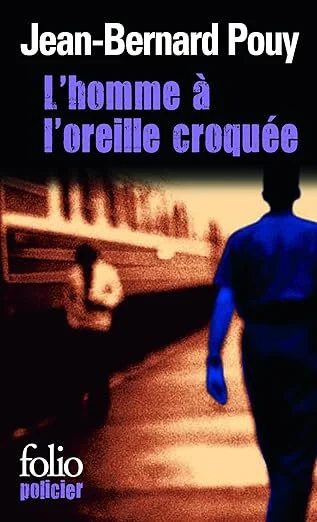
Back-to-back and cover to cover: a rare photograph of the author, taken some forty years ago on a platform of the Transiberian, which actually ended, nilly-willy, on the cover of a crime novel.
© Michèle Schembri
Humphrey Beauvoir saw the light on the left bank of Paris in 1961. So it was seriously considered to christen him Yuri, in hommage to Gagarin. Since he was born on a Sunday at noon, he spontaneously entertains a tortured relation with the very notion of work and equally hates Wednesdays weeks and gloomy Sundays. Some attribute his bouncing enthusiasm and signature dimples to the two memorable sets performed by Ray Charles close to the maternity ward on the very day of his birth. Others relate his innate skepticism and disturbing long faces to the noxious nuclear fallout of Krouchtchev’s Tsar Bomba, which circled the globe three times during the following weeks.
After an existence spent in the secret service of books, the former wannabe cosmonaut, precocious punk and outdoor hermit has finally reached the crossroads. It’s time, in his humble opinion, to be more assertive and share bits of a life-long conversation with fellow humans from all walks of life. If only to defend our common ground facing a bossy machine eager to educate us and attest how so many contradictory wonders can happen at once in this world, which itself is such a huge reflection of our collective imagination.
In the meantime, the author is busy plotting his final transmigration by taking refuge in the past he once knew.