
Before the War Finishes Raising Them
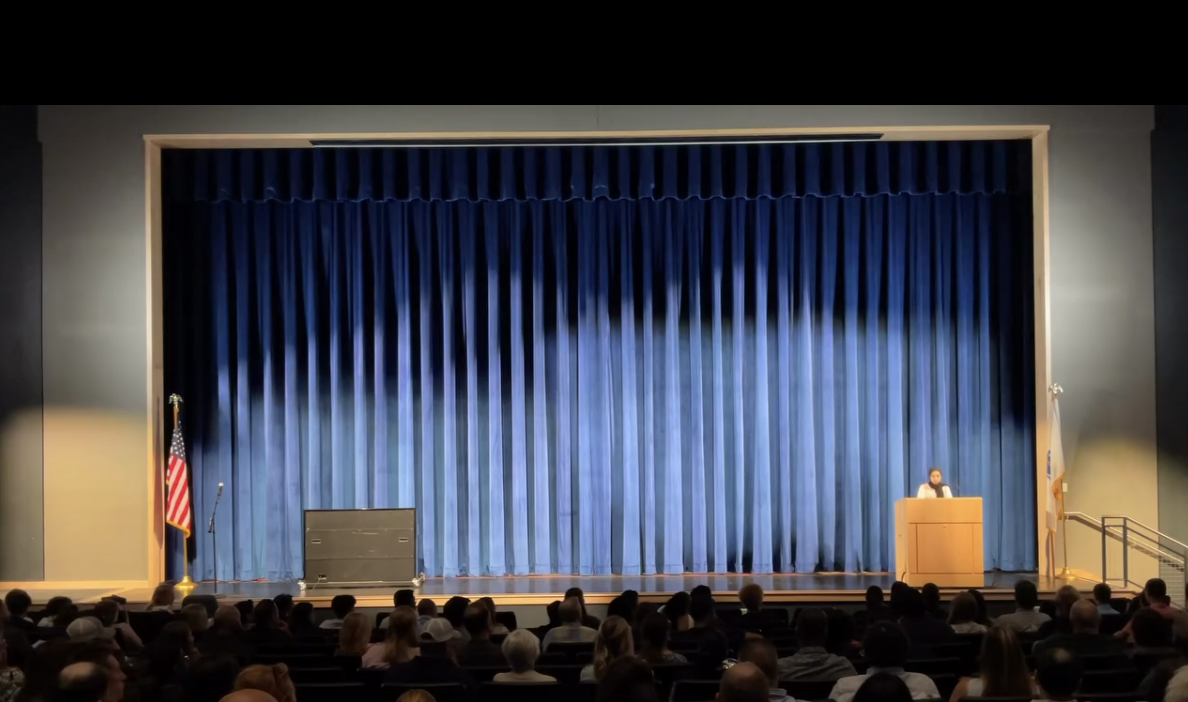
Sham AbuMousa in Walpole, MA
June 2026
She wore a thobe. White, with the red cross-stitch running in long columns down the chest, the tatreez the women of our country have embroidered for longer than anyone can say, each pattern a village, a name. In a middle-school auditorium in Walpole, Massachusetts, on a bright June morning, my daughter wore Palestine on her dress and walked to the microphone.
“Good morning, students, families, and staff,” Sham began. “My name is Sham AbuMousa, and it is such an honor to speak here at our promotion ceremony.”
She told them about her first day at that school, only the summer before, how sure she had been that she would get lost, be late, and that a teacher named Mr. Warren would hand her a lunch detention without mercy. The auditorium laughed. She let them. “Sometimes the moments that scare us the most end up being our biggest lesson,” she said.
I laughed too, then had to look at the floor, because I knew the inventory of things that had frightened my daughter, and a first day of school was near the bottom of it.
“As someone who had to leave their country and start all over again in a different place,” she went on, “it was hard to fit in. Everything was different from what I knew.”
The families around me heard a girl who had moved, a new address, the ordinary upheaval of changing schools. They nodded with the easy sympathy you give that story. They did not hear the other story, because Sham had decided not to tell it. She did not name the place she left, or say she had crossed out of it at twelve, in an ambulance, without her mother and without her brothers, or that before Massachusetts there had been a school inside a humanitarian compound in Abu Dhabi, and before that, Gaza. She folded all of it into the gentle word country and went on talking about teachers and friendships and the courage to say hello first.
“A year ago I did not speak English well,” she said. “Now I’m confident I can deliver the promotion speech.”
A year. I did the arithmetic the way only a parent does, silently and helplessly.
The speech is not the argument. It is the evidence. The argument starts earlier, in a place she was born into and did not choose.
Since 2006, roughly two million people have lived inside 360 square kilometers, about the footprint of Detroit, with no meaningful control over who leaves, what enters, or when. Three generations have grown up inside that arithmetic. A child could reach adulthood in Gaza having never once stood outside it. I wrote something in Arabic after we were evacuated to the Arab Emirates in a state I would not call composure. One line still holds:
It was not merely zero. Zero is a luxury. Zero gives you the possibility of failure.
We use “zero” to mean poverty. But zero is a floor, and a floor is a kind of wealth. From zero you can fail and recover, take the wrong job, lose a year, because somewhere behind you there is a second apartment, a passport that opens a border, an aunt in another city, a plan B. Two million people have grown up beneath zero, without margin, forbidden to fail because there is no line of return.
The environment was engineered, and the engineering has an author. The closure; the control of borders, airspace, and sea; the permit regime that decided which grandmother could be buried with her family present; the repeated wars; the destruction of whatever had been rebuilt since the last destruction, these are Israeli policies, made by governments and defended in public for two decades. Palestinian politics has done its own damage: Hamas has governed Gaza since 2007 and owns its choices about militarization, repression, and the society it set out to shape. Both things are true. They are not the same size. One party has held decisive power over whether a child in Khan Younis could leave, eat, study, or see a doctor.
There was no justice at the beginning. That is a starting condition, and it precedes every argument anyone wants to have about what came after.
I am not going to tell you that deprivation manufactures militants. It doesn’t, and people who say so have usually never sat in a room full of Gaza’s teenagers. Human beings metabolize catastrophe in every direction. Some go furious, some go quiet, some become extraordinarily gentle, most just try to get through the day.
Children are not impermeable to what surrounds them, and no one should pretend a childhood is weatherproof.
A school is not only a school. It is evidence, offered to a child by adults, that tomorrow is expected to exist, that fractions are worth learning now because there will be a later in which fractions are useful. Destroy the schools and that argument is withdrawn. UNICEF reports that more than 97 percent of Gaza’s schools have been damaged or destroyed, that some 700,000 school-age children have gone more than two academic years without normal classroom learning, and that more than 58,000 children have lost a parent.
People will argue for a generation about what to call what happened after October 2023, and I am not going to litigate the word here. I will say the smaller, harder thing: history did not begin that morning. The attacks on Israeli civilians on October 7 were atrocities, nothing here excuses them, and Palestinian suffering does not license the murder of anyone’s children. But a boy born in Gaza in the summer of 2014, born, as it happens, during a war, was nine years old that morning. He did not vote, plan, arm, or agree. Read me his charge sheet. Then tell me what childhood he was owed, and by whom.
We keep asking what kind of adults Gaza’s children will become. We are strangely reluctant to ask what kind of childhood we are handing them.
Here is what I know from my own house. Sham did not acquire a new personality at the American school. She was already exact, already stubborn about doing things properly, already an artist, known for her drawing in Gaza, known for it in the compound in Abu Dhabi, known for it now in Walpole. Her mother, Heba, used to say Sham was smart in doing what needed to be done: a compliment and a small complaint at once, the way you tease a child more disciplined than you were at her age.
What changed was not the child. What changed was that she met a functioning school, teachers who noticed her, classmates who made room, a year in which nothing exploded, and adults who behaved as though her future were a real object. She responded the way children respond to conditions. Within a year she was at a microphone telling American thirteen-year-olds that failing is fine, that they have millions of chances to fix their mistakes, that “sometimes we have to take the first steps ourselves.”
I want to be careful with the word people reach for here. They love resilience, because it lets them admire our survival without asking why survival should require such extraordinary strength. My daughter’s strength is real and it is hers. It is also a bill somebody else ran up. A child should not need courage before she needs algebra. A thirteen-year-old should not have to be remarkable. She should be allowed to be thirteen.
So I am proud, and I am angry, and the two do not cancel. No father should have to discover his child’s character through catastrophe.
Which leaves the practical question, the one that survives whatever disagreement you and I have. If another generation grows up inside the same architecture, closure, grief, ruined schools, no work, no exit, no expectation of a later, what exactly does anyone imagine Gaza looks like in fifteen years? Name the mechanism by which that produces a neighbor you would want.
Now reverse it. Suppose the center of Gaza’s reconstruction were not concrete but childhood. Not classrooms reopened, but schools built to be excellent. Early-childhood education. Trained teachers paid on time. Psychosocial care as ordinary infrastructure rather than a pilot project. Libraries, music, sport, laboratories. Real internet and the world it carries. Vocational training, scholarships, university pathways. Somewhere safe to play. And eventually a border a young person can cross and come back through.
Call that charity and it dies in a donor conference. Call it security policy, call it defense spending, and it is the most serious proposal on the table. Call it what it is and it is the most serious security proposal on the table.
Weapons suppress a threat for a period. Walls sort populations. Armies destroy infrastructure, which gets rebuilt. None of these can produce the thing everyone claims to want: a generation of Palestinians able to picture a future that is not war. That picture has to come from somewhere, and it cannot be taught as a lesson to children whose entire lived evidence says the world is made of force. Security built against children does not become security when those children are adults. Security built around their futures might.
The opposite of radicalization is not indoctrination in the other direction. It is possibility.
When Sham came down from the stage we did not embrace. We slapped a high five, hard—a private ritual, lighter than a hug, that lets us celebrate without opening everything a hug would open. The crack of it turned heads. A woman beside me asked if that was my daughter. I said yes. She said, she’s amazing. I said thank you. I can always say thank you. It is the longer sentences that fail me.
Twice in my life I have stood beside something so large that language simply left. Once in a morgue in Khan Younis. Once on a June morning in Massachusetts, watching my daughter walk back to her seat in a dress stitched with the patterns of a country that tried to erase her, wordless again, for the opposite reason.
There are about a million children in Gaza. Some of them draw. Some are the best in their class at mathematics and have no class. Some would have been surgeons and cannot study chemistry. I am not asking you to find that beautiful. I am asking you to find it expensive.
For a long time I thought our story ended at survival, that the most I could write was how we got out. Survival is not the end of anything. It is the prologue.
The only question left is who will be permitted to write what comes after it, and how many of them we let reach the page.
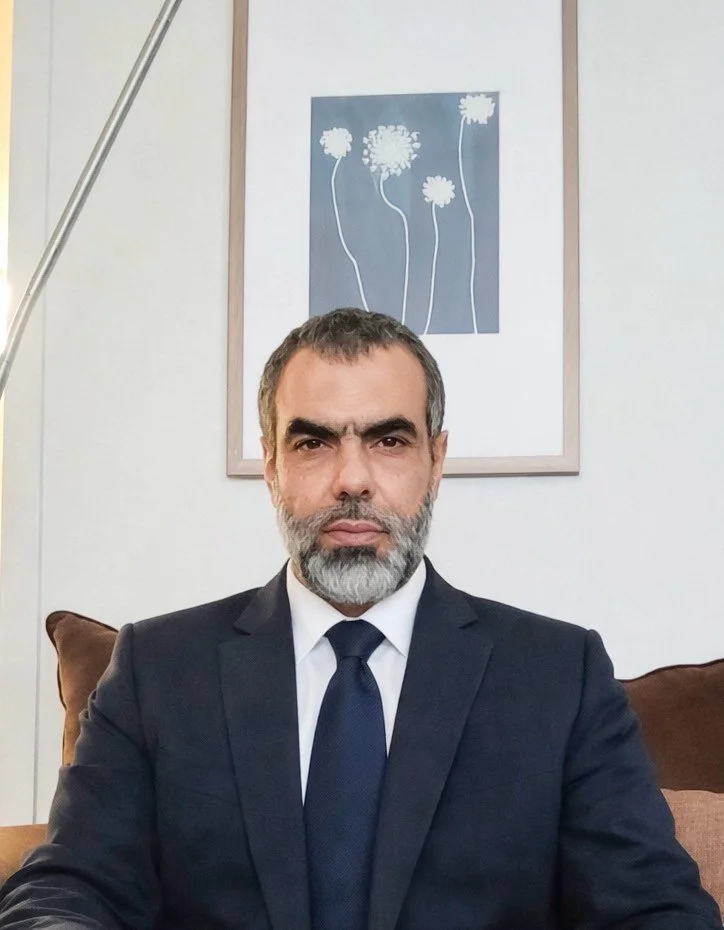
Jaser AbuMousa was a Program Officer at the Swiss Agency for Development and Cooperation (SDC) in Gaza, Palestine, until the outbreak of the current war in the Gaza Strip on 7 October 2023. During the war, he lost his wife, Heba, two children, Hmaid (18) and Abdulrahman (8), and later his mother and sister to Israeli airstrikes.
He left Gaza with his two surviving children, Abdallah and Sham, and resided in the United Arab Emirates for 13 months while seeking medical treatment. Born in Khan Younis in 1979, Jaser holds a BSc in Civil Engineering and an MSc in Project Management, specializing in risk management. His professional experience spans infrastructure, humanitarian response, security coordination, political analysis, and international development.
In 2025 he, Abdullah and Sham arrived in the United States to start a peace fellowship at Yale University. Currently, Jaser is a senior fellow at the Middle East Institute in DC and a senior policy adviser at the International Peace Institute in NYC. They are living near Boston.