
The Heart Knows
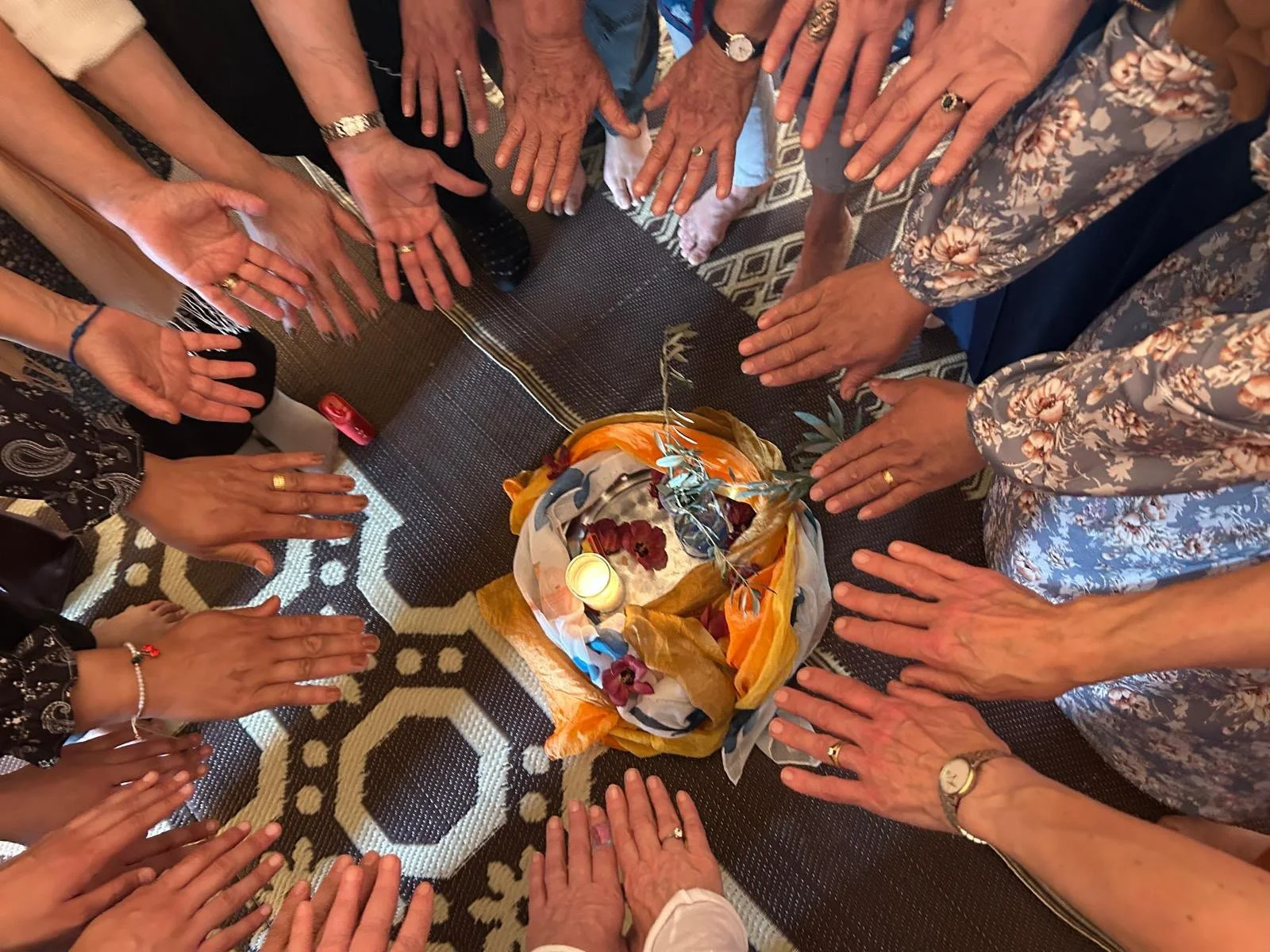
Photo Credit: Tsvia Barkai-Yacov
I drive along a desolate stretch of the northern Dead Sea, with the cliffs of the Judean Desert to my right, and the sun-bleached coastline to my left. It’s scorching outside and I’ve traveled a long way to get here. I’m not sure this is the right place, but as I walk across the burning sand toward the dome-shaped tent, I hear voices floating out of the half-open entrance, women’s voices in Arabic and Hebrew. I think Is this even possible? But yes, I’ve come to the right place, an eight week Palestinian-Israeli workshop called Woman to Woman.
Almost every Sunday this past spring, I showed up for this workshop, organized by Sulha, an NGO of Palestinians and Israelis who work together toward peace. Before signing up, I had a lengthy phone conversation with Dafna, one of the leaders, during which she explained that the workshop would be intensive—deep conversation, meditation, tough questions and equally tough answers, a demand to be one hundred percent present at every meeting. I was nervous, unsure how it would work. Finding common ground was rare even before October 7, and now, after three years of intense bloodshed, grief and destruction, I had no idea what to expect. I signed up because I still carry the conviction that dialogue between individuals is not only possible, but necessary.
Meetings between Israelis and Palestinians are rare due to the Israeli government’s policy of separation and division. I am privileged to meet Palestinians from the West Bank on a regular basis as a volunteer driver for Road to Recovery, an NGO that drives seriously ill children from the West Bank checkpoints to hospitals in Israel. Sometimes, on these journeys, I talk to the mother or father accompanying their child, but often they simply fall asleep in the back seat.
The workshop would be different.
The evening before, I packed a bag for the journey down to the Dead Sea. I was told that each meeting lasted four and a half hours, beginning in the morning, but other than that I didn’t know what to expect. I packed sunscreen and a hat, prepared a salad large enough to share with a dozen or so people, and filled a bottle with water which, by early morning, would be icy cold from the fridge. Then I went into my father’s bedroom to check on him.
He was ninety-six and had been ill for some time. During the war with Iran, he spent a week in a makeshift ward in the underground parking lot of a Jerusalem hospital. Every time a missile fell, sirens sounded throughout the parking lot, four stories below ground, on the tinny loudspeaker system. I vowed then to get him back home, to my house, where he had lived for the past six years.
That was back in March, now it was April, and a ceasefire had been announced between Iran and Israel. The house was quiet; it was already dark outside. My father was lying in bed, growing steadily weaker. I surveyed him for a moment, watching his chest rising and falling. His watery eyes, once vivid blue, flickered open as I leaned over him, and then closed. I wasn’t sure he could hear me. “Listen,” I whispered, my face almost touching his. “I have a very important place to go tomorrow. Please don’t die while I’m out.”
In fact, he died very early the next morning, with me at his side. The first person I called was Dafna—not a family member, or a friend—because I knew how important this workshop was for her and everyone else. “I’m sorry,” I said, “but I promise to come next week.”
Seven days later, I kept my word and went down to the Dead Sea, a two-hour drive from my house. I drove through heavy traffic out of the city and down the winding highway that leads to the lowest place on earth. I thought about Joy Harjo’s words from her poem, “For Calling the Spirit Back from Wandering the Earth in Its Human Feet”:
Don’t worry.
The heart knows the way though there may be high-rises, interstates, checkpoints, armed soldiers, massacres, wars, and those who will despise you because they despise themselves.
Still, I was worried. It felt strange to leave the house of mourning my home became during the shiva. There had been a stream of visitors, friends and neighbors, bearing home-cooked meals; I was never alone and I stayed indoors except to go to the nearby cemetery for the funeral a few hours after my father’s death. Now here I was, packing my bag again and driving off. I wasn’t about to break my promise to Dafna, or my real commitment: to the idea that dialogue is still possible.
The workshop took place in a large, air-conditioned dome simply furnished with a couple of couches and mattresses arranged in a circle on the floor. It was daunting to walk in. I was about to meet women who faced occupation and great hardship on a daily basis. How would they relate to me? It felt as though my very presence might be an imposition.
We were a small group of women from all walks of life and all ages, secular and religious: a painter, an English teacher, a cheesemaker, a young woman who still lived at home, another with a dozen grandchildren.
Some of the Palestinian women came from refugee camps and towns in the West Bank; their journey down to the Dead Sea entailed getting up very early and traversing several checkpoints on the way.
When I was asked to introduce myself that first morning, I kept it brief: “I’m Joanna and my father died last week,” I said. Anything else seemed superfluous. A silence fell over the circle we had formed, and then women, none of whom I had ever met before, Israeli and Palestinian, came up to me. Some hugged me, some murmured condolences, others held my gaze for a moment across the room. They understood.
Each meeting began in a circle, sitting together on the floor or reclining on mattresses, a kind of unity that did not erase our differences, but encouraged us to look each other in the eye. I was reminded of another line from that same poem of Harjo’s:
When you find your way to the circle, to the fire kept burning by the keepers of your soul, you will be welcomed.
The keepers in this case were Dafna, an Israeli Jew, and Nuna, a Palestinian Arab born in Jerusalem, both of whom guided the group with love and determination. We held hands, we sat back-to-back, we moved around the room to music in Arabic and Hebrew. We discussed roots, the meaning of home, and the essential role of women today. As the meetings progressed, we spoke more openly to each other, and we listened. One woman from the West Bank told us that Israeli soldiers had come banging on her door one night demanding her family get out of their beds and stand outside, including her children. The soldiers threw them all out of the house. She wasn’t even told why. I felt a flush of shame, sitting there as an Israeli, hearing what had been done. I was not the only one.
In another group conversation, a young woman revealed that her older brother had been arrested a couple of days earlier by Israeli soldiers. He was looking for work. I was surprised she’d found the strength to continue coming to the workshop. Over lunch, I asked her about this. I had no idea how she would react, whether she might find my question offensive.
She smiled at me. “I want to meet Israelis who are not the enemy,” she said. “I need to find even the slightest flicker of hope I can cling to, to keep my faith.”
Going to this workshop was indeed a leap of faith. I knew that on all sides of this conflict, people would be quick to condemn us. Nevertheless, every Sunday we sat together, we danced, shared food, and twice we went to the nearby Ein Feshkha, a freshwater oasis where we swam or sat by the stream, our feet dangling in the cool water. We had time, we had space. It felt safe.
One of the participants, Sawsan, a young Palestinian Arab born in Jerusalem, provided simultaneous translation from Arabic to Hebrew and vice versa so that each woman could express herself in her own language. She was attentive, attuned to the nuances of each language. Her presence was a balm for us, a bridge between us.
Sometimes we separated into small groups for more intimate conversation. We talked about family, about the earth beneath our feet, the occupation and what it means to be a woman and raise a family during these terrible times. One Israeli woman talked about the importance of learning the language of the other, as a practical act of goodwill. Many of us felt it was essential to give our children the opportunity to see that, despite everything, the world is not only for or against, us against them. We wanted our children to see that a person can hold more than one grief, more than one opinion in her heart. There was a palpable acknowledgement of each other’s narratives and a very real wish to understand.
The eight weeks passed quickly. The power of the women in that room was their willingness to be open and vulnerable. There is nothing passive about sitting in a circle and letting another woman’s grief, or aspirations, reshape you.
Once you’ve let women in that deeply, there is a further wish to keep listening. I speak only basic Arabic, although I picked up more at the workshop. Since then, I’ve been studying regularly because I want to be able to talk to these women in their own language; to walk into a room and say good morning in Arabic is a blessing and a privilege, but it is not enough. I’m now waiting for our next workshop to take place in November, and I’m not the only one.
One woman put it like this: “We share our aches, our worries and joys. The beautiful thing is that despite the wars, the extreme conditions, despite the differences between us, we are brought together in one circle under the shadow of these difficult circumstances.” She said this with love in her eyes, sitting outside on a wooden bench on the last day of the workshop.
Since then, the group has met again and there are plans to widen the circle, to gather more women together in this tent. It will take more than a lifetime to heal this broken world, but I believe repair is possible if we can find our way back to the circle.

Joanna Chen is a British-born writer and literary translator from Hebrew and Arabic whose full-length translations include Agi Mishol's Less Like a Dove (Shearsman Books), Yonatan Berg's Frayed Light (Wesleyan Poetry Series, a finalist for the Jewish National Book Awards) and Meir Shalev's My Wild Garden (Penguin Random House). Her writing has appeared in The Los Angeles Review of Books, Guernica, Narratively and numerous other publications.