
The Smoke Signals of a Generation

Paul Njihia
8 Boys
100x135cm, painting, 2022
I vividly remember the first Kenyan student who told me he had received answers to the university entrance exam ahead of time. He was thin and serious and had recently graduated from an elite high school. We were sitting in the shade of a tree at his father’s house, not far from Kisumu, in July 2023. He leaned toward me with the confidence of someone older than his years. “We finished our national exam syllabus at the end of Form Three,” he said, looking at me with steady eyes, waiting to see if I understood the weight of what he was about to say.
“So, when we started Form Four, our principal told us that we didn’t need to go to classes anymore. Instead, we were told we needed to attend ‘talks.’” He emphasized the word talks, as if describing a mysterious ritual. These weekly sessions were delivered by “professors,” and their job was “to reveal what would appear on the national exams at the end of the year.” He smiled wryly.
“We were never told this exactly,” he added in a lowered voice, “but our principal told us to take our notebooks and listen carefully.” He went on to describe how “the ‘professors’ would write down a series of questions and systematically tell us how to solve them—one by one, for about two hours straight. No anecdotes or instructions; just questions and answers. And they didn’t care if we were listening.” Nor did the “professors” care if the students understood what was being written on the chalkboard; the students only needed to memorize the answers. The young graduate leaned back and looked at me with an unreadable expression: “Those who did listen ended up doing well because we got the exam questions before everyone else.” He did not seem particularly proud or ashamed. He spoke about the practice as casually as someone discussing the weather or the price of maize flour. I did not yet know that when this arrangement failed, schools would burn.
As long as exams have existed, so has the temptation to cheat on them. The higher the stakes, the greater the temptation. From the examination halls of Imperial China to Padua and Oxbridge and the universities of twenty-first-century America, whenever a test has held the power to open—or close—the doors to education, employment, status, and social advancement, people have found ways around the rules. Though the methods have changed—hidden notes, copied answers, impersonation, collusion, and bribery have been overtaken by digital technologies—the motivations are generally the same: while sometimes a symptom of laziness, most cheating is driven by fear and ambition. In countries such as India, Kenya, Korea, Mexico, Japan, and the United Kingdom, a single exam can alter the trajectory of a young person’s life. It is not unusual in such circumstances to find that students, teachers, intermediaries, and institutions will begin to collude—especially when they can all benefit in some way. Cheating becomes part of a wider economy, a measure of the corruption and inequities that drive a society.
As I spoke with more people in Kenya and read newspaper reports, I began to realize that the student’s experience was not an isolated story, not the whispered confession of a single student, but part of an unacknowledged ecosystem governing many elite schools in Kenya. The system worked for everyone involved: the students got the scores they needed, and just as importantly, the principals and teachers who presided over them received credit for their good work. When the candidates scored highly, principals praised everyone involved for their dedication and sacrifice. One graduate told me how his principal loved to preen before parents, boasting that he had sourced “professors from outside to come and talk to my students. Why should we not attain good results when we invite professors to come over and teach our students?” This might have sounded innocent enough, but the truth was a little more slippery: these so-called “professors” were not professors in any academic sense—they had no doctorates and certainly no university offices cluttered with well-thumbed books. They were exam brokers who provided the students with answers to stolen exams.
After days of talking to several people in the Ministry of Education, I eventually located one such “professor” willing to talk with me. He explained the operation matter-of-factly. According to him, about eight to ten people would band together and collect roughly six hundred thousand shillings (around $4,500). With that money, they would search for someone inside the Kenya National Examinations Council willing to collaborate, and then simply buy the questions and the answers. Once armed with the contraband, the brokers miraculously transformed themselves into credentialed academics. They shed their anonymity and re-emerged as “professors,” eager to offer their expertise and deliver their cryptic, two-hour sermons to any school willing to pay. Many of the school principals, eager to bolster their reputation for high performance, turned out to be willing, even avid, in their complicity. They made all the arrangements and instructed students to bring pencils and notebooks, listen carefully, and take rigorous notes. The elite schools in Kenya charge high fees and are thus under pressure to prove their own importance.
“Exam cheating,” the broker told me, “is a racket that emanates from the Ministry of Education.”
I remember the room where he told me this. The air was thick with late-afternoon heat, with only a single window cracked open to let in the breeze. His voice conveyed neither bravado nor shame; in fact, his tone was diffident. The arrangement was simply something that had to be lived with. And yet, despite his supposed air of detachment, he was eager to attach blame to the Ministry itself. “It’s the rotten behaviors of the staff in the Ministry of Education,” he insisted, tapping his finger against the table for emphasis, “that is what leads to exam leakage. The big, prestigious national schools administer leaked exams yearly. They buy leakages year in, year out.”
But the exam trade doesn’t begin there. It is, after all, the parents who finance the entire operation, though they often do so without realizing the extent of their participation. Most believe, or are at least willing to believe, that they are paying for supplementary tutoring. It’s a convenient fiction.
The process begins every October, about a week before the national exams. Schools host what they call “prayer meetings,” gatherings meant to bless the candidates and ease their anxious minds. But beneath the hymns and benedictions lies a different kind of invocation. “During these meetings,” a student told me, “the principals ask parents to contribute money as payment for the extra time teachers put into educating their children.” She paused, then added, “Or they might even openly tell the parents that they had leaked exams and needed to pay the brokers.” And there it was—faith, fundraising, and fraud, braided neatly together into an annual liturgy. The sham requires no coercion, at least none that can be pointed to; it requires only the steadfast pressure of parental hope and expectation, though in this context the hopes and expectations often end up being coercive. Parents, wanting success for their children, reach into their wallets, savings, or even borrowed money, and pass envelopes of cash into the right hands or transfer money to the appropriate M-Pesa accounts. For those not able to pay immediately, the schools extend a mendacious sort of mercy: the option to settle their “donation” later, when graduation certificates are released at the end of the year. Here, in this educational marketplace, it is possible to buy exams on credit.
As I listened to these stories—told in staff rooms, under trees, in cramped offices with flickering fluorescent lights—I felt the uneasy truth settle in. The system wasn’t broken. It was functioning exactly as designed, held together by secretive arrangements and the quiet complicity of the would-be credentialed.
To understand how the buying and selling of exam questions and answers could become a practice so impassively tolerated, one must step back and look at the broader transformation of Kenya’s educational landscape. It was not built so that the exam economy would become part of the system. In the late 1970s, when I was in high school, getting a higher education in Kenya meant climbing a narrow path reserved for the diligent and lucky few. There were not enough high schools and universities, so those who made it to these institutions were often guaranteed a good job after graduation. The exam economy did not really exist then, although I suspect that, since the teachers hired by the government to set the national exams were from elite schools, they likely told their students what to expect. Unsurprisingly, it was the same elite schools that performed well on exams every year. But it was still done on the sly, if it was done at all. It certainly wasn’t as common or as normalized as it is today, nor as brazen.
Over the years, however, the landscape has changed. Now the road to a university degree is much broader and invites more travelers. One of the reasons the path is so much broader is the country’s “Economic Liberalization,” that grand phrase that has dragged its way into almost every policy document and political speech in Kenya and in other parts of Africa. The government built more schools. Private companies, churches, and ambitious investors followed suit. Today there are roughly 10,500 secondary schools and 72 colleges and universities scattered throughout the country, an expansion of almost 1,800 percent since the late 1980s, when there were just four fully fledged universities.
The increase in the availability of post-secondary education might suggest that pressures surrounding the national exams would decrease. And yet it has only gotten worse. Kenya’s population has nearly doubled since my school days in western Kenya, and almost 45 percent of the country is now under the age of twenty. There is now a tidal wave of youth clinging to dreams of prosperity that often crash against the hard truths of the economy: even with a college degree, there are not enough good jobs to go around. It is now more necessary than ever to get into college, and to get into the right one, since there are more qualified people than there are middle-class, white-collar positions to absorb them.
This situation is not unique to Kenya, certainly, but in such a landscape, the national exam becomes more than a test. It is a sorting mechanism, a lifeline, a ticket to security and potential prosperity. The pressures and the repercussions are much greater now than in my school days in the 1970s and ’80s, when it was often enough to succeed with a relatively low score (we had not experienced grade inflation). Now one must distinguish oneself with the highest marks imaginable to secure a white-collar job. And thus, the furtive promises of principals and “professors” become more irresistible.
All this is to say that “studying your way out of poverty,” a phrase that once held the weight of possibility, has become an airy falsehood and sounds almost like an ancient proverb. How can one compete with those who come prepared with bought answers? The system that was meant to reward effort now seems to reward access, intrigue, and covert transactions conducted in the shadows. Since the exam trade, once whispered about in disapproving tones, is now the most reliable route to top marks, many students end up trusting in the “leakages,” the brokers, and the “professors,” rather than their own abilities to pass the exam.
There have been several government crackdowns on the exam trade. Unfortunately, the efforts have unleashed consequences no policymaker ever thought to include in their PowerPoint slides. Whenever the government disrupts the system with a crackdown on the exam trade, the schools begin to catch fire. Quite literally. Students strike matches and set their own schools alight when the exam “leakages” dry up and the “professor model” is threatened. The pattern is unmistakable once you know what to look for. In 2008 and again in 2016, when the government launched aggressive efforts to stamp out the exam marketplace, Kenya saw spikes in school arson. The cases are not rare. Since the mid-1990s, at least 750 incidents have been reported: students have set classrooms, dining halls, and dormitories ablaze with alarming frequency. Both girls and boys participate. Most cases occur in boarding schools, which make up nearly half of Kenya’s secondary institutions. And the toll has been heartbreaking: over 200 students have lost their lives in these fires.
Tragically, the burning of a school has become normalized, so much so that a blaze hardly makes the news unless it is catastrophic. Reports of simple torchings that merely damage buildings blend into the background noise of a world too busy to care. Only when there are casualties among students does the arson merit any attention.
But why arson? Why is this form of protest repeated again and again by teenagers in neat school uniforms who spend their days reciting math formulas and Kiswahili grammar? Anthropologist Elizabeth Cooper, in Burning Ambition: Education, Arson and Learning Justice in Kenya (2022), argues that fire has provided the students with a regrettably effective vocabulary of dissent. Students set buildings afire with “some confidence” because they have come to understand—cynically, but astutely—that this is “how justice works in their society.” They know it will cause a reaction.
Their complaints about school conditions remain sadly familiar: ugali full of weevils, dormitories packed like matatus at rush hour, teachers stretched thin or only vaguely interested, principals with authoritarian swagger—and always, always the crushing weight of exams. These complaints were familiar to me decades ago, but now it is the longer-term economic fears that have made the students so resentful and fearful. It is one thing to endure miserable conditions while in school; it is another to feel that a prosperous future is unavailable to you, especially when that future has been persistently promised if you get good grades.
For students in the more elite schools, this denial feels even more devastating. These are the children who have been shielded, coached, indulged. Their privilege won’t permit poor scores. And so they now expect exam papers to arrive in advance, slipped quietly into the hands of trusted intermediaries. They have been taught—explicitly or not—that they can no longer trust that their success will be earned by their effort alone. It must be organized, arranged, and negotiated in advance. When that arrangement collapses, their fury ignites. Deprived of what they perceive as a right, they are not only frustrated but driven to even hotter, more volatile responses.
And so, the schools burn. Not merely because teenagers are reckless, but because they feel robbed. Because the path to the success they were promised has suddenly narrowed or even been closed off. When the crackdowns on the exam economy occur, they feel as if their futures have been stolen from them by the authorities. In the ashes of the burned buildings lies a truth no one seems willing to grasp: the fires are not simply rebellion. They are both a protest and a plea for help. They are the smoke signals of a generation caught between impossible expectations and impossible odds.
Still, there remains a sad irony: in their desire to be part of the system’s credentialed hierarchy, the students end up reinforcing the very power structure they are fighting against. When a school burns, the parents of all the students are usually charged for rebuilding it, even the parents of children who are not sitting for exams. This is because the candidates are often joined in their protests by students in the lower grades, who want the professor model kept alive for when their own turn comes. The same families who paid at the prayer meetings, some of them with borrowed money, pay again to restore the buildings. And the school stands once more, with the arrangement that produced the fires still intact.
I think often of the student under the tree near Kisumu, leaning back, his expression unreadable. I took his calm for indifference but now I think it was a kind of resignation.
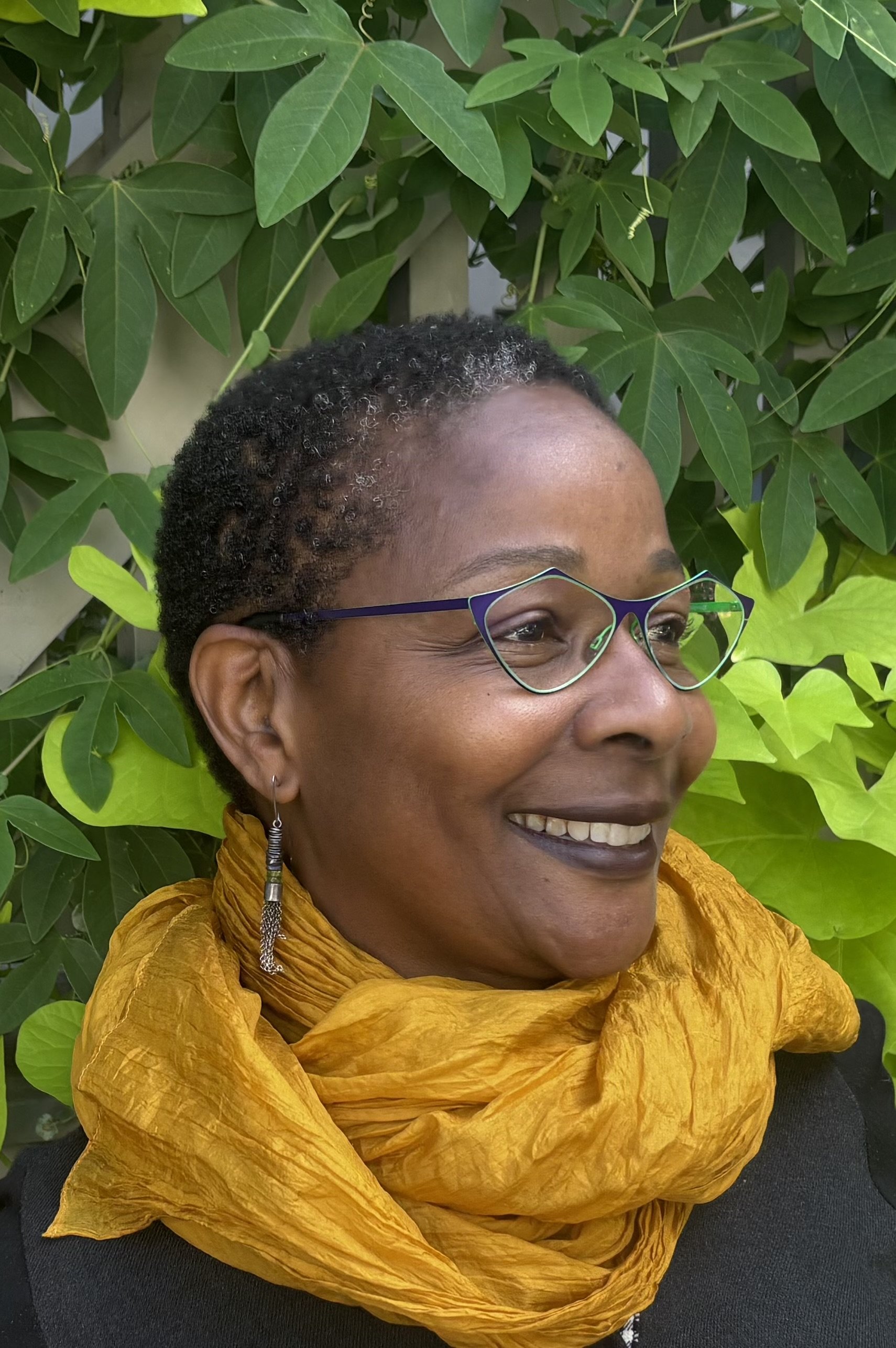
Photo by Ada de Gooyer
Kenda Mutongi is Ford International Professor of History at MIT and the author of two award-winning books: Matatu: A History of Popular Transportation in Nairobi (2017) and Worries of the Heart: Widows, Family, and Community in Kenya (2007). Her recent articles exploring the intersections of history, politics, and everyday life in Kenya have appeared in Liberties Journal, Boston Review, The American Historical Review, and The Washington Post.