
Late Light
For Fanny Howe
It’s been a year since Fanny died. I miss her more than I expected to, and I expected to miss her a lot. I am not celebrating Fanny’s accomplishments here, not speaking of what she gave, as a writer and a poet, to all of us in this world. Others, especially poets, have been doing that better than I could do, and younger readers and writers who never met her will continue to do so. Here, I speak of a lifelong friendship, and of the memories that are swimming back to me.
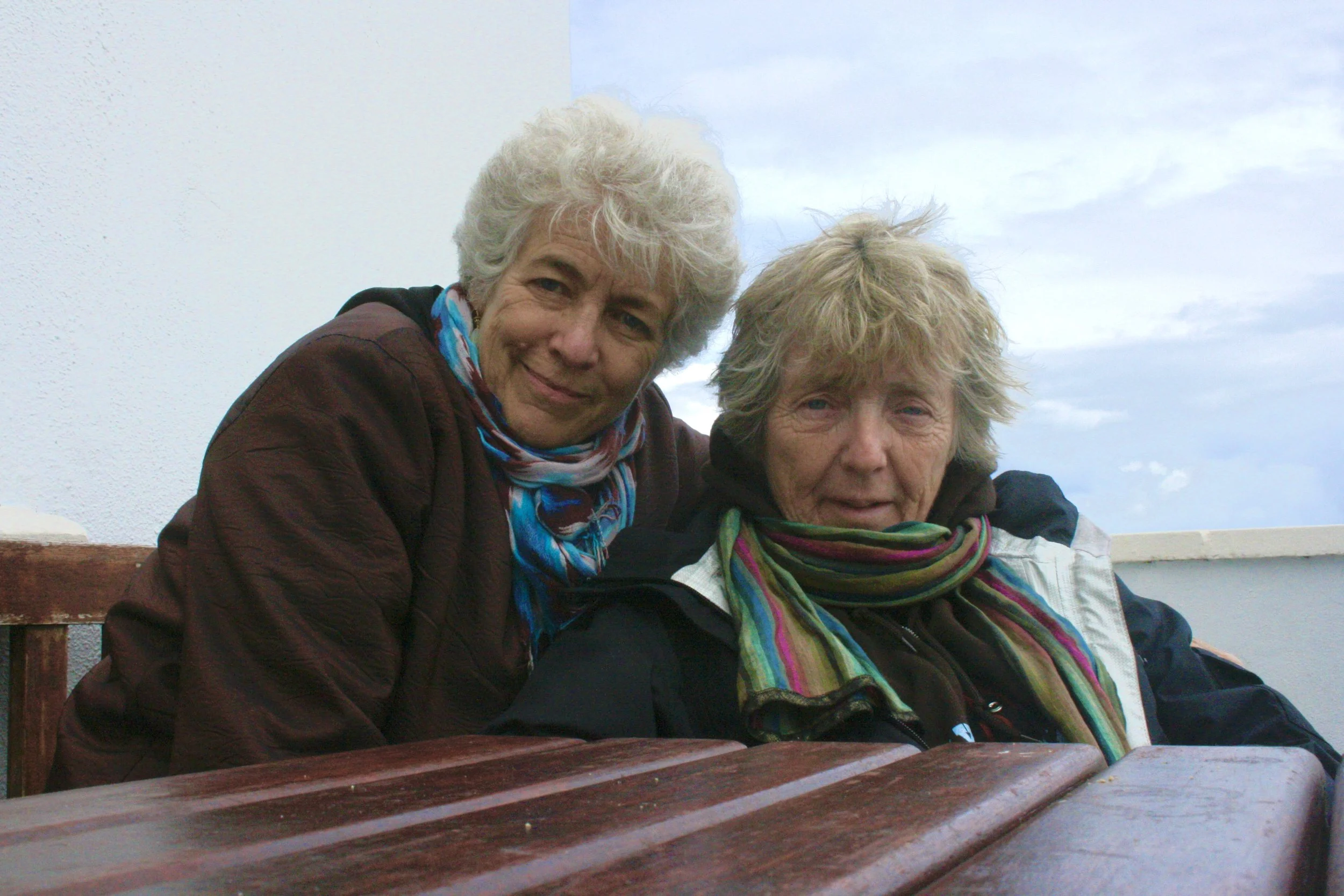
Sue and Fanny on the boat to the Aran Islands, 2010
I’ll start at the end.
Fanny died late on a July night, in a hospice facility in Lincoln, MA. That afternoon I was in my study in Berkeley, CA, an unbearable 3,000 miles away. I had just learned that my friend was dying, and I knew she would be gone sometime soon. Why was I filing off a hangnail? Why was I sharpening a pencil? I was doing small things, and she was doing a big thing. Suddenly overcome by a wave of drowsiness I lay down on the couch and immediately fell asleep.
When I woke after a deepwater nap, the physical objects around me didn’t seem real. Their thingness was something I couldn’t understand. Even the books had no meaning as books. Only the light seemed real. A nearly horizontal band of evening summer sunlight came through the high window of my study and landed on the bookcase, and the yellow of the late light made the colored spines of the books glow. It was the light that was beautiful, not the books. Things were obstacles between me and the universe.
It seemed that Fanny was going through a door into emptiness, and I was at the threshold, seeing her to the door, even though I was across the continent. I could see through the door to the universe on the other side, and I could feel the cool breeze of the universe on my skin. Fanny was entering vastness, I knew it. She herself had always been vast to me, in spite of her mischievousness and love of gossip. Or maybe her vastness was even vaster because it included mischief and gossip. Vast is a good word for Fanny—a small word for something big. Fanny was like that word.
The next morning, I got a phone call telling me that Fanny had died in the night. I was outside, behind the house. I walked through the garden, up the porch steps, and into the kitchen, and everything around me was vibrating—the plants, the trees, the planks of the porch. How strange it is to be alive! How strange to be present in this interval between birth and death. To be in this window for breathing.
Fanny and I grew up two blocks apart on the same street in Cambridge. Her wild Irish mother, who had been a famous actress at Dublin’s Abbey Theatre, founded the Poet’s Theater in Harvard Square, and my parents stored the theater’s scenery in the old barn behind our house. I knew Fanny to say hi to, but we didn’t become friends until we were young adults. The difference between 6 and 8 is bigger than the difference between 26 and 28, the ages we were when we both came back to Cambridge after we had journeyed into other cities and other worlds.
Our paths crossed in the circles of literature and the civil rights movement, and this time we became friends. I was already married and had a baby. I wanted to be a writer, but I wasn’t yet. Fanny was a writer. Her first book, Forty Whacks, came out about then, and we—her friends—were excited. She was doing it! She was an artist. My admiration for Fanny’s writing sometimes made me feel shy, but she took me as a friend, not a fan, and after a while, my shyness went away.
I was happy when Fanny came to live with me and my then-husband for six months, in 1968, renting a spare room in the house we were also renting. Our lifelong—and unspoken—commitment to each other began in those days of sitting together at the kitchen table, talking of books and men and the Vietnam War, both of us smoking cigarettes and drinking strong tea that made Fanny’s hands tremble like an old woman’s, even though she was not yet 30. Baby Noah bounced up and down in the kitchen doorway, suspended from the door jamb in his Jolly Jumper, looking surprised and delighted to be free from gravity. A poster on the kitchen wall, provided by Fanny, showed the crossed street signs Haight / Ashbury, surrounded by sunflowers, and the words “Summer of Love” curving across the bottom in psychedelic colors.
Another memory: Fanny, visiting our family at Martha’s Vineyard, sitting in a butterfly chair outside the house, writing in a notebook, and nursing one of her babies as she wrote. “How can you do that?” I asked. “Write and nurse at the same time?”
“I’m not writing,” she said. “I’m just writing something down that I already wrote in my head.”
Both our marriages ended when our children, who were in the same age range, were very small. It was a comfort to be single mothers together, not in the same place, but at the same time, and we visited each other wherever we lived. Not long after her divorce, I went to Guilford, Connecticut, to see Fanny and her children in a tiny cottage near the beach. She was fending for herself and her brood, scraping together grocery money thanks to welfare and sporadic teaching in New York. The four of them made a cozy pod. At Fanny’s request, Danzy, age 6, showed me her Irish step dancing, dangling her clicking feet from an immobile pelvis. Then Fanny made baloney sandwiches, and we watched the daily episode of her favorite soap opera, “All my Children.”
Neither of us ever married again, but of course we didn’t know that was going to be the case ahead of time. We both struggled with singleness. Fanny, who liked hearing the amorous details of her friends’ lives, always wanted to know if I had a boyfriend. Sometimes I did, and sometimes I didn’t. We both were attracted to men who were outliers, alcoholics, on the edge. Not husband types. And, when our children were children, each of our families felt like a complete package, self-enclosed—a mother and her children. In retrospect, I can see that in each of our cases, the doorway into the family that a new husband would have had to pass through was not widely ajar. Also, Fanny, as the white mother of three biracial children, faced challenges I knew nothing of.
Even after our children grew up, there was still an independent streak in both of us. Fanny wanted to be her own travel guide, in charge of her own path in life. One time she rented a car and drove to western Mass for the weekend, for a reason I don’t remember. She told me when she came back that having a rental car was like having a husband, only better—someone who was always ready to take you places you wanted to go without complaining.
Going through old letters recently, I came upon a bunch from Fanny. In 1990, while she was at the MacDowell residency program in New Hampshire, she wrote: “Happy here, very. Reading, video-ing, scribbling…very solitary, and only lonely when ‘in the world.’ Then, very. I gave a bunch of readings— NYC to N England. Saw tons of people and felt bereft. Here—solo—not so.”
Later that year she wrote: “I don’t like living alone. Wish I could—after Xmas—live in Berkeley with you—taking the front room to be mine.” Six years later, she took a leave from teaching at UC San Diego to be Writer in Residence at Mills College for a year, and she lived in that front room. We were happy living together. When the year was up, and she was back in San Diego, she wrote to me at the remote Tassajara Zen Mountain Monastery, where I was on retreat for three months:
“I really am serious in my invitation for you to share my apt. next year, and live down here, near the Zen lady. [Joko Beck was a Zen teacher in San Diego, whose weekend retreats I often attended] And very possibly teach a course a quarter, and you could commute up to Berkeley to still do the magazine, and write, and walk on beaches and in canyons, etc. You could move into my place in Sept. If this appeals to you, please consider it done….”
I was taken aback to find this unremembered invitation. I always wanted to live with Fanny. I had reasons not to do it, including an editing job in Berkeley that I loved. But now, in 2026, staring at her scribbly handwriting on the creased paper, I imagine myself in her San Diego kitchen, watching her take her Barry’s Tea bag out of her cup and put it on a little dish to use again later. Oh God— I should have taken her up on it!
Fanny was not exactly fickle, but her plans for the future were always changing. In another letter from that time, she wrote, “My thoughts run to the future, and to wanting to have some sort of plan which makes profoundest sense. I would like to be part of a small community (anarchist!) which includes shared commitments to social issues, to religious thought, and to the neighborhood. I have exhausted the uses of solitude, have learned all I can from it. Now it's time to get serious about trying to establish a way of life, which can serve, too, as a model for other people. Would you be interested in exploring this with me?”
Yes, I would have been, but it was one of those big ideas that didn’t get explored.
At the beginning of our friendship, Fanny was not a Catholic and I was not a Buddhist, but we talked about the invisible things. She used to give me Tarot readings, and she consulted psychics. I joined the Berkeley Zen Center in the 1970s. When Fanny became a Catholic a few years later, our friendship became an interfaith one. It made Fanny sad that her conversion caused some people, especially in the poetry world, to take her and her work less seriously, but her Catholicism was not about the Vatican, and not about sin. It was about liberation theology, about loving the poor and those who suffer, and, yes, about the mystery of the Mass.
I used to be envious of her faith, and I missed having somebody like God to talk to. Later, I realized that it was okay for me to talk to God, whether God was there or not. No Buddhist teacher ever told me not to, and Fanny steered me to read Catholic mystics like Simone Weil and Meister Eckhart, who helped me understand that not knowing exactly who god is—well, that’s the whole point. For her part, Fanny had doubt as well as faith, and I, in my Zen way, have faith as well as doubt. Faith and doubt animate each other. We were fellow pilgrims on the same camino.
Fanny met Fr. Dunstan Morrissey at a Simone Weil conference in Los Angeles. She could recognize immediately the people who would become her spiritual friends, and they were drawn to her as well. Dunstan was one of these people. The next time she came to Berkeley, she took me with her to find Dunstan at his retreat center, called Sky Farm. She said, You have to meet this monk! We drove through vineyards outside of the town of Sonoma for a few miles until we came to a gate and a wooden panel with the words:
WAKE UP!
LIFE IS TRANSIENT
SWIFTLY PASSING
BE AWARE OF
THE GREAT MATTER
DON’T WASTE TIME
“Hey! That’s a Zen quote!” I told Fanny.
We found Dunstan outside his chapel, which was made of a giant wine barrel that had been discarded by a nearby vineyard, with a wooden cross on the grass-thatched roof. Dunstan had long white hair, a full white beard, and bright blue eyes. As I write this now, in this time when they are both unaccountably gone—gone!—I think his eyes and Fanny’s eyes had the same shine. He wore a blue cotton smock, like a French peasant, and slip-on shoes that were steeply worn down at the outside heels. He greeted us warmly and said, “I want to show you something.”
We followed him and his giant Russian wolfhound Sophie up the hill to a grassy slope. “I just finished digging my grave!” He was jubilant. He lifted up a piece of plywood and there it was, a rectangular cavity six feet deep, with a spectacular view (as long as you weren’t buried yet) of the mountains. “I feel a great sense of relief, now that it’s ready for me.” He replaced the plywood, so Sophie wouldn’t fall in.
We visited Dunstan every time Fanny came to Berkeley. The year she lived with me and taught at Mills, it was very often. Sometimes we stayed at Sky Farm overnight, in the two guest rooms that were made, like the chapel, out of old oak wine barrels and still smelled of wine. We sat at the big slab table in Dunstan’s library, surrounded by books from many religious traditions, with a fire crackling in the wood stove on chilly days, and Dunstan poured us strong green tea out of an iron pot. He often spoke of “the realm beyond the opposites.” He and Fanny talked of things I didn’t know about, like the Book of Revelations, and the Desert Fathers. I paid attention and looked them up later.
I, in turn, brought Fanny with me to one of my sacred spots, Green Gulch Farm, and introduced her to my old Zen friend and teacher Norman Fischer, the abbot at the time. They already knew of each other through poetry. Norman gave us tea in the abbot’s room, and we talked about the similarities between Zen and Catholic monasticism.
Fanny wrote to me, “The year in Berkeley has loosened up some chains that circle my “belief system”—and Buddhism has helped a lot. The day up on the hill in Green Gulch was a kind of final touch on these shifts.”
In another letter: “Do you think that my years of celibacy and solitude are the equivalent of meditation? It hit me—maybe—"
I asked Fanny if she prayed. She said yes, all the time, but there weren’t any words to it. Another time, after Dunstan’s death, she admitted to me, “I sometimes pray to Dunstan.” She seemed embarrassed, I suppose because Catholics are only supposed to pray to God or the saints. Still, this gives me the idea that I could pray to Fanny, not asking her to make something happen, but to give me some of her pluck.
The first time I went to Glenstal Abbey, a Benedictine monastery in the West of Ireland, was more than twenty years ago. I took my 82-year-old mother to a weeklong writing workshop that Fanny taught there, in the long, long days of an Irish June. Fanny and my mother were fond of each other, and I wanted to give my mother a good adventure while she was still up for it.
Fanny’s dear friend Mark Patrick, the abbot, met my mother and me at Shannon Airport. Approaching Glenstal, we drove between stone pillars onto the spacious grounds, past jungle-like plants with huge leaves, and donkeys braying behind a fence. And there it was, a veritable castle, with an arched gate in the high stone wall, and towers and turrets. Fanny didn’t like castles, because they were built by the rich at the expense of the poor, but this one was okay because it belonged to Benedictine monks; they had bought it from a wealthy family who had left Ireland during the revolution. In the guest house near the church, we found Fanny. I had just seen her in Cambridge, and now, by magic, here she was, on the other side of the Atlantic Ocean, in a castle of monks, fussing over us and making us strong Irish tea— tea again!—in the guest house kitchen.
Fortified, we were ready for Fanny to show us the garden. I pushed my mother along the path in a wheelchair borrowed from the Abbey. She could walk, but not far. In the garden, Fanny and I sat on the stone wall lining a lavender bed in the full force of its perfume, and my mother sat beside us in the wheelchair. The upper tier of the garden had plants that were mentioned in the Bible—fig, mint, rose—but we didn’t go up that time, because of the wheelchair. In the trance of jetlag, we were happy to stay where we were for a time, watching every single thing glow in the Irish summer light and hearing the bees.
I liked wheeling my mother around, from the guest house to the church, in Fanny’s wake, to hear the monks chant the psalms at Vespers. To the refectory for the silent supper with the monks and other guests. We passed the cold cuts and pots of tea down the long table in silence, while one of the monks read aloud. That week it was a book about the history of the popes, including the bad things they did.
One evening, Fanny took us to visit her friend Ciaran, one of the monks, in his wood-turning studio. It was full of sawdust and cigarette butts, and his beloved border collie lay on the floor, thumping her tail. He showed us bowls he had made from fallen Glenstal trees, and the curved wood felt good in the hand. He poured us each a shot of Irish whiskey, and we sat on stools and talked about dogs we had loved. Ciaran and Fanny were close. He was a lonely artist, a heavy drinker, his faith was cracked with doubt, his dog was his heart’s companion. When Ciaran died about 15 years later, Fanny was grief-stricken. She told me Glenstal would never be quite the same without him.
At the end of the exhilarating week of writing our hearts out, Ciaran gave my mother and me each a bowl he had made from Glenstal trees. Hers was of ash, mine of holly. Our names were burned into the bottom.
I went to Glenstal with Fanny six or seven times. The writing workshops continued and grew to as many as 25 people. Her students loved her and many came back year after year. The last few times, she asked me to teach it with her. Each year she started the first meeting with the same device: she gave a first sentence and a last sentence and the instruction to write your way from the first to the last. One year it was: “The car broke down two miles away from that rotten old pub, the Slug and Lettuce.” You had to get to: “The dawn was rosy on the balcony, where I was happy for the last time I can remember.”
At the end of each writing workshop, the students, some of whom were in their 80s, took Fanny and her sidekick, me, to Crokers, the cozy old pub in the nearby village, much nicer than the Slug and Lettuce would have been if it had existed, for dinner.
In Zen practice, we try to “be here now,” knowing that the present moment is the only moment we get. “Now” is Berkeley, 2026, but as I write this, I’m in the pub with Fanny, years ago and miles away, squeezed in with old and young. We’ve been eating and drinking for a while, and we’re onto the apple pudding now. We’re all laughing, especially Fanny. She tells a joke about how her dear friend Fr. Christopher slips a little brandy into the oatmeal he makes every morning for the guests’ breakfast. Several people sing a song to the tune of “Molly Malone,” with words they made up for Fanny. Fanny is blushing and grinning. She is completely happy.
In the last years of her life, when she was based in Cambridge, Fanny couldn’t decide where to live. With children and grandchildren spread out from England to California, she was torn apart. In England, she’d be twice as far from California, and in California it would be the other way around. So she stayed in the middle, in Cambridge, and grieved that she had no family around her.
She became frailer and frailer, she stopped driving, her vision and mobility were impaired, and she knew she shouldn’t continue to live alone. With encouragement from friends and family, she moved into an assisted living place—a small and warm-hearted community of interesting Cambridge people, with good meals, close to Harvard Square. I thought this was the perfect solution for Fanny: she was in her hometown, she had an old friend already living there, she was settled in a safe spot near her dear Charles River and the Catholic monastery she liked to go to for Mass, and she was at last freed from having to decide where to live. One of my old friends who lived there told me enthusiastically that she felt like she was back in our old college dorm. But that was not the feeling Fanny wanted. She was not a dorm kind of person. She told me in a voice of doom, “This is the last stop for me.” I think she meant that there was no more sense of possibility, no more mystery. And worst of all, “My grandchildren are all far away!” Within a few of months of her arrival there, she died.
The last time I was at Glenstal, Fanny took me to the small cemetery, bordered by garden beds and tall shade trees, where the names of monks were engraved on stones that lay flat on the grass. She wanted to be buried there, and she asked my opinion about which plot would be the best.
“I like the shady one in the corner,” I said. “But what about Mount Auburn?”
Once she had taken me to the renowned Mount Auburn Cemetery in Cambridge, to show me the gravesite she had picked out for herself on a grassy hillside among rhododendrons. “I can’t wait to lie down here!” she had said. Now, at Glenstal, she said, “I can’t decide.”
In the end, her indecision became her decision, and half her ashes were buried on either side of the Atlantic Ocean.
I’ve been surprised at how fully this writing takes me into the times I had with Fanny. It looks like I’m writing in my basement study in Berkeley. But no, Fanny and I are sitting on towels on Short Beach, watching our four-year-old granddaughters wade in the shallow water, looking for hermit crabs, and I can smell the rockweed that has washed up on the sand.
And then, each time I get up from my writing to use the bathroom or move the laundry from the washer into the dryer, I walk away from Fanny. She’s dead all over again. Writing this piece makes me sad, and yet this sadness is precious. The grief keeps me connected. If I get over my grief for Fanny, will she be completely gone?
No, I’ll have a cup of Barry’s tea, and she’ll be with me.
The author thanks Linda Norton and Isabel Lyndon for interviewing her about Fanny and transcribing the interview.
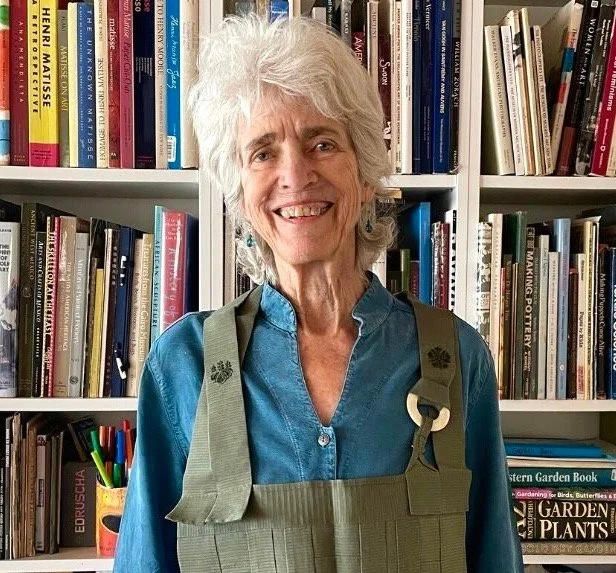
Susan Moon is a writer, editor, and lay Zen teacher. Her books include the memoir in essays, Alive Until You’re Dead and the groundbreaking collection, The Hidden Lamp: Stories from Twenty-Five Centuries of Awakened Women, with Florence Caplow. She lives in Berkeley, California, and practices with the Everyday Zen Sangha.