
Hungary and Post-Illiberalism: The End and the Beginning
The rivers will return to their beginnings.
Czesław Miłosz
The 2026 Hungarian Parliamentary Elections
On Sunday evening April 12 in Budapest, the Danube’s banks were packed with crowds of celebrating Hungarians. The nation had experienced a historic election: voter turnout had approached eighty percent, surpassing all of the country’s post-1989 elections. Further, not only had Prime Minister Viktor Orbán’s sixteen-year “illiberal” government been overturned, but early indications pointed to an overwhelming victory for Péter Magyar and his center-right Tisza party. By choosing Tisza’s pro-European platform, voters had also reaffirmed their April 12, 2003 decision in the Hungarian European Union Membership Referendum. Magyar invoked this signal date’s dual significance in his first post-election speech, as the Hungarian parliament glowed, dramatically lit behind him. In a Europe increasingly obstructed by Orbán’s right-wing, Eurosceptic Fidesz party, the election’s outcome indeed represented a decisive break with the trajectory of Hungary’s recent past.
The Democratic Breakthrough
The exuberance of the evening’s rejoicing by the Danube, however, also reflected the extent to which the victory had been hard-won. Four successive terms of Fidesz’s constitutional “reforms”—including extensive redistricting and a complex winner’s compensation system—along with the ruling party’s domination of public media, had made even the possibility of electoral alternation highly uncertain. Over two years, and increasingly in its final weeks, however, Tisza gathered momentum, with strong rally turnouts even in many of Fidesz’s traditional strongholds. Finally, a series of scandals, first and foremost the damaging revelation that Hungary’s Foreign Minister Péter Szijjártó had repeatedly shared EU Council meeting information with his counterpart, Russian Foreign Minister Sergey Lavrov, impacted the playing field.
Leading up to the election, on the streets of Budapest—as had been the case with prior Fidesz campaigns—the theme of fear dominated the party’s election posters. In one, Péter Magyar and Ukrainian president Volodymyr Zelenskyy were depicted together as on a wanted poster, in stark Soviet-style black and red, accompanied by the caption, “They’re dangerous.” Rumors that Russian intelligence agents were in the capital, and the claim, rapidly debunked, that Ukraine had planted explosives near a Serbian gas pipeline that served Hungary, further set the tone of the final week’s campaigning.¹ In Budapest the pre-election tension was palpable. The US administration’s endorsement of Orbán did little for the Fidesz campaign, which appeared to have seriously misjudged its electorate.²
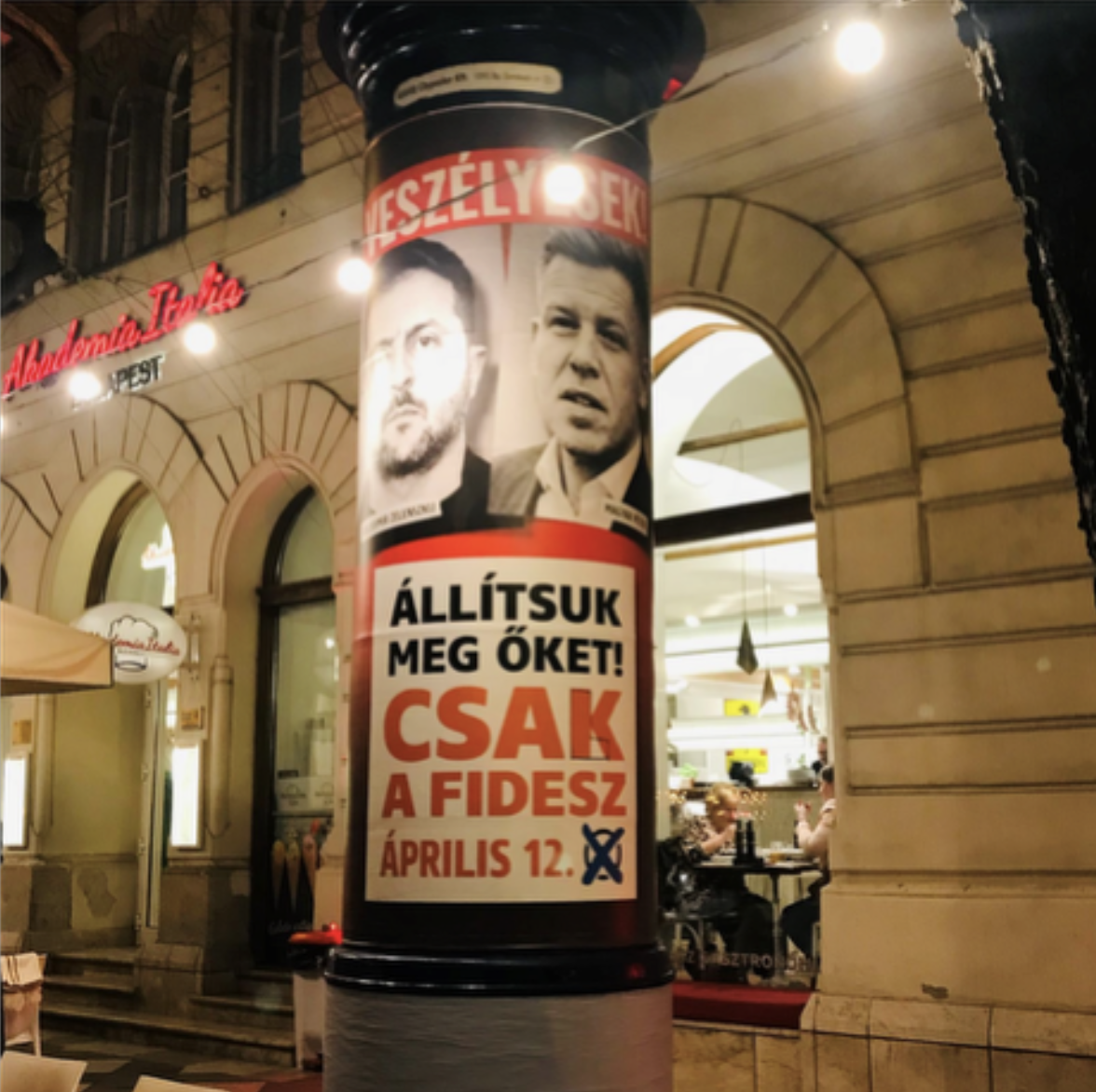
Budapest, April 11, 2026. Photo by Ellen Hinsey
Despite these hurdles, Tisza’s united opposition achieved its breakthrough and the implications of the election’s outcome rapidly spread, not only across Hungary, but throughout Europe and to the United States. Prime Minister Viktor Orbán—the architect of Europe’s foremost laboratory of “illiberalism”—had been roundly defeated. Not only had the Tisza party won, but it had garnered 141 parliamentary seats, the largest majority in the country’s post-1989 history, a prerequisite for implementing democratic reforms.³ While many Hungarians had feared this might be their last chance for electoral alternation, a formidable determination had made this possible, despite the disparities, that observers such the Organization for Security and Co-operation in Europe (OSCE), reported afterwards.⁴
This does not mean, however, that the evening was without its concerns. Almost immediately, post-election commentaries turned to whether Magyar possessed the ability to carry out his intended reforms, his former relationship to the Fidesz party, and whether the opposition—which politically represents a wide right-left spectrum—will hold together. What was certain, however, was that change had come to Hungary. And this fact alone electrified the city, and affirmed the potential of human agency and democratic solidarity. It also fulfilled the appeal made by graffiti sprayed on a wall in Budapest that called for citizens to no longer “fear the government.”
But now, on the night of April 12, 2026, all that was past. Instead, one heard repeated in Budapest’s streets and beside the Danube, in the metro and on the television, the simple two-word phrase: “It’s over.”
Autocratic Gradualism
Hungary’s structural transformation into an illiberal state was, by and large, accomplished during Fidesz’s two terms, 2010–2014 and 2014-2018. This period in Europe will be remembered as one of significant challenges to democracy. After propagating a new Hungarian constitution that made way for a restructuring of the State’s institutions—and a systematic dismantling of the country’s democratic checks and balances—Orbán’s third and fourth terms (2018-2022 and 2022-2026) were characterized by an intensifying relationship with Russia, in parallel with an ever-growing censorship of civil society. After enacting “LexNGO 2021”⁵—akin to Russia’s “Foreign Agent Law”—in December 2023, Fidesz passed a new law that established the Sovereignty Protection Office (SPO) to investigate organizations or individuals “liable to jeopardize the sovereignty of Hungary”.⁶ Referred to the Court of Justice of the European Union (CJEU)for whether it was in breach of EU law, the SPO raised grave concerns that Hungary was poised to cross the line into a full-fledged dictatorship.
Over the last decade, illiberalism’s technique of what I term ‘autocratic gradualism’ (in contrast to the classic coup d’état model of military dictatorships) has been one of its defining characteristics. This process is not new: in the twentieth century it was expertly described by the German lawyer and political scientist Ernst Fraenkel in his classic work The Dual State (1941). In his study, Fraenkel chronicles the process by which anti-democratic forces gradually take over a multi-party system, implanting a single party-state with control of all the levers of power, including the judiciary and the military.⁷ The last decade has seen a proliferation of such “illiberal” regimes—more accurately described in Hungary’s case as an “electoral autocracy”⁸—that mix state capture with certain trappings of democracy such as elections, and have been increasingly facilitated by ever more sophisticated technologies.
Clientelism
Fidesz’s institutional restructuring was accompanied by a vast clientelist system—preferential economic treatment in exchange for political loyalty—and other forms of corruption. In 2001 former Minister of Education Bálint Magyar first identified a syndrome he termed the “post-communist mafia state.” However, the spread of “illiberal” challenges over the last decade to previously “mature” democracies has raised troubling questions, pointing instead to an epochal shift in governance. During a period when Western political scientists were proposing “populism” as the term of use for growing political trends, experts in Central Europe, confronted by new realities, were warning of the aforementioned sophisticated and technologically driven “electoral autocratic” model, with its leveraging of unrestricted executive power for economic gain. Exactly how much the Orbán system cost the Hungarian people may never be known. And the “illiberal playbook”—tried and tested in Hungary—began to be viewed by some as the model to be emulated and exported.
The 2026 Hungarian Inauguration: The Rebirth of Political Transparency
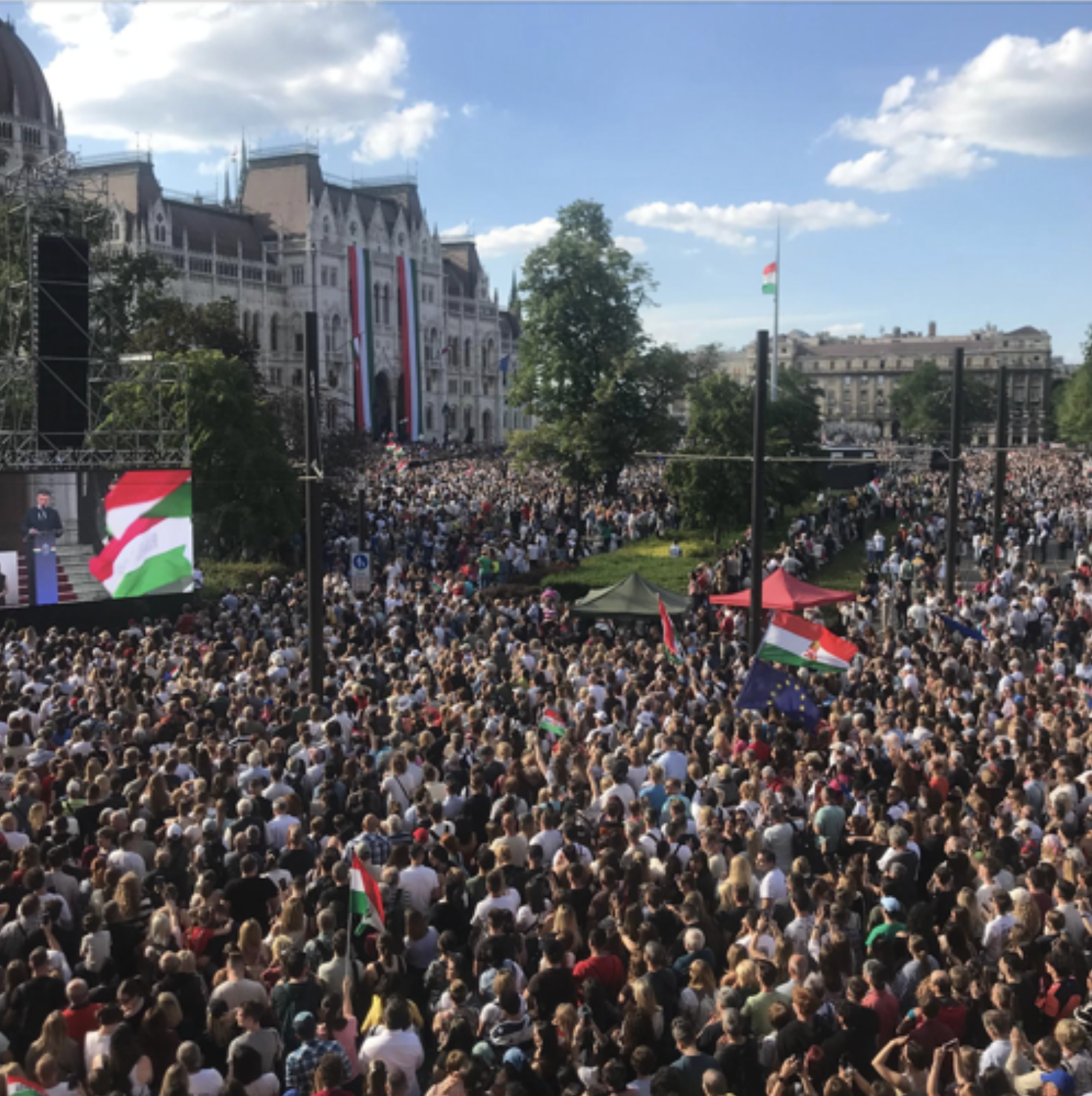
Hungarian Parliament, Budapest, May 9, 2026.
Photo by Ellen Hinsey
On the morning of May 9—the 76th anniversary of the Schuman Declaration, a foundational date in the establishment of the future European Union—crowds began to gather in front of large screens set up in Kossuth Square outside the neo-Gothic Hungarian Parliament. Many of those present expressed the sentiment that this day was of even greater importance than the 1989 regime change. The schedule of events passed by word of mouth and through social media: the transfer of power would take place at ten o’clock inside the parliament, followed by Péter Magyar’s first speech as Prime Minister. The official investiture would then give way to multiple anthems, among them “Zöld az erdő” (the unofficial Roma anthem),⁹ the European anthem (“Ode to Joy”), and “Himnusz,” the Hungarian national anthem. After a short military parade, at three o’clock Magyar would deliver a second speech before the parliament, followed by a celebration that was expected to be very well attended.
Against the background of Orbán’s sixteen-year system, however, these optics were far from arbitrary. By 2016, journalists’ access to parliamentary sessions had been severely restricted, and independent media were increasingly barred from government news conferences.¹⁰ Signaling a complete reversal, the May 9 open-air event, with its large video screens, reflected Tisza’s intent that, from the very first hour, the workings of the new government would be “transparent.” As the moment of the transfer of power approached, family members, young couples, and small groups of friends began to congregate in the square. At times, these were poignantly punctuated by a single figure, standing apart, solemnly erect. A woman, waiting alone, dressed in formal clothes. An older man, a hat pressed between two hands. But the small family groups also emanated a similar air of democratic dignity—a pride mixed with anticipation—and at times, total incredulity. It was indeed a signal day: there was the hope that Hungarian democracy was about to be restored.
Democratic Groundlings
While it might have been sufficient for Péter Magyar’s investiture as Prime Minister to limit itself to the usual formalities of state, instead the day contained its surprises. Whatever the future holds, Magyar’s first official speech was highly consequential—for Hungary and for Europe. It appeared the moment had come for truth-telling. And Magyar, visibly moved by the responsibilities that had been placed on his shoulders, began his discourse. Outside, however, to add a bit of levity to the occasion, those on Kossuth Square—standing in front of the large video screens like Elizabethan groundlings before the final scene of a tragedy—spontaneously responded to Magyar’s speech, boldly voicing their reactions and opinions. Their sharp criticism was clear when certain names were evoked—those they counted as miscreants—conversely, they applauded each statement that affirmed the reconstruction of Hungary’s rule of law. This, they believed, had been much abused over the previous four terms in the very same amphitheater with its wooden-clad risers. The preamble to Magyar’s speech set the tone for the hour-long address, and bears quoting:
With faith, willpower, and love of country, I will work every day [...] every hour …I have seen how power can slowly subjugate a person. How a politician can gradually become a pawn of his own system. […] Hungarian history serves as a warning to every prime minister. A warning that power is fleeting. […] That is precisely why I would like to state clearly here, in the House of Hungarian Democracy and Constitutionalism. I will not rule over Hungary; I will serve my country.¹¹
Magyar’s promise “to serve” rather than “to rule,” as well as, later in his speech, the evocation of values such as “Integrity, courage, wisdom” might seem, to those not in Hungary, anachronistic or rhetorical. But on May 9, this was not seemingly the case. Such a new start is imperative if Magyar is to initiate the changes involved in his government’s difficult program. For despite the day’s high spirits, those gathered were more than aware that Orbán’s illiberal system was deeply embedded in the country’s institutions. Accordingly, even more than in neighboring Poland, Hungary’s democratic recovery would be immensely complex—and far more difficult to carry out than its destruction.
For the Tisza government is now confronted with the fundamental question of whether Orbán’s “illiberalism” can be “reformed” or if it needs to be swept away in its entirety. On May 9, Magyar’s speech balanced on the knife-edge of this complexity. Did Tisza’s 2026 victory represent, as Magyar said, “a mandate to open a new chapter in Hungary’s history” and “to change not just the government but the system itself, to start anew”? On the other hand, if Tisza did not wish to merely replicate Fidesz’s scorched-earth legislative methods—and instead renew the tradition of “restraint”—what options did the government possess? Regretfully, democracy holds no deus ex machina: for now, the return from illiberalism remains uncharted territory.
Informational Justice
Despite these unanswered questions, before the screens on Kossuth Square, something different —but also of critical importance—transpired. The previous decade and a half had progressively blanketed the country in a fog of disinformation and increasing fear. Reminiscent of what Hungarian constitutional scholar Gábor Attila Tóth has evoked regarding transitional justice following the fall of other authoritarian regimes, a moment of “informational justice” took place outside the Hungarian parliament on inauguration morning.¹² This was achieved through an affirmation of factuality and the calling out of the previous system’s illegality. Speaking to both those inside and outside the chamber, Magyar made clear that this period had now ended:
The political system that constantly fed off itself, even plundering the homeland, pitting people against one another, while squandering Hungary’s economic, moral, and social reserves, has failed. Twenty-two years after Hungary was given the greatest opportunity in its modern history through EU accession, our beloved homeland has now become scorched earth. It has been plundered, pillaged, betrayed, and deceived.¹³
Magyar announced that a National Asset Recovery and Asset Protection Office was being prepared and that Hungary would rejoin the European Public Prosecutor’s Office, among other European institutions. Magyar somberly concluded his speech, however, with the caution that “freedom in and of itself is no guarantee […] In fact, freedom is a grave responsibility […] We must now transform […] hope into functioning, revitalized institutions, trust into laws […] and victory into a better, more humane everyday life.”¹⁴ Again, this might seem like an oratorical flourish. But for many, the day was suspended in a type of hope that occurs only once in a generation. A massive civic effort had borne fruit, and while the future would bring challenges and setbacks, for a moment the yoke of fear and the deformations of illiberalism – which had deprived a population of its dignity – had been lifted. Whatever may come, it must be entered into the historical record: May 9 in Budapest was not a cynical day.
The Enduring Task of Democracy
Before leaving Budapest, I spoke with András Kádár, co-chair of the Hungarian Helsinki Committee (HHC). We met in the NGO’s offices housed in buildings associated with Central European University, which, under pressure by the Fidesz government in 2018, relocated to Vienna. Following April’s dramatic election results, in the HHC’s sober black and white meeting rooms, Kádár began to tackle a number of complex issues. He reviewed the challenges the Tisza government faced, such as how to rectify the legality of Hungary’s captured institutions, starting with the presidency and the Constitutional Court. These problems raised serious questions about how structural changes might be made while respecting international standards. The Court of Justice of the European Union’s (CJEU) decisions in recent Polish cases are being studied to distill fundamental principles.
Kádár added to this, emphasizing his words: “Next steps also entail the central question of whether there will be, with the new Tisza government, an honest and genuine effort to create an impartial Constitutional Court that authentically fulfills its purpose—which is to counterbalance the executive and legislative powers. Its purpose should no longer be merely to serve the interests of the executive, which is what the current court has been doing.” In Kádár’s further reflections on key issues, he remarked: “Some of what we currently face comes down to the vulnerability of democracy. We must try to protect democracy and the rule of law by the means we possess. Yet there will always be those who seek to disregard these things.” In terms of Hungary’s democratic reconstruction Kádár believes there remains—above and beyond the debates surrounding possible procedures and technicalities—the critical question of whether Magyar will now re-instill the democratic culture of restraint.
Finally, there was hard-won gravity in Kádár’s voice when he concluded, “We need a return to mutual tolerance, and the idea that people who think differently are not enemies, but members of the same political community.” After our talk, I joined the flow of pedestrians along the side streets adjacent to the CEU buildings. Disbelief and complex anticipation hung in the air. Hungary, which in 2014 had announced its illiberal experiment to the world, had now become the beacon and laboratory for illiberal recovery. The country had seemingly caught itself before descending into an autocracy that could only lead to greater tragedy. In this, Hungary’s experience of illiberalism—as well as the force of its rejection—has much to teach the “mature” democracies, still balanced precariously on the temptation of that precipice. However, Hungary has shown that when the light has almost gone out, there can re-emerge an enduring human drive to live in a free society, and not in a tyranny. And the possibility—if we take hold of this message and reinforce our own democratic values—that we too might succeed in initiating an era of post-illiberalism.
Starcevic, Seb, “Serbian Intelligence says Ukraine not Involved in Pipeline Explosives Plot”, E&E News by Politico, April 6, 2026. https://www.eenews.net/articles/serbian-intelligence-says-ukraine-not-involved-in-pipeline-explosives-plot/
For an analysis of the impact of government media on the 2026 election see: Ferenc Vicsek, “Research Report-Government Propaganda has Virtually no Effect on the Opposition”, PPI 2026. https://www.dimenziomedia.hu/cikk/Government-propaganda-has-virtually-no-effect-on-the-opposition-Research-Report-PPI-26-161
Out of the Hungarian parliament’s 199 seats, Magyar’s Tisztelet és Szabadság Párt (Tisza) (“Respect and Freedom Party”) garnered 141 seats, Fidesz-Magyar Polgári Szövetség (“Fidesz- Hungarian Civic Alliance”) 52 seats, and the far-right Mi Hazánk Mozgalom (“Our Homeland Party”), 6 seats.
OSCE, “Hungary, Parliamentary Elections, April 12, 2026, Statement of Preliminary Findings and Conclusions.” https://odihr.osce.org/sites/default/files/documents/official_documents/2026/04/HUN%20Parliamentary%20Elections%202026%20PS_13.04.2026.pdf
The “Act LXXVI of 2017 on the Transparency of Organizations Supported from Abroad” was found in 2020 to have violated EU law by the Court of Justice of the European Union (CJEU) and was withdrawn. In 2021 Hungary passed LexNGO 2021. See: https://www.dejusticia.org/en/the-hungarian-case-and-its-anti-ngo-laws
Act LXXXVIII of 2023 on the Protection of National Sovereignty.
Fraenkel, Ernst, The Dual State: A Contribution to the Theory of Dictatorship (New York: Oxford University Press, 1941).
For a longer discussion of regimes, see: Gábor Attila Tóth and Ellen Hinsey “Rebuilding a Constitutional Democracy” (New England Review, summer 2026).For an extensive overview of regime type nomenclature, see also: Magyar, Bálint and Bálint Madlovics, A Concise Field Guide to Post-Communist Regimes (Budapest: CEU Press, 2022).
In an act of symbolic inclusion, the Roma anthem “Zöld az erdő” was chosen for the investiture proceedings. Hungary’s far-right party Mi Hazánk Mozgalom (“Our Homeland Party”) protested, staging a walkout during its performance.
Human Rights Watch, “Hungary: Media Curbs Harm Rule of Law,” February 13, 2024. Independent media were repeatedly barred from government news conferences.
Péter Magyar, Inauguration speech to Hungarian Parliament, May 9, 2026, https://www.youtube.com/watch?v=ux34YMN7w8c
Friderikusz Podcast, Gábor Attila Tóth, “On Justice and the Recovery of Public Assets.” https://www.youtube.com/watch?v=WFEUigYtcPk
Magyar, op. cit.
Magyar, op. cit.

Ellen Hinsey is the author of ten books of poetry, essays, dialogue and literary translation. Her volumes of poetry include Anatomy of the Eclipse, The Invisible Figure, The Illegal Age, Update on the Descent, The White Fire of Time, and Cities of Memory, which received the Yale University Series Award. Her essays on democracy are collected in Mastering the Past: Contemporary Central and Eastern Europe and the Rise of Illiberalism (2017). Her book-length dialogue with Tomas Venclova, Magnetic North, explores post-war Eastern European culture and ethics under totalitarianism and was a finalist for Lithuania’s Book of the Year. Hinsey’s work has appeared numerous publications including The New York Times, The New Yorker, The Irish Times, Paris Review,Poetry, The Southern Review and Der Tagesspiegel, among others. A former Berlin Prize Fellow of the American Academy in Berlin, she has most recently been a visiting professor at Göttingen University. She lives in Paris.