
Hello Means Goodbye
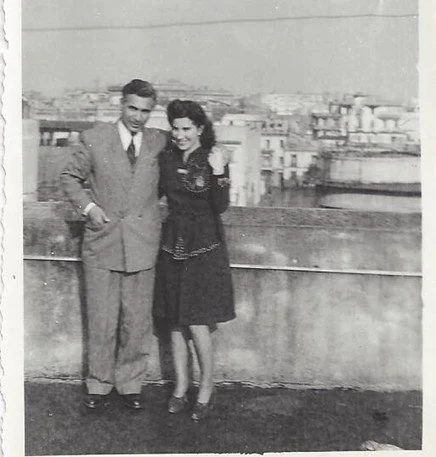
The author’s parents in Casablanca
I was five years old, holding my father’s hand as we strolled down a seaside sidewalk. I wore a new white sundress bought in New York, my winter home. My father wore belted slacks and a short-sleeved shirt he ironed himself that morning. We shared the sidewalk with men in striped djellabas, whose lowered hoods pointed triangles down their backs, and with women who glided by like night spirits, covered head to toe in black with only their eyes visible through slits. Peugeots whizzed down the wide boulevard, passing donkey carts piled high with cactus fruit, blood oranges or ripe cantaloupes. Men in worn tunics and clear plastic shoes sat atop the carts flicking reins.
“Listen,” my father told me, “their animals understand the words for ‘left’ and ‘right.’”
Sure enough, a driver called out and his donkey turned down a side street, clopping away at a steady pace. Trailing them lingered the fragrance of fruit, which mixed with that of gasoline, donkey dung and ocean to create the distinct smell of Casablanca in 1962.
That street, that time and place, were home.
“Labas?” how are you, my father said, for he had run into an Arab friend. Or maybe the friend was French, and he said “Bonjour! Comment allez-vous?” Or maybe the friend was Armenian, and he said “Parev! Inch bes-ek?” He switched easily among languages, might even have known a Berber tongue or two. At that age I didn’t know the difference between Arabic, Armenian, French, English and Turkish. It was all my father’s language. It all meant hello.
As I recall them now decades later, those street “labas” conversations could go on for a long time as each family member on both sides was inquired after individually. Madame labas, culshi labas, is everyone ok? We might even have stopped for refreshment at one of Casa’s outdoor cafes. I loved those places, with their blocky wicker chairs and close-set tables under “Cinzano” umbrellas. My father and his friend would order bitter cups of black coffee and I would sip an orange soda. “Une Fanta, sil vous plait,” my mother had taught me to say. Drinking it, I’d watch the parade of city life pass by—water sellers in pompom hats, veiled women in conversation, dark-eyed children peeking at me from behind their mothers’ robes.
After the café stop, my father might have taken me by the hand into the twisting alleyways of the souk, the local market. We’d pass skinned lambs, pointy yellow slippers, and hanging kaftans. At the entrance to the mosque, beggars with smallpox-ruined faces would stand on crutches, reminding fellow Muslims of their holy duty to give alms. Worshippers in hooded djellabas dropped coins into outstretched palms before adding their shoes to the collection outside the courtyard, into which I’d peek to see men washing their feet at a fountain. We were Christian, not Muslim; we didn’t take our shoes off in church.
After some more turns, my father might stop at a display of sequined wool rugs or hammered brass trays. “Labas?” he’d say to a smiling man. I’d notice that under the hem of the man’s robe peeked the tips of lace-up leather shoes like you might see on the streets of Manhattan, only these were battered like they’d walked here the whole way. My father and I would step into the cramped stall, sit on low, three-legged stools with the shop’s proprietor, and drink sweet mint tea from gold-rimmed glasses. The man and my father would discuss something in Arabic. I’d understand a word here and there; they seemed to be chatting about family and the weather. But then some business was concluded about bales to be sent to the docks. We’d stand up. My father would take my hand, say “bslama” to the shopkeeper, and we’d thread our way back to the rushing Peugeots.
—
Sitting today in upstate New York, an April snow shower streaking white across my window, these scenes from Casablanca come back to me as if I’d once witnessed the dawning of the world—or its destruction. When I was five years old, six, eight, even during a later visit when I was sixteen, I did not understand what I was seeing. I did not know that the Arabic greeting “labas,” for us, also meant goodbye, that all those souk visits and craft purchases headed to the docks meant we were leaving Morocco. Or that the Morocco we knew was passing into history. After being ruled as a French colony for more than forty years, Morocco rose in the 1950s, like many other African nations, to gain independence from European rule. To hold power in Algeria next door, France waged a brutal war. No one knew how dangerous Morocco might grow, whether from imperialist or anti-imperialist violence. One day when my mother was pregnant with me, a bomb exploded in downtown Casablanca in a spot she had just left.
Throughout history, Armenians like us had been caught repeatedly in the crossfires of other nations’ wars. My parents were born during the Ottoman genocide that drove my people from their ancient homeland in Asia Minor. Now as Europe’s colonialist powers waned, my parents would not do what their own parents had done: get trapped in the maelstrom of collapsing empire.
Armenians have lived always in between the world’s polarizations. We originated in the Bronze Age, in the Caucasus Mountains straddling Europe and Asia. We were Christian but for centuries had lived in Muslim-majority lands. America first labeled us as “Asiatics” and restricted our immigration, but 1920s court cases decided we were white enough for citizenship.
In all corners of the world, the decision is made every day whether to embrace or exile those who are different. Sometimes the stars align for periods of grace, and disparate voices harmonize into something beautiful—the borderless Levant, perhaps, or James Baldwin’s Paris, or the Malabar Coast before the arrival of Portuguese warships. It’s tempting to forget that an era’s very diversity was often created by displacement; my father would not have spoken so many languages if he’d not been pushed around by war or the threat of it. But in that crucible, he gained a kind of fluency that is fleeting in this world. I wanted to better understand who he was, heart and flaw, beyond my child point of view.
—
Today I live in upstate New York, nearly 4,000 miles from Casablanca. In my home is a closet where I keep client files, newspaper clippings and electronics equipment. As a reporter and freelance writer, these are my tools and records. But the day I hauled those boxes out one by one, I was searching for a particular one that held photos and documents my mother had sent me over the years. I keep these things because they are precious; I bury them because they vex me like an unpaid debt. I found the box near the bottom of a stack, carried it to a coffee table and opened the lid. The smell of old paper rose like smoke from Aladdin’s lamp. I lifted out handfuls of black-and-white prints, sepia studio portraits, and fading Polaroids. Grandparents, aunts, uncles, my parents. My parents young. Here they smile arm-in-arm on a rooftop, he in a Bogart-worthy suit and she in a trim dress, with 1940s Casablanca spreading out behind them. There they lean into each other on a sandy beach. I wanted to drop those photos back into their box and shut the lid—anything but feel this rush of sadness over how young they were, how much in love, how hopeful.
I didn’t shove the box back into the closet. Instead, I found a photocopy document I didn’t remember seeing before. I recognized the letterhead: “Oceanways Trading Corporation.” The original must have been on that crinkly onionskin they used to roll into manual typewriters. I wrote my grade school rough drafts on piles of that leftover paper—another of the fragments from lost things on which my childhood was built.
The photocopied document is handwritten, a page and a half of my father’s nearly indecipherable scribble. Words and sentences are crossed out and written over; he seems unsure of how to phrase things to achieve his aim. But the title of the document is clear: “Life history of K.S.” He must have written it between 1952 and 1956, possibly as part of his effort to emigrate to the United States. He lists a 1952 visit to New York but mentions only two children. No me yet. I was the third child, born in Casablanca five days before the end of French rule.
Of himself, K.S. writes, “Born in Adana, Turkey, on March 3rd, 1912. Lived with his parents in Beirut, Lebanon, 1920 til 1935. Is a Lebanese citizen.” To those who can read between these lines, the “…ian” ending of the last name identifies the writer as Armenian. “Born in Adana, Turkey… in 1912” means he was born three years after some 30,000 Armenians had been massacred in Adana, and three years before the empire-wide genocide that claimed more than a million Armenian and Greek lives. “Lived with his parents in Beirut, Lebanon,” means at least some of my family didn’t die among the “poor starving Armenians” people recall so dimly today, as perhaps a century from now people will remember Arab families who loved their children in Gaza.
My father’s family survived because his father was a doctor, a profession the Ottoman government deemed useful. After the Ottoman defeat in World War 1, my grandfather sent his family to Lebanon while he remained in the Cilician region, working to establish an Armenian homeland promised by European victors. When the political winds shifted to favor Ataturk’s Republic of Turkey, French troops surrounded my grandfather with bayonets and exiled him from the land. He joined the rest of the family in Lebanon.
My father was eight years old when he moved to Lebanon in 1920.
Although he spoke only Turkish and Armenian, my father was placed in an Arab school where, he once told me, the other children threw stones at him and called him “dirty Armenian” until he learned their language. “Little by little they got used to us and started to accept us among them,” he’d said. He also learned to read English, taught by his grandfather who’d been a journal editor in Turkey.
My mother said that when she met my father, he was writing poetry. None of it survives. I know he’d wanted to be a doctor like his own father, but the refugee family had no money for medical school. Instead, the onionskin tells me, he earned a business diploma from the American University of Beirut, worked for a year in the bookkeeping department of the Lebanese railroad company, and then moved to Casablanca in 1935, at age twenty-three.
Among the photos I pulled out of the box on my coffee table was one that looked like it must have been taken early on in Morocco. He sits in tall grass in front of giant palm fronds. Under his jacket, my father wears a crisp shirt and carefully knotted tie. His slacks are pressed to a razor crease. He sits with his forearms resting on bent knees. On his wrist is a square watch with a leather band. I remember that watch. I used to find it, along with his gold and silver cufflinks, on my explorations through a notions box on his Long Island dresser. By then the watch face was scratched and the leather of the band worn white at the edges. But here in this picture, everything is new. I am touched to see how handsome he is, how well he wears a suit, how confidently he looks into the future. It evokes the part of me that always hopes President Lincoln won’t go to the theater that night, that Mozart will take care of his cold, that Juliet will wake up on time. That The War to End All Wars will.
—
When he first arrived in Casablanca, my father worked in a store that sold embroidered linens, sending most of his wages to his family in Beirut. But he saved enough to soon open his own textile business. Then World War II struck; global powers clashed in Casablanca and travel was restricted. My father worried about his family in Lebanon but could not go to them. He must have had few illusions about Nazi power. During the previous World War, Turkey’s ally Germany had abetted the Armenian genocide, and now dark rumors were spreading about events in Europe.
Stuck in Casablanca, my father rooted for Charles de Gaulle’s Free French forces in Egypt. He watched from the shore as American gunships battled German U-boats off the coast, perhaps even saw the motorcades drive by when Churchill and Roosevelt met at the Casablanca’s Anfa Hotel to plan the Normandy invasion.
When travel became possible again in 1945, my father visited his family in Beirut, and met and married my mother, who joined him in Casablanca. My brother, Ara, was born in 1946, followed by my sister, Anais, in 1950. Then me.
After World War II, a dearth of basic goods created high demand for textiles in Morocco, which my father satisfied by importing large bales of U.S. Army surplus blue jeans, shirts and blankets. The onionskin tells me he worked as an “independent businessman” and an “agent to…O.T.C.” The letterhead identifies Oceanways Trading Corporation as an “Import–Export” company on 299 Rue De Strasbourg in Casablanca. My mother’s older brother, Tsavag, moved to Casablanca with his family to work with my father.
Moving from the pile of coffee-table documents to the computer on my desk, I typed “299 Rue De Strasbourg” into Google Earth. Up popped a satellite photo. I was astonished to see the address exist in 21st century reality, as if a lost world had materialized in ordinary time. The photo showed a building several blocks from the Casablanca pier. I was certain this was the warehouse I used to race through on giant freight dollies, egging my brother on to push me as fast as he could run.
Even after my family moved its center of gravity from Casablanca to Long Island, my father continued to live in Morocco for part of each year. During the summers, my mother, brother, sister and I would join him. We stayed in different apartments or houses from year to year, and often stayed for a few days first with my uncle Tsavag and his family. My mother would make my bed on a couch and, when I was really young, line chairs in front of it so I wouldn’t roll to the floor. On makeshift beds in the living room might be my uncles Zareh and Harout, my mother’s other brothers, visiting from Beirut. I’d wake early and watch them snore in pre-dawn light, feeling safe as a kangaroo peeking from its mother’s pouch. Through the balcony doors at the end of the room I could hear car horns beeping and carts clattering from the street below.
Soon everyone would be sitting in pajamas, drinking coffee and talking business, politics or family gossip. These people had grown up together as refugees in Beirut but now lived scattered across the Middle East, North Africa and North America, gathering in various combinations during Casa’s sunlit summers. On the dining table for the taking would be warm croissants, crunchy outside and soft inside, with butter and marmalade jam.
“Kourig, eench ga eench chiga,” Uncle Tsavag might say to my mother, fishing in his bathrobe pocket for his first cigarette of the day. Sister, what is and what isn’t? Like all things Armenian, this greeting encompasses a thing and its opposite, a presence and an absence.
“Anmen-eench lave-eh,” my mother would reply. All is well. Or maybe my mother said “Anmen-eench lave-eh esenk,” All is well, let’s say, meaning, all is not well but I’m pretending not to complain. The dance of contradictions is baked into the very language of my family.
“Usta, ca va?” Tsavag would say when my father entered the room already shaved and dressed, smelling of citrus cologne. Tsavag and my father called each other “Usta,” which in both Arabic and Turkish means “expert,” or “shark.” Between those two it really meant “buddy,” or “brother.” If they were a comedy duo, my father would have been the straight man, family first to the bone.
Some years, we stayed at our own two-bedroom apartment in Casablanca, on the top floor of a building whose staircase wound around and around so that when I peered up from the bottom or down from the top it looked like I was inside one of the curving seashells I’d pick up year after year on the Casa beach. Up its creaky elevator would ride family friends to play bridge card games with my parents. Their generation kept courtly social formalities, addressing one another with the French honorifics Monsieur or Madame, or Armenian Baron or Deegin, serving cake on doilies and tea in porcelain cups.
That apartment was near a mosque. I was accustomed to hearing five times a day the haunting Muslim call to prayer. In 1960 another sound also rose everywhere in Casablanca: Ray Charles singing “Hit the Road Jack,” on loudspeakers and transistor radios all over town. That’s what I hear when I think of those days: the call to prayer, Ray Charles, and the rough beauty of Moroccan Arabic, a language I understood like a jigsaw puzzle with only a handful of pieces filled in.
For a few years, we rented a house across the street from the beach in a neighborhood called Ain Diab. My mother would let me cross by myself in the morning to the strip of sand where friends and family would be bodysurfing the waves. They took turns teaching me how to lean into the swells at just the right moment to let the rush of water carry me ashore. My family were experts at riding turbulence of all kinds. They watched the rise of Morocco’s new ruling class, and prepared, if this next wave of power broke in violence, to swim to new shores.
As part of that preparation, we would drive through the Moroccan countryside, south to the seaside resort of Agadir or northeast into the Rif Mountains—not yet nicknamed “Kif Mountains” by American hipsters for the hashish that grows there. My father, with his undying loyalty to all things French and unreliable, favored Peugeots.
In the Rif, the earth crunched red under our feet, the peaks stretched for miles and the fresh blood of animal sacrifices stained the roadside shrines. Our destination was the ancient city of Fes and its mazelike market.
“First say ‘beshhal hadīk,’ how much is this?’ my father instructed eight-year-old me, preparing to unleash me on the merchants of Fes. “Then, no matter what answer the man gives, even if he is trying to give you the item for nothing, say ‘ghali bezaf!’ It costs too much!”
We stepped through a Moorish archway from the modern city into a warren of medieval streets so narrow my father could have stretched his arms and touched the market stalls on either side. He turned into a doorway, past a roomful of gold-stamped wallets and up some stairs onto a balcony. Before our eyes spread the leather-dyeing pits of Fes, like colossal wasps’ nests with liquid reds and ochers filling each earthen pocket. The stench of tanning chemicals and urine was overpowering.
Back in the sales room, I cast my eyes on a glorious pair of slippers, red with yellow, green and purple stitching and sparkling silver bangles.
“Beshhal hadīk?” I asked the proprietor, a tall man dressed in a cream-colored robe. He named a price and waited. My father said, “Remember what comes next?” and when I pulled from memory the words “ghali bezaf,” the man repeated the words and laughed, exchanging a conspiratorial smile with my father. It seemed a game they both enjoyed teaching me how to play.
From Fes we’d drive over the Atlas Mountains to Marrakesh, where the Jamaa el Fna square thrummed with drummers, storytellers, and food vendors offering orange juice and roasted meats. In the earthen-red Marrakech souk, my father bought brass trays, wooden boxes, leather handbags, folding wallets and ceramic dishes, and had them shipped to New York. He bought hundreds of Moroccan rugs, whose woven patterns looked like modern abstract art.
Once we visited a rug factory. I peered into a big room and saw dozens of children my age sitting in rows at great looms, their fingers moving furiously fast. My father grew silent and we left quickly. There was no tea and no labas. I don’t know whether he ever bought rugs made by child labor. But the experience left me with the lingering feeling that beyond the protected bubble in which I lived lay a Morocco where children were not children. Signs of that other Morocco were everywhere. A stone’s throw from opulent houses slumped makeshift shacks. Legless beggars scooted on wheeled pallets down the street, alongside gleaming Mercedes. Injustice seemed as ordinary as white bread.
We were connected tangentially to the fading colonial legacy. Since forming the first Christian nation in the 4th century, Armenians, under constant pressure from conquerors, had looked toward Europe for protection—and Europe had betrayed them time and again. My father admired the French, their building projects and administrative competence. He respected De Gaulle first for fighting Nazi power and later for accepting the necessity of decolonization. Yet the Moroccan independence movement to him heralded danger—the clash of competing powers, the instability of regime change, the rise of monarchy. Little by little, my father sold everything he owned in Morocco—his textile business, an office building—and sank the proceeds into craft goods for export to the United States. That’s what he was doing on our souk walks, I later realized; with currency flight outlawed, he was investing in the stakes we needed to start over.
—
In America, my father opened a store on Long Island to sell the rugs, leather goods, tagine pots, thuya-wood boxes and brass trays we’d bought on our souk walks throughout Morocco. I learned that money is a shapeshifter. It can exist as an office building, then as Moroccan dirhams, then as geometric-patterned rugs, then as U.S. dollars, then as food—if everything goes well. Or it can simply disappear.
As I settled into my Long Island life, the polyglot world of Arab shopkeepers, Berber tribespeople and Armenian expatriates faded into memory.
When I was nine years old in third grade, my teacher asked me if my family had lived in tents before we came to America. She seemed to think we’d been grunting primitives who didn’t know how to use forks and knives.
“We lived in a house,” I stammered, “but sometimes an apartment.”
In fourth grade, my teacher told us to bring grab-bag gifts for Christmas. Popular items of the day were plastic pop-bead bracelets you could pull apart and snap back together. My contribution was a Moroccan coin purse, made of soft sheepskin dyed a mustardy yellow, stamped with a curly gold design in front and the words “Genuine 24-carat” on the back. The item had been made in the back recesses of the Fes medina, which I’d visited with my father to see the artisans at work. A blond girl named Lisa reached into the grab-bag pillowcase, pulled out my gift and tore off the green-and-red paper. Disappointed not to score a pop bracelet, she turned the item over in her hands, read the gold stamp and declared, “Genuine junk.”
When my mother packed stuffed grape leaves for my lunch, the class wits would gather at the long cafeteria table and pretend to gag when I unwrapped my package. I took to scrounging change for English muffin pizzas that tasted like socks. I didn’t want to be that weird immigrant kid with the wrong grab-bag gift, wrong clothes, wrong lunchroom food. I wanted a father who did not embarrass me with his foreign strangeness, accented English, and mysterious global comings and goings. So after “genuine junk” I chose my side: American, which on 1960s Long Island was the kingdom of white suburbia.
One day as my father drove me to school after I’d missed the bus, I lectured him on proper pronunciation.
“That!” I commanded him to say.
“Tat.” He couldn’t pronounce the diphthong “th.”
“That! Say it!”
“Tat.” He tried, turning the scalloped steering wheel between his hands. “Tat.”
“It’s a simple word!” I said, as if addressing the most exasperating dimwit the world. All the other fathers could say “that.” Mine grew silent and focused on the road. He seemed to shrink.
On parent-teacher nights I cringed to imagine what oddball things my father might say; God help me if he said anything about the ill-advisement of sending troops to Vietnam when even the French had known to leave. Daddy didn’t understand things. He was too old-world. Whatever language he addressed me in, I answered in English. I hardly noticed the languages dying on my own tongue.
—
When I was 16 years old, my parents took my sister and me on their last trip to Morocco. Something happened that awakened me to the complexities they had for years navigated. On August 16, 1972, as King Hassan II was returning from Paris to Rabat, Moroccan fighter jets tried to shoot down his Boeing. The royal plane landed safely but the rebels continued to strafe it on the runway—until Hassan reportedly grabbed the radio and told them the “tyrant” had been killed. Thus he foiled the coup and its instigator, General Mohammed Oufkir.
The day of the coup attempt, I was at a party my parents’ friends Azad and Berjouhie were throwing in Casablanca. Tables inside their house and outside in the walled courtyard brimmed with fragrant tagines, steaming couscous, bowls of oranges and finger-length Moroccan bananas. In a specially dug firepit, a lamb had been roasting all day for a dish called mechoui.
In addition to my parents, my sister and me, the invited guests included several U.S. State Department employees. They were late. On arrival, they said there’d been a bit of trouble in the capital; General Oufkir had tried to overthrow the government. By the time the Americans arrived at the scene, the attempted coup had been foiled and Oufkir was dead.
I began to see that such turmoil was exactly what my parents had shielded us from. As a liberal American teenager of the 1970s, I saw things in black-and-white: colonialism was bad and self-rule was good. “But the people are still poor,” my father said. “They have no real power.” Looking back, I think he believed that in any form of government—colonialism, monarchy, even democracy—power too often serves itself at the expense of people. After gaining American citizenship, he voted in every election, not because he believed in the purity of his adopted country but because it was governed by a system of law that at its best empowered human dignity.
My father saw many things astutely, but he did not see that in America his children would become aliens to him. He didn’t anticipate how we’d be embarrassed by his accented English and foreign ways—or how he’d struggle to sell his Moroccan merchandise. He remained dismayed that people favored mass-produced junk over handmade crafts.
“In America,” he said to me once, “everybody calls you by your first name but nobody is your friend.”
Yet even if he had seen all that, I doubt it would have changed his mind. He’d have said “malesh,” never mind. His children might not have grown up rich, we might not have grown up wise. But we grew up—and that was the point.
—
I traveled again to Morocco in 2002. It had been thirty years since my last visit with my parents, and thirteen years since my father passed away at the Los Robles Medical Center in Thousand Oaks, California. I was hoping to connect with some sense of my original self. Instead, I felt like a tourist. Fumbling through my guidebook dictionaries, I couldn’t order the simplest meal in either French or Arabic.
I spent a week in Casablanca with my mother’s friend Berjouhie, then in her eighties. One day, I asked Berjouhie to take me to the house my family had rented in Ain Diab, by the beach. We climbed into her battered Fiat and barreled through the busy streets, the car’s side mirror bumping broken-necked against the driver door. Along the shore road Berjouhie spotted the house, swerved over and parked at a crazy angle across the street. We stepped out and looked around. The house was a little stucco gem behind a graceful fence, white with blue shutters and a flowered yard. My heart clutched to see it. But it seemed out of place now. A billboard loomed above it, picturing a giant bearded face selling Coca-Cola. The quiet street I used to cross by myself was a four-lane highway. Where a small beach stand once sold baguette sandwiches now rose the giant yellow arches of Casablanca’s second McDonalds.
We stood there quietly. Then Berjouhie looked into my face and said gently in Armenian, “My mother used to say, ‘Don’t go to America; stay where you are and America will come to you.’”
Leaving Berjouhie in Casablanca, I took the train to Fes—everyone in my compartment sharing what food they’d brought—and joined a tour group attending the city’s annual music festival. Normally hundreds of Americans would attend, but the year after 9/11 we were down to a dozen, a mixed bag of retirees and music buffs. We were led by guides through the Fes medina, where a pair of men followed me hawking polyester scarves. Feeling like prey, I stumbled back to the street. Out of our guide’s eyesight, a man approached and deliberately brushed against me. Another started to close in. Morocco is notorious for harassment of woman travelers; the atmosphere can change quickly. I wasn’t in a land of soft-focus nostalgia but rather a complex one of sudden menace alongside gracious hospitality.
One day toward the end of my visit, our tour leader took us to lunch at his cousin’s house in the hill country outside of Fes. We sat in a rectangular living room with a map of Corsica on one wall and on the adjacent one a window overlooking the green panorama of the Rif range. Four turbaned men sat on the floor by the door and started chanting. A woman came in, placed trays of steaming couscous in front of us, and left. As everyone ate, I stepped to the outside toilet. It had gleaming porcelain footrests, and instead of toilet paper a bucket of water for washing. As I came out, a girl of about fourteen came to me and said in halting English, “Would you like to meet us, the women?”
“Yes, please,” I said.
First, she led me to an earthen place under the house. She opened a wooden door, and a wave of heat blasted out, along with a ripe, not unpleasant animal smell. After a few moments my eyes adjusted to the dark and I saw an enormous brown cow resting on dainty folded legs in the dirt. She looked at me with big, soft eyes.
The girl then led me to a room at the side of the house. Inside, a dozen women sat on cushions along the perimeter. Their lunch of couscous, goat meat and carrots sat on copper trays in the center of the room. The women gazed up at me smiling with open faces. But I felt awkward, second-guessing as I often do whether I was really welcome or just intruding. I didn’t know whether to enter and sit down or retreat and leave them in peace to their meal.
Then it came to me, the feeling of being six years old, holding my father’s hand on a Casablanca sidewalk.
“Labas?” I heard myself say to the women. “Culshi labas?”
Their eyes lit up at hearing these words. They nodded their heads.
“Labas, l-hamdullah,” several of them said. Good, thanks be to God.
We smiled at one another for a while as I stood in the doorway. But no more words came. I was not who I might have become, skillful at connection. I didn’t cross the threshold to join them. Instead, I put my right hand over my heart in a gesture of respect, turned, and left.
Labas, for my family, meant hello. But it also meant goodbye. Maybe if I’d known, so long ago, that I didn’t have to give up the world to become an American, I would have accepted their invitation.
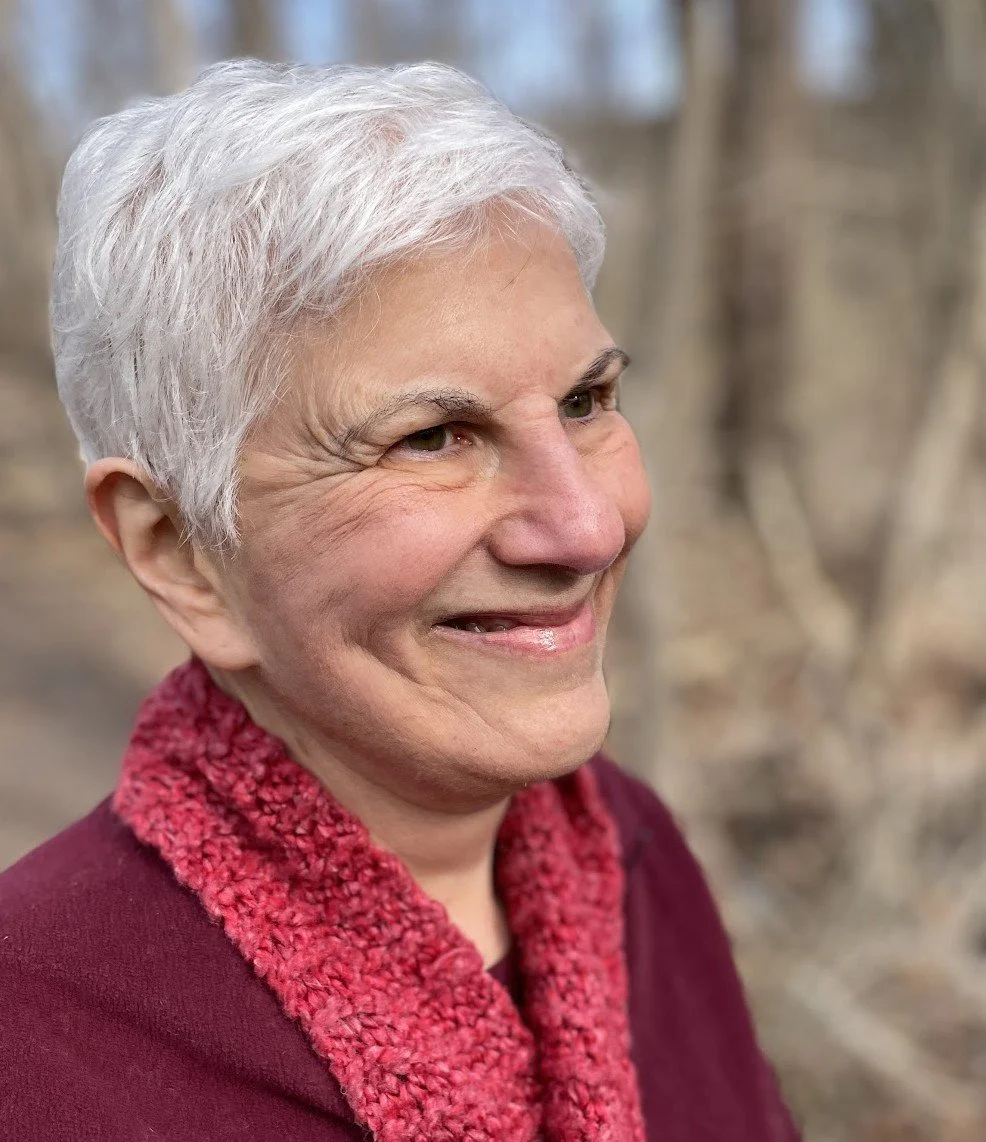
E. C. Salibian is a non-fiction writer whose work has appeared in The Sun, Fourth Genre, Cutleaf Journal, Los Angeles Review of Books and other publications. She is at work on a memoir in essays about her Armenian family. Salibian lives in Rochester, New York.