
A Conversation with Four Ukrainian Female Soldier Poets
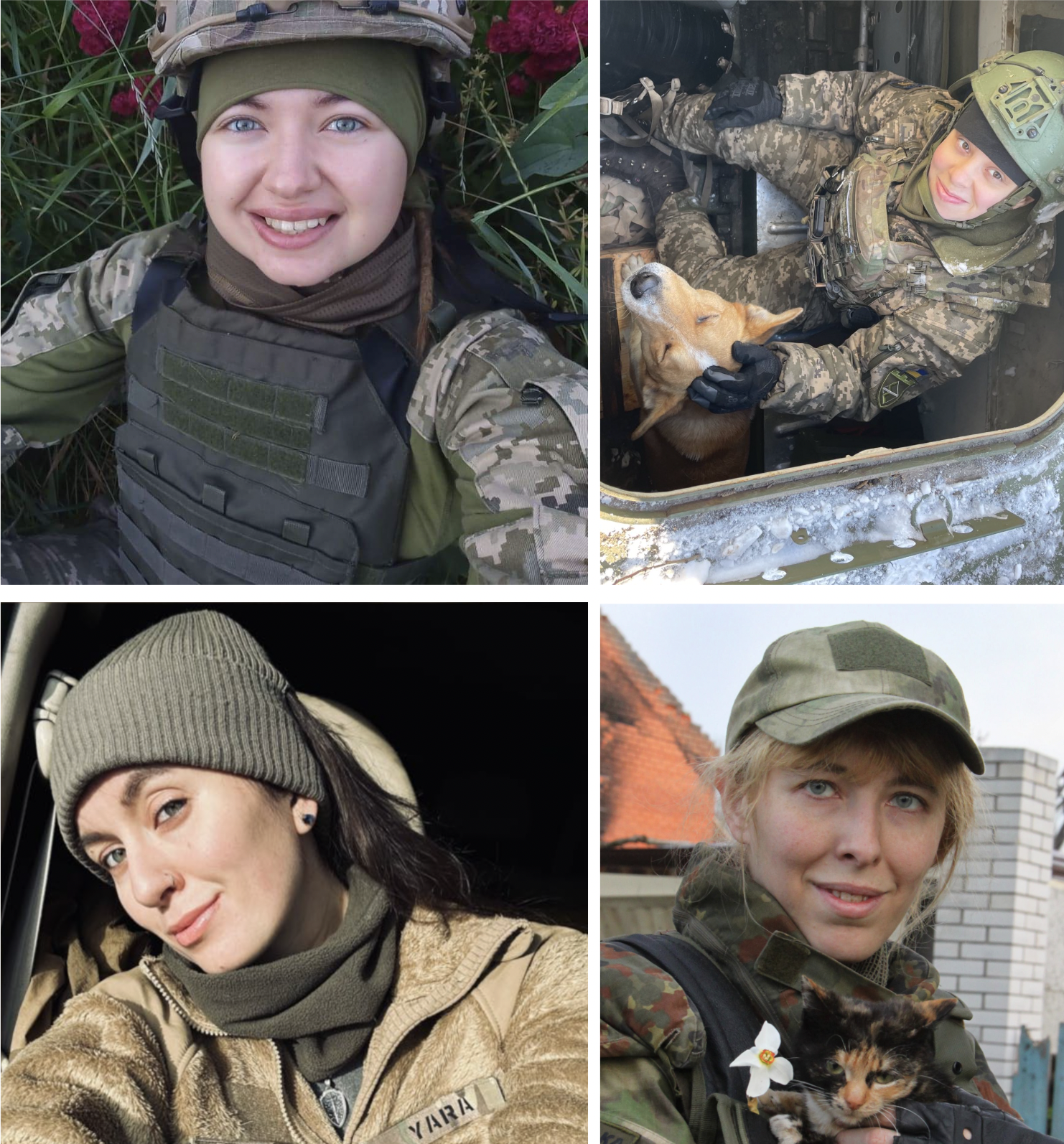
Iryna Bobyk, Liza Zharikova, Yaryna Chornohuz, Olena Bilozerska
“A woman in military uniform is a powerful symbol,” poet and soldier Yaryna Chornohuz declares, “but not everyone is prepared to see us as subjects.” Her six years of service in the Ukrainian armed forces —first as a volunteer combat medic and now as a strike drone operator—have placed her on the front lines of Russia’s illegal invasion. In social media and in newspaper editorials, Chornohuz regularly shares her military experience, her daily life on the front lines, and her thoughts on women in combat. In this way, Chornohuz has become a spokesperson for women in the Ukrainian military. But the key to her art and activism is understanding that female soldiers in Ukraine have identities beyond archetypes. They have joined the military for different reasons, at different times, and speak with their own voices.
More than seventy thousand women soldiers currently defend Ukraine against Russia’s full-scale invasion, with over 5,500 female military personnel serving on the front lines. While Ukrainian men between the ages of twenty-five and sixty can be drafted into the armed force, women are exempt. Consequently, those Ukrainian women serving in the military are willing and highly motivated volunteers. And, as Ukraine enters the fifth year of war with troops in short supply, women soldiers are sought after more than ever.
The full-scale invasion has forced a seachange in the Ukrainian military—breaking down enduring sexist stereotypes, increasing the visibility of women in the ranks, and opening up new roles for female soldiers. Women in the armed forces now serve as fighter pilots, artillery commanders, snipers, combat medics, drivers, and drone operators. Perhaps the most inspiring example of these changes is Ukraine’s first-ever all-female drone interception team, which began operating on the front lines in November 2025.
“It is gratifying to see how attitudes toward women in the military have shifted during these years of full-scale war,” writes Chornohuz in a 2026 editorial, “Many of my sisters-in-arms, now veterans, have fought their way into combat positions and direct participation in combat operations—including as infantry soldiers and assault troops—have risen to command positions and senior ranks.” Reflecting on her service in the armed forces, Chornohuz hails the progress that women soldiers have achieved during the full-scale invasion, yet she laments that outmoded gender stereotypes and prejudices regarding women in the military persist. Too often, she claims, Ukraine’s military, media, and popular culture portray women soldiers as “silent” and “dehumanized” “symbols of resistance” rather than as fully realized agents:
A subject is a living person with her own will, motivation, actions, aspirations, and goals. She changes. She is sometimes imperfect. She carries trauma and has her triggers. But she moves forward, and she holds the right to movement, growth, and unconditional respect for her choices and her acts in defense of the state.
“A subject has a voice,” Chornohuz concludes, “and she uses it.” Here, then, are the full-throated voices of four poets who have made their diverse experiences and intersecting identities—as women, as soldiers, as Ukrainian citizens, and as artists—the subject of their verse. In the trenches and on the page, they fight with weapons and words to defend the soul of Ukraine. No shining symbols, they are real soldiers telling the muddy, bloody exhausting truth about war.
The text below has been abridged and edited for clarity.
I would like to hear, in your own words, your biography as an artist. How do you see yourself having grown since you began writing?
YARYNA CHORNOHUZ
The thing is, I am from a family of writers. My grandfather [Oleg Chornohuz, 1936-2022] was quite a famous Soviet writer—Ukrainian writer—but he wrote humor novels in Soviet time[s]. And my father [Yaroslav Chornohuz, 1963-2026] is also a poet, but he’s a poet for his generation or just for a small group of people.
I started writing when I was seven, eight years, but, of course, it was naïve things. I started writing more seriously after 2014. I was a student at the National University of Kyiv-Mohyla Academy and a social activist who took part in different social campaigns against pro-Russian initiatives. At the time, I wrote poems and some small novels. Some of my writings won awards in Ukrainian literature competitions.
My first book was published in 2020, and it was called How the War Circle Bends. In this first poetry book, there were poems from me as a civilian and from me as a volunteer and then military—poems from the front line and from my life in Kyiv and about living in a country at war. This book is about my understanding that Ukraine and its history exist in this war circle. So, it doesn’t matter if you’re a civilian or you’re a military [member]; it still touches you. That was my first book.
And the second, [dasein: in defence of presence], was published in 2023, and this is front line poems and poems that I wrote before the full-scale invasion when I was in my home base near the Black Sea and during our rotation before the full-scale invasion. These, I think, are very difficult for me to read.
IRYNA BOBYK
I think I inherited and adopted my passion for art from my father. Although he wasn’t an artist by profession—he was a miner and worked hard all his short life—he loved singing, painted well, and had a great love of literature, just like me.
As a child, I loved to read adventure literature (Jules Verne, Rafael Sabatini, Henry Rider Haggard, Edgar Rice Burroughs, Robert Ervin Howard, etc.). Also, I used to write fanfiction based on my favorite works. I did this because I didn’t have any characters I wanted to be like (I discovered J.K. Rowling, Ursula Le Guin, and others later in my teens), so I would invent this strong and interesting girl that I was not, introduce her into the plot, and make up stories in which she showed herself in all her glory.
Of course, these were very childish, naїve fanfics, but they were my first literary attempts. I started writing poetry in the first year of middle school. At first, these were congratulatory texts for my mother and other relatives, but later my teachers began involving me in children’s literary competitions actively. The prizes were often books, trips, or toys, and this was an additional motivation to write and improve my writing. I started writing poetry to express my feelings, and prose to write down my own stories at the age of sixteen, and I haven’t stopped ever since.
In 2017, an electronic collection of short stories The Artist was published (Strelbuks Publishing House).
In 2020, I won the Sashko Bilyi Prize for active pro-Ukrainian public activity and for the best works of fiction on patriotic themes.
In 2024, I published a collection of poetry and prose «Д’воїна» [D’voyna, which can be translated as To the Warrior or Of the Warrior Girl] was published by Bilka Publishing House.
I am currently working on my first novel, and I hope to soon publish another collection of poetry and prose, the working title of which is Sisters-in-Arms, Friends, Shadows.
LIZA ZHARIKOVA
I was born in eastern Ukraine and started writing in Russian. I also studied to be a pianist at the Sievierodonetsk College, then entered the music academy, but did not study there. I chose to major in Ukrainian philology. While studying at the Faculty of Philology, my worldview changed, due to the books I read on Ukrainian history. I gained access to a wider range of information, not just Russian propaganda, which dominated the East. And then I started writing in Ukrainian.
I didn’t show my first poems in Ukrainian to anyone because I didn’t think they were perfect. In these ten years, I feel that I have grown as a poet since my first attempts in Ukrainian. I don’t consider [my early] poems in Russian in my creative biography now; they are more teenage practices of writing.
OLENA BILOZERSKA
I have been writing all my life, ever since I can remember. When I was a child, I was writing naïve and childish poetry, but I think it still was poetry. I believe I have this skill inherited from my family members: my father and my grandpa were also poets and were writing quite good poems. I also used to write in Russian, as I am from the capital, Kyiv. But since I was twenty, I wrote predominantly in Ukrainian, and now I write only in Ukrainian.
I sometimes post my poetry on Facebook, and many people comment, like, and share my poetry. And one reader commented, “How can you write such good poetry if you aren’t even a poet?” And that made me think, “What makes somebody a poet?” Probably, in the opinion of this person who left the comment, it was somebody who is a part of some literary communities, attends festivals, has published books and collections of poetry. And I don’t have any of that. I just have been writing poetry all my life without making it very much public and very much available to readers and very much my job.
What is your creative process, and how has it been affected by your military service? For example, when and how do you write? How much time to devote to revision?
IRYNA BOBYK
Since I am now a civilian, I can compare how I wrote in the army and after I was discharged. During my service, I wrote short stories of about a thousand words. And poems. Mostly I wrote poems because they require maximum emotion and minimum concentration: you feel something acute (pain, fear, loneliness, etc.) or you come across an interesting story—the first few lines come to mind—then you need to find some time to concentrate and finish writing—then go back and edit for a few days. And then it’s done. But the most important thing is the therapeutic effect of this process. The emotion doesn’t bother me from the inside; it’s written down in a poem. It makes me feel better.
Writing during the war weaned me off writing on paper. Now it’s only on my smartphone. After writing something, I immediately uploaded it to cloud storage as soon as I had access to the internet. I developed this useful habit after the first loss of my belongings, and it has saved my poems many times.
As for the time to write, I always had it—breaks between combat missions, hospitals, moving, etc. War and combat operations were not my non-stop reality. It was much worse with the ability to concentrate when my head was full of current tasks, training, problems, and questions.
Since I became a civilian, I have had the luxury of writing longer prose—my new collection contains stories of five thousand words or more. I can now write, getting into the taste and painting every emotion of the characters, contemplating and reflecting with them. My emotions have become dulled; I am no longer the naked nerve I used to be in the service. And this cannot but affect my work. For example, here are the inner reflections of Myrka, a character in the collection Sisters-in-Arms, Friends, Shadows, which I wrote after I left the service:
Mirka clutched her head with her hands and focused on the scenery outside the window to distract herself. But it didn’t help much, the bossy voice was gaining strength:
“There is a war going on. You see what they have done to this blooming village. You will go to your place, but are you sure that the Russians will not crawl there, too? The shelling of civilians. You’ll give birth to a child, and they will die under the rockets. And if the child is crippled? Where will you get the money for treatment? And even if this does not happen, you see what is happening to the economy, what are the prices for everything? You hope for philanthropists and volunteers, but you have to keep this look in your eyes every time: ‘She got pregnant, got out of the army, and now she even wants something, you should have thought about it!’—Are you sure you can stand it?”
“I have friends, brothers- and sisters-in-arms, I will not be left alone.”
“That’s what you think. Everyone has their own problems and troubles. You are needed when you are tough and strong, when you help others, inspire them at least—and when you become weak and vulnerable, you are forgotten.”
And this is what Meva, a character in the story “The Lucky One” (from the collection D’voyna), wrote at the front:
“The soldier was not wearing a helmet or a buff, so Meva could clearly see that he had dark short hair and a round, angry face. Before that, she had talked to a friend, and she expressed doubt whether Meva could shoot a person when she looked him in the face. As it turned out, she could. This did not cause her any feelings, except for the desire to do her job well. “If he had not come to my land, he would have been alive. He came and got a bullet,” the woman shrugged.
OLENA BILOZERSKA
In order to write poetry, you have to find yourself in a state of tranquility and peace. It’s hard to write when you are in a trench or when you are under shelling. So, of course, with me, writing poetry doesn’t happen very frequently because it is rare that I can find myself in this state of peace.
There was one exception when I wrote a poem coming back from a reconnaissance operation, and I wrote it literally on the go while working. But I had a fever at the time, and it was rather an exception than a rule. Usually, I do not write in trenches or specifically during my service like some poets might do because I think writing poetry requires a lot of self-awareness and also self-isolation when you are isolated only with your inner thoughts, and it’s quite impossible to find yourself confined in the trench because you should always mind the incoming and what’s going on around you. So, mostly, military service prevents my writing.
During the full-scale invasion, new themes for poetry appeared, and, of course, the main theme is the full-scale invasion itself and those experiences that happened during the war. I don’t want to use the word inspiration because in my mind the words inspiration and war don’t really match—but I think we can see that to some extent, war has become maybe a push to these new themes and new topics in poetry. But even when I write about the war, I don’t do it when I am at war. Mostly this is for safety reasons.
YARYNA CHORNOHUZ
I write, I would say, quite regularly, and I am writing only when I have something to say. Sometimes I have a feeling I call sharp truths—a sharp understanding of something. I feel that I have to sit and write that. We can call it inspiration, maybe, but, in fact, it’s when you feel that there are lots of things in yourself, and you feel this sharp understanding of something, and you have to say it. And that’s how all my poems are created. I can write one poem a month. It’s almost four years that I’ve been in the army, and I don’t know how many—maybe forty or fifty poems.
LIZA ZHARIKOVA
Before I joined the army, I did set aside some time for this. Especially when I was trying to write prose, and I also worked with poems at certain hours. Mostly, it was when I was getting to work, I could rewrite several times in my phone. I almost never post my poems immediately after writing them; they need to sit and take on some kind of coherent form. That’s why I rewrite them several times whenever an idea comes to me. I posted only some poems as soon as they were written, because it was more like living with an emotion than cultivating my literary skills.
BRENT
Where do you publish them?
LIZA
I post them on Facebook, Instagram, and Telegram as I’m creating them because my younger colleagues tell me that’s where they read them.
BRENT
Do you write even when you are at war, during your service?
LIZA
It depends on the combat position itself. If it is directly on the contact line, we don’t take phones there, mostly. It’s certainly not the place for poetry, and you can’t hide there and not give away your presence. If it’s a duty as a medic at an evacuation point, it’s ninety percent waiting and ten percent work on days without hot fighting. When it’s important to stay awake and listen to the radio, rewriting a poem several times until it becomes a good poem is good practice to keep your concentration.
Many of the poets I have spoken to—including Tetiana Vlasova, Lyuba Yakimchuk, and Mykola Antoshchak—said that, when the full-scale invasion began (on 24 February 2022), they could not write a single word for several days or weeks or months. As an artist, what effect does fear or trauma have on art and the ability to create art?
YARYNA CHORNOHUZ
Yes, I’m not sure that any one of us could write at that time. But after three months of the first hard battles, the poetry and writing were the things that helped you to get out of fear.
For me, it’s like a meditation when I write about difficult truths and about my difficult experience in the war as a combat medic, as a military member, and just as a Ukrainian. It gives me courage. I don’t know, maybe this is my option as a soldier, because when you’re soldier in the war, you have to find motivation all the time; you have to find your practices of meditation to calm yourself down. And, so, poetry helps me. Fear is not, for me, very important.
IRYNA BOBYK
Fear is an extremely powerful and, thus, fruitful emotion. It is with the help of art that you can get rid of it to start acting effectively. I have a poem I wrote before my first serious combat mission. I was young and inexperienced at the time, and I was scared:
Поспи, моя пані, бо завтра бій,
Жорстокий, безжальний, а значить — твій.
Поспи, моя пані, ще маєш час,
Перед тим, як заснути, молись за нас.
Перед тим, як заснути, молись до богів,
Хай помножать у серці хоробрість і гнів,
Бо твої то боги, тож замов їм слівце,
Вони теж воювали — все знають про це.
Їхній подих я чую на своїм плечі:
«То стріляють по тóбі, та ти не кричи. Відповзай за горбок і так само стріляй,
Це усе, що ти можеш, на щастя й на жаль.
Ми тебе вбережемо від мін і арти,
Тож усе, що ти мусиш, — стріляти й повзти».
I wrote this poem to try to calm down and sleep before that task. It helped.
LIZA ZHARIKOVA
For me, it depends on how far away from the war I am. When it started in eastern Ukraine in 2014, I had a moment of stupor and inability to write. I felt guilty that I was not directly defending my home region. This really happened for a while. When the full-scale invasion began, I wrote some poems even during the Kyiv defense operation, but they were completely different poems. They were more pretentious, which is not typical for the circle of poets I communicate with. They were not straightforward; they were so sublime, full of rage, confidence. This is what I lacked as a person, and I tried to compensate for it in my poetry. In my poems, I tried to be really confident and express the faith that we will defeat the Russians and prevent them from taking over Kyiv. At that moment, writing poetry felt like a natural response for me.
Only later, when I learned about the crimes of the occupiers in the liberated Kyiv region—such as Bucha, Chernihiv region, Yahidne, and so on—I paused for several months. It’s probably easier for me to be closer to the war and write about my experiences than to just sit and watch the news and not be able to do anything about it; I can’t write about it from a distance.
OLENA BILOZERSKA
The full-scale invasion wasn’t shocking or frightening for me because I have been on her front line since 2014. I expected the full-scale invasion, and I had been preparing myself. I thought that a full-scale invasion would be a natural continuation of what started in 2014. For my creative work, it had quite a beneficial effect. I have written much more than in 2014, and I also believe that my poetry of 2024 is of better quality than ten years ago.
When I spoke with poets Halyna Kruk and Yulia Musakovska, they both said that the full-scale invasion had compelled them to write harsher, more direct, more immediate verse that didn’t rely on traditional poetics of imagery and metaphor. How has the full-scale invasion affected your poetry?
YARYNA CHORNOHUZ
This is absolutely true. I even have a poem about metaphors dying, that only pain can tell the truth. These metaphors or tropes become eliminated. But I would say difficult intellectual metaphors could explain this experience somehow. Like in my poetry, sometimes if I use a parallel or metaphor, I use something like poppy flower, for example, because in Ukraine this poppy flower is considered as the blood of soldiers, which is left on the field after battle. But it’s difficult to use that and not to make it naïve. So, it should be very natural.
Poetry in wartime is a small text that uncovers very difficult truths that you cannot explain in another way. You cannot explain it with a documentary, with just prose text, just ordinary text. Only a small poem can explain some very difficult things, some difficult reflections about our time and about wartime. All the headings of my poems, they are in—I don’t know how to say that.
BRENT
Brackets.
YARYNA
Brackets, right. So, brackets everywhere. It means that this is a text written in times when your life is taken into brackets—like we can have a parallel with maths. In maths, these brackets mean including, like when you have near a number these brackets, it means including this number as well. So, I’m saying that because just to explain that it was hard for me when I choose heading to my poetry to write all in capital letters. I understood just to give a name to my poetry, I have to find something that will show that my life is taken into measures, into brackets. This is about metaphors and these things.
LIZA ZHARIKOVA
I don’t avoid metaphors in my work. Many of the poets who are now at war tell me that those who write during the war and have not changed their writing style have no heart. Perhaps I am one of those who has no heart because metaphors have not disappeared from my poems. I used to avoid metaphors related to the experience of the war, which has been going on for ten years, and I started publishing my poems. I stopped being ashamed of my Ukrainian language and published my poetry. I have been avoiding such metaphors for a long time—e.g., bomb, grenade, dead body—everything related to war. In our reality, this is not a metaphor. To write a different metaphor related to life, to bring together some concepts from different spheres and see some artistic detail is still okay for me. I don’t consider it a sin against reality, and that’s why I still use metaphors.
IRYNA BOBYK
It’s hard to say, because for me, the beginning of the full-scale invasion was not the point that divided the world into “before” and “after.” Like many other Ukrainians, I saw it coming and had no illusions about Russia. This war between Russia and Ukraine started in 2014, and I joined the Ukrainian Armed Forces in 2019. In the unit, we were preparing, and we were ready in the morning of 24 February 2022. The officer on duty woke us up, we got ready and went to perform our tasks. After the full-scale invasion, life became more concentrated—more losses, more pain, more work.
But my poetry, in my own opinion, did not change dramatically. Only fairly smooth changes associated with growing up and gaining experience. The general mood of my work, both poetic and prose, has changed: my “pre-army” works are more melancholic, and those written during and after my service are mostly thirstier for life; they are full of a desire to fight and not give up. But at the same time, the sadness, which, of course, is present in my work, has become deeper and blacker. Such changes are associated with changes in my personality caused by war, hostilities, and military service. I have grown up.
Obviously, the perspective of artists who are serving on the front lines is invaluable, as they can talk about the war first-hand. However, Dr. Taras Pastukh, a professor of literature at Ivan Franko National University who has written many articles about contemporary Ukrainian war poetry, told me that some literary critics adhere to the adage that “you cannot make soup when you are sitting inside the pot.” What is your own thought on the perspective of the artist to their subject matter? Can a person be too close to the war to write about it clearly and effectively?
OLENA BILOZERSKA
I partially agree with what Taras Pastukh has said because when you are at war for a long time, when you are “professional” soldier, you don’t have the same sensitivity towards war. You are less sensitive and therefore less capable of capturing feelings, emotions, reflections, and whatever influence war has on you, you become insensitive at some point. So, it’s harder to write really powerful things when you are not sensitive towards them anymore.
IRYNA BOBYK
I sincerely respect Professor Pastukh; he was one of my favorite teachers when I was a student. I can agree that when you are “out of the pot,” you see a more holistic picture of what you were involved in. But many details, subtle nuances are already escaping me, so I’m glad I wrote down what I could in the process. It would have been ideal to keep a diary, and I even tried it once—but it was lost, and I no longer had the self-discipline (as well as the time and internal resources) to start doing it again.
Do you think that there’s more emphasis placed on, or interest in, poets who are on the front lines?
YARYNA CHORNOHUZ
Yes, there is more interest in us because we are writing about an experience that is very unique. A good number of my poems are written from when I was in my military post or about feelings that I had there. When I read one of my poems at an event, other poets said they could feel this atmosphere of being there in the trench. So, yes, of course, our poetry’s very different.
But my friends who are civilian poets also found some parallels in my poetry and their poetry where we feel the same, despite the fact that I am military and they are civilians, so some things are felt in the same way. Kateryna Mikhalitsyna is a Ukrainian poet from Lviv. She’s my friend, and she’s writing for kids, and she had a poem about when war makes you feel very small and like you are the small catcher of the shrapnel—something like that. And when you are a soldier, you also feel yourself like this in another meaning. You are like a conveyor.
One of my readers who is very educated in modern literature told me that my book is unique because it gives her an understanding of what you are feeling when you are in the military for years, when you are losing your friends, and when you live day by day in the measure of death and the risk of death. So, she said that my poetry gave her a very physical understanding of this experience. We are the medium between military people and civilian people who also experience the war, but differently.
OLENA BILOZERSKA
Probably the best writers—not in terms of their talent, but in terms of the right level of this sensitivity towards war—are people who have been there a short time, such as a soldier who has been wounded quite soon after he began serving, so he didn’t spend a year or even six months in the war. It also could be some volunteer who spends twenty-four hours with the soldiers. Or a civilian person who accidentally became a victim of shelling or a wife of a military man.
Another option is just to write about the war—again, not in the trenches but when some time passes and you get to reflect on your experiences, then the writing will probably be better and more objective. And another reason why personnel on the front lines don’t write very often is that they’re mostly very busy and don’t have time for poetry or for journaling.
On the front line, you’re busy, you must risk your life, you must help your comrades, you must sleep. [laughs] Acceptable to sleep a little bit. So, you do not have time, you don’t have internal resources for writing. But when a little time passes, you are able to write poetry again.
IRYNA BOBYK
I’m going to say something very cynical: the more tragic your death was, or the more difficult things happened to you, the greater the interest society has in your work.
Ukraine’s Ministry of Culture and Information Policy operates a “Poetry of the Free” website that invites ordinary Ukrainians to upload and share their poetry about the war. Currently, over 4,000 poems have been uploaded to this website. What do you think about poetry as an emotional outlet, as a form of group therapy? Do you see your own poetry as an emotional outlet or as a record of events? Or is it both?
LIZA ZHARIKOVA
Yes, for sure. Personally, my poetry helps me deal with difficulties in life not only during the war, but also even before. It especially helped me read poetry in the moments of personal crises related to the illness of my relatives, and I always had a book with me back then. One time it was a book by Halyna Kruk. I read her poetry, and it helped me recover and stay strong. During the war, people write a lot of social media posts, and some write poetry because they are looking for an emotional outlet. It is much better to write not very good poetry on a civilian poetry site than to spread Russian propaganda and decadent sentiments about demoralization without analyzing the real problem.
So, let people write poetry, and let it help them feel better, and maybe some of those thousands of poets will have a desire to bring it to some quality level. Why not? A greater quantity of texts means greater quality texts in the future.
IRYNA BOBYK
Literary work is a way for me to pour out, comprehend, reflect on my emotions, relive some stories. I’m very glad that many other Ukrainians get emotional relief in such a constructive way. Yes, of course, a large proportion of those poems are not very professionally written. They can be perceived as verbal noise, valuable only for their therapeutic effect for the author (I’m not counting outright graphomaniacs), but at the same time they are a powerful source for studying the impact of war on the inner world of many people. I also think that some beginning authors will be motivated to develop and improve further if they realize that they have readers.
YARYNA CHORNOHUZ
It is [an] emotional outlet and reflection, I would say. The writing of my poetry as a soldier of a reconnaissance unit—there are also locations. For example, one of my poems is called “Siverskyi Donets” [«Сіверський Донець»]. This is the name of the river, which was a front line in Luhansk region and a little bit in Donetsk region. For a very long time, it was the front line in the time of this hybrid “half-war” or before the full-scale invasion and also it is [the] front line right now, but in different directions. So, my unit and my company—my platoon—we spend lots of time in the grey zone near that river, and I wrote a poem about that river, “Siverskyi Donets.”
Yes, there are emotions of the military whose comrades are being killed and have to deal with this loss. So, in my poetry book, I think how to survive loss, how to live with loss, how to live when you are alive and your comrades are not—this [is] the thing from which emotions emerge. This loss and to live with it.
Many of your Ukrainian poet colleagues have responded to the war publicly and regularly through social media. What value have you found in social media in terms of connecting with your readers and with your community of poets?
LIZA ZHARIKOVA
Especially when I can’t participate in any literary events because of my military service, social networks help me maintain social connections and not feel cut off from my previous civilian life, which is often the case with my fellow soldiers. Maybe I’m luckier than they are in this regard. While they are without the previous social circle at work, in the wide family circle with their loved ones, they feel lonely, so thrown out of reality, unnecessary to anyone except for this hard military service. I feel in a circle of like-minded people thanks to social networks.
OLENA BILOZERSKA
Definitely, there is a tremendous value for any artist in social media. Before, especially in Ukraine, to be renowned as a writer or poet, you had to have a printed, published version of your poetry collection. And that’s quite a humiliating process to find a publisher, to receive recognition for your work. With social media, you don’t have to humble yourself, and you don’t need to have a mediator anymore, such as a publishing house or literary agent; you don’t have to have a mediator between you and your audience. You speak directly to your audience through social media, and I have been using social media to promote my works.
IRYNA BOBYK
Social media is a powerful tool for interacting with readers. It would be foolish for me to ignore it, especially in these conditions that make it impossible to travel to festivals, offline book presentations, etc.—i.e., the conditions of service in the army and participation in combat operations. That’s why I post poems, prose excerpts, and some reflections, and I’m grateful to readers for their feedback, discussions, and support. I love and appreciate my audience very much.
YARYNA CHORNOHUZ
Social media is very useful, of course. I found readers there, and it’s also a connection for me with other poets. As a poet, and as any artist in our time, and especially when you are a military poet, you have a big responsibility in society. I am also writing about other things, not [just] poems. Some people regard me not as a poet, but as an opinion maker or something like that. So, I’m writing my thoughts about different things. And, for me, it’s like rehabilitation because when you are in the army, you just have all the same people, and we’re not talking about our emotions with each other, of course. And you can just write it to the people on social media, and you feel that you are listened to by someone, you are heard by someone. So, it’s also rehabilitation for me when I am writing something to the public.
As an artist, what do you perceive as your influence or your responsibility, particularly now in terms of the war? Do you feel a great responsibility to record the war for posterity, for future generations?
OLENA BILOZERSKA
Yes, of course. It was also one of my responsibilities as a journalist, and I started working as a journalist a long time ago in 2004. I have been covering many groundbreaking and important events, protests, basically everything that has been happening in Kyiv and other cities as well. And even back then, I already felt a tremendous responsibility to report history for future generations. And now, as an artist and poet, my responsibility is the same: to record what I see, to be a very objective and truthful witness to what’s going on, and to pass this information and this truth onto future generations.
You need to practice what you preach, so if you dare to write patriotic poetry, you have to take up arms and actually go to the war. I give you an example of some Soviet poet who was glorified as somebody who is writing about the Soviet victories and the great war with Nazi Germany, and they asked him, “Okay, you write such patriotic poems. Why don’t you go to the war yourself if you are such a patriot?” And he said, “I’m a poet, and poetry and words are my weapons.” I disagree with such a stand because if you dare to write about it, you should also have some nerve and courage to actually take up arms and actually do that. And I am very proud of living up to what I have been writing about for many years and actually showing an example to everybody and actually practicing what I preached in my poetry.
IRYNA BOBYK
I’m not a historian or a documentarian, at least not yet, and I don’t claim to be a global figure with my work. I just want to record what I saw and what I felt. And that’s a very small piece of a huge canvas of this war. It is the point of view of one young woman who felt obliged to defend her country. Perhaps in the future someone will read my works to learn more about the life and feelings of women who served and fought in the armed forces—this will be enough for me.
LIZA ZHARIKOVA
Our war is probably one of the most documented in the history of mankind. It is an online live war. We even see videos from the assault directly from the third assault brigade, from the Ukrainian Armed Forces. Therefore, I do not see any mission of documenting the events of the war and the practices of war—i.e., how the war is going on. I see more sense in listening to human stories, those who volunteered to fight for their country in different years, including 2022. These human stories are of great value because we are losing people, and we need to listen to how a person came to defend Ukraine, to risk their life for it, having previously been in some other realities and interests.
YARYNA CHORNOHUZ
I feel responsibility. But you know, as an artist and as a military member, it’s not possible to write every day. Every day, I am on duty, and it’s difficult to write. But I feel responsibility to preserve the memory of my comrades killed by Russians. I feel responsibility for those who are not with us. This is mainly why I am writing.
The history of the war will be written. We have many, many good historians, good sociologists, and good reporters in Ukraine who can record this war in facts. But for me, it’s most important to save memory, to save moments, to save emotions of me and my comrades who were killed very young in this war. And this book, my second poetry book, is dedicated to my five killed comrades. Three of them are officers, two of them are just soldiers. And I had hesitation about publishing my book because I believed it was not a time for books because we are still in these events in this war. But I understood that I can be killed like they were, and that’s why I decided that I will give it to the publisher just for memory. It was very difficult. This is a source of traumatic experience for me. It was very difficult to read from this book in my first presentations because it’s traumatic. I’m speaking again and again about very traumatic events for me. Sometimes I wanted to burn this book. I mean this literally. I hated it because this is a collection of very, very painful things for me. And still I had to do that in the name of memory because I don’t want my comrades to be just numbers in statistics. So that’s why I’m writing it.
When the war is over, what do you perceive your role will be?
IRYNA BOBYK
That’s an interesting question, thank you for asking. I have been thinking about it. The answer, of course, depends on how this war ends.
Option one: the war will be put to rest somehow, and Ukraine will return to peaceful life. And those who didn’t fight in the war will speak out, pushing veterans to the margins, and we will not have the strength and health to fully resist. I will continue to write, to popularize Ukrainian literature, while observing the new dominance of Russian culture.
Option two: Ukraine is occupied. In this case, I will have to emigrate, because ending my life in a Russian torture chamber is not in my plans, and I will not be able to join the partisan struggle because I have to take care of my family. Therefore, I will settle somewhere where there is a large enough Ukrainian diaspora and become like the poets of the Prague School.
I don’t like either of these options, but I’m not optimistic enough to seriously expect a complete collapse of Russia and a healthy, prosperous further development of Ukraine without this monstrosity of a country near me.
YARYNA CHORNOHUZ
First of all, I don’t believe this war will end very soon. Russia has waged war against us for centuries. And the Russian Empire, the Soviet Union, and the Russian Federation are just different types of the same empire that kills its neighbor nations and especially those nations that are in the matrix of their imperial ideology, as Ukraine is. That’s why our literature reflects these realities. The poetry of our famous artists—Taras Shevchenko, for example—is about truth. True art is always about very difficult truths—about, I would say, desperate truths. And our country lived for centuries in the reality of genocide. Despite the years of genocide perpetrated by Russia, Ukraine has created a very interesting and intellectual literature. Literature in Ukraine is the only thing that could save our spirit. We are lucky that we had in difficult times artists who were very well educated and who could say difficult, interesting things about these events. Literature is the thing that saved our nation.
Maybe if I have a chance, I’ll go on leave for my daughter. Yes, I’ll go on leave, and then I’ll return. So, I’m a civilian, then I’m again military, then again I’m civilian, and military, so like this. I’m planning that to the end of my life; I’ll be living with this Russian war, and I have to do my job. So, I don’t have a period after war. I understand I am very realistic and that I have to do this all my life. So, in these pauses when I will be back to civilian life, I will be a writer, I think. I am working right now on one more poetry book and also on a book of essays. Maybe one day I’ll write a novel about all these events, but everything is too fresh now. I need distance to write a good novel about this.
What would you want Americans—particularly young American university students—to know about Ukraine right now?
LIZA ZHARIKOVA
I would like them to know about the continuity of our struggle. Not only our poetry and music are passed down from generation to generation, but also our struggle for the right to speak our truth in Ukrainian. Russia has always suppressed any flourishing of Ukrainian culture. In the nineteenth-century Russian empire, it was decrees that declared that Ukrainian language wasn’t real and should never be used. Then it was the Red Terror, then executions for mere attempts to speak the Ukrainian language. In the 1960s-1980s, it was psychiatric hospitals and prisons, in which many artists ended up. Even then, artists still were being murdered, as happened, for example, to Alla Horska. In the 1990s-2000s, it was tons of money invested into Russian books, music, and media for Ukrainians. Now it’s bombs, bullets, and mines that are trying to take away our right to be ourselves, because if Ukrainian books are destroyed in the occupied territory in my native village, they are removed from libraries, especially modern ones that are not reinterpreted by the Soviet optics. The Russian canon took our classics and added a part of its canon that it was poor Ukrainians who fought against the rich (landlords, mainly of Polish origin). The Soviets distorted the image of Ukrainians in literature. That’s how briefly I would like this to be known about us, so that we can finally, for the first time in our history, with arms in our hands and a state, win back our right to be ourselves and write Ukrainian literature.
IRYNA BOBYK
That we are a country of fighters. We never give up—neither before an external enemy nor before internal problems, and we will always fight to live happily and prosperously.
I would also like Americans to read and think about the 1994 Budapest Memorandum. In short, after the collapse of the Soviet Union, Ukraine had nuclear weapons, which it agreed to give up in exchange for the recognition of its independence and guarantees of its security. The United States, the United Kingdom, and, ironically, Russia, acted as guarantors. But what do we see? Twenty years have passed, one of the countries that was supposed to guarantee our security is attacking us, while the rest are aiding us a drop at a time, calling us beggars and accusing us of ingratitude. We gave up our nuclear warheads voluntarily. Looking at what has happened to us, would any other country agree to get rid of its nuclear weapons, not to produce new ones, not to use the existing ones? Is this the world you want to live in?
OLENA BILOZERSKA
Ukraine is the only shield protecting the rest of the world from the wild horde and pure evil.
YARYNA CHORNOHUZ
I want them to understand the difference between us and Russians and not to believe that we are one culture. We never were one culture. I want Americans to understand that Ukrainian artists, writers, philosophers have been stolen by the Russian imperial narrative. Lots of our writers and artists are Ukrainians, but Russia says to the world that they are Russians. So, when you are reading about any Russian artist—or who is considered to be Russian—you should find if they are actually Ukrainian. Lots of them, like Kazimir Malevich and Nikolai Gogol, are Ukrainians. They are Ukrainians who had to survive in an empire that destroyed people who consider themselves something other than Russian.
Since I was a child, I had a feeling that my Ukrainian identity is under a big threat. All my family is from the center of Ukraine—from different regions—but from the center of Ukraine, and all my family is Ukrainian-speaking. It’s very important for our family. And I was the only child in my class who didn’t speak Russian on breaks. I was born in 1995, just four years after Ukraine became independent. And still I had to explain to my classmates and even adults, why do I speak Ukrainian all the time? Why do I speak Ukrainian on breaks? They said to me with irony, “You are such a true Ukrainian” because at that time in the 1990s—and even in the beginning of the 2020s—the Ukrainian language was associated with something rural or something that won’t make you a successful person. It’s this typical colonial narrative about Ukraine and the Ukrainian language. And I remember television was very pro-Russian when I was a child. So, at that time, Russia waged an information war against us. Yes, an information war, a language war, a culture war at the time. As a child, I felt that my identity was under threat, and if I wanted the language of my family to survive, I had to speak it. I have to do more.
Another important thing is supporting us because thanks to the U.S., we exist as nation. Thanks to our courage to sacrifice our lives, but also thanks to the free world who gave us weapons. So, it’s very important to support Ukraine politically, not to forget about the war because without help from other states, we’ll be destroyed.
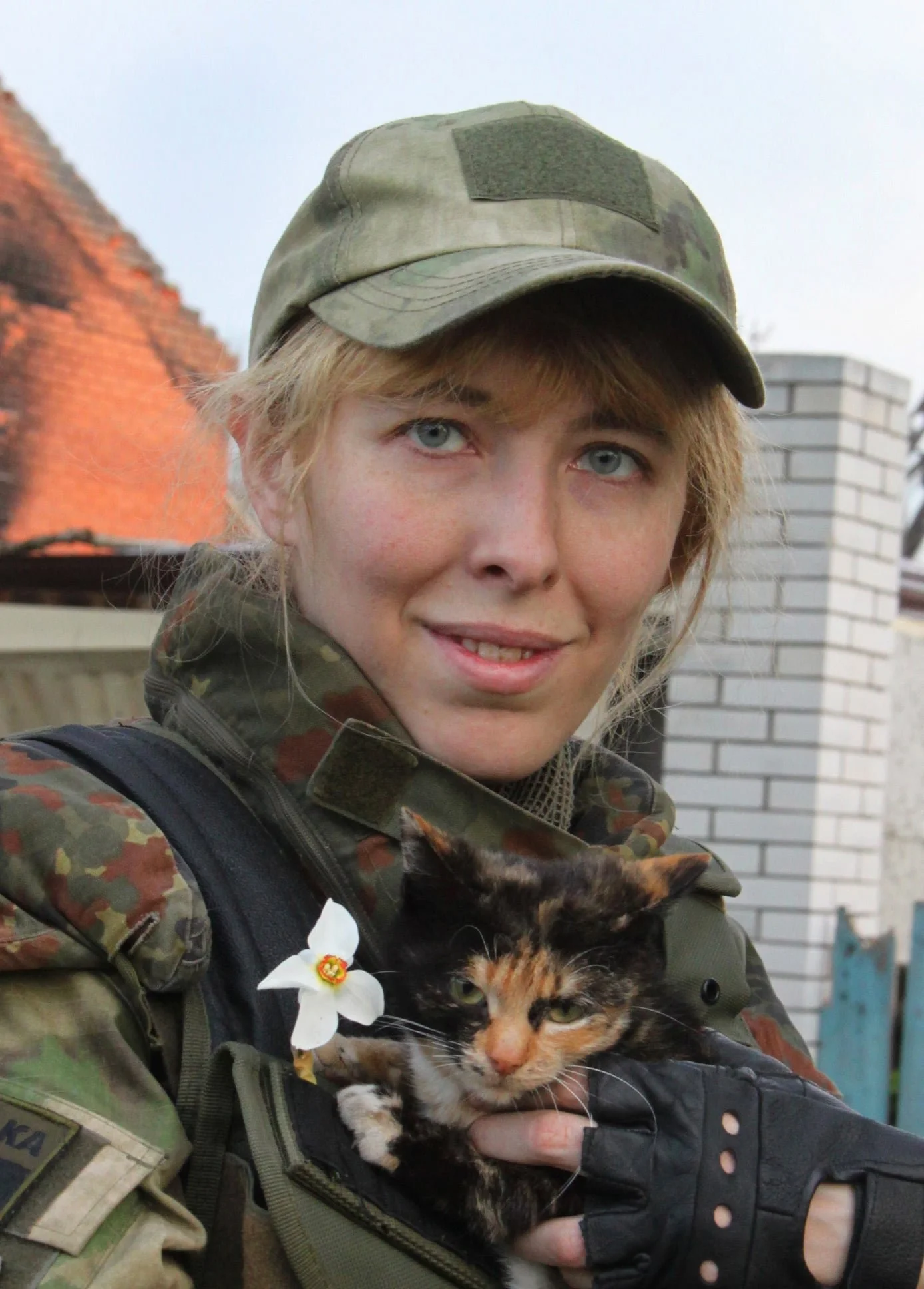
Poet, journalist, and social activist Olena Bilozerska / Олена Білозерська was born in Kyiv in 1979 and graduated from the Kyiv National University of Culture and Arts in 2000. She has been fighting Russian forces since 2014, first as a volunteer in the Right Sector and then in the Ukrainian Volunteer Army. Bilozerska enlisted in the Ukrainian military in 2018, where she served as senior lieutenant in the Marine Corps and commanded an artillery platoon for two years. Later, during the full-scale Russian invasion, she served as a sniper in one of the special forces units. Bilozerska’s lobbying efforts were instrumental in opening up combat positions to women, and she is featured prominently in the 2017 documentary Invisible Battalion, which profiles six women soldiers serving unofficially in combat before the policy change. In 2020, Bilozerska published Diary of an Illegal Soldier, a memoir of her military service during the early years of the Russo-Ukrainian war. In 2025, she gave birth to her long-awaited first child at the age of 46. Our conversation took place via Zoom on 12 May 2024 through interpreter Vira Hrabchuk.
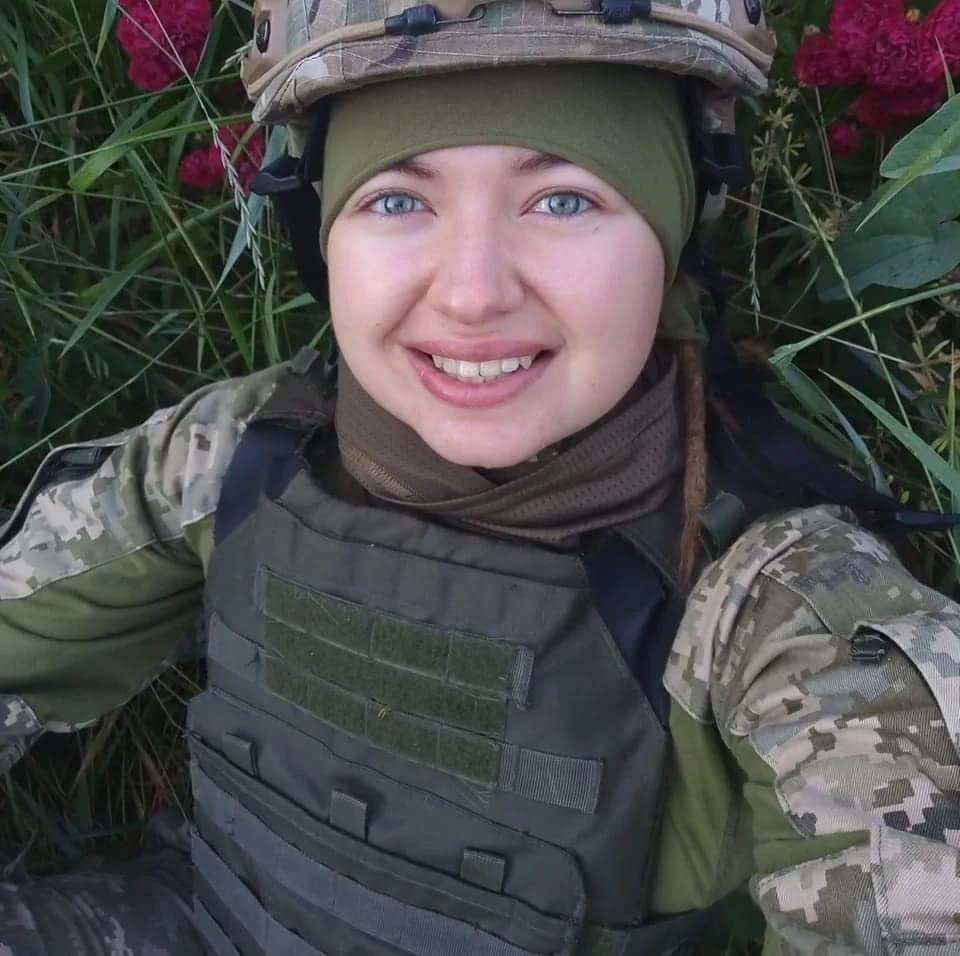
Poet Iryna Bobyk / Ірина Бобик grew up in the village of Ostriv in the Lviv region and studied at the Faculty of Philology at the Ivan Franko Lviv National University. In 2017, she volunteered as a combat medic, and in 2019 she formally enlisted in the armed forces. She fought in the battle for Kyiv during the early days of the full-scale invasion in 2022. Bobyk has spoken out publicly for women’s equality in the military, and she supports the mobilization of healthy women who meet the age requirement and who are not responsible for the care of children and sick or elderly relatives. Her most recent publication is her poetry collection «Д’воїна» (D’voyna) (2025). Bobyk replied to my interview questions via email on 18 May 2025, which were then translated by interpreter Vira Hrabchuk.
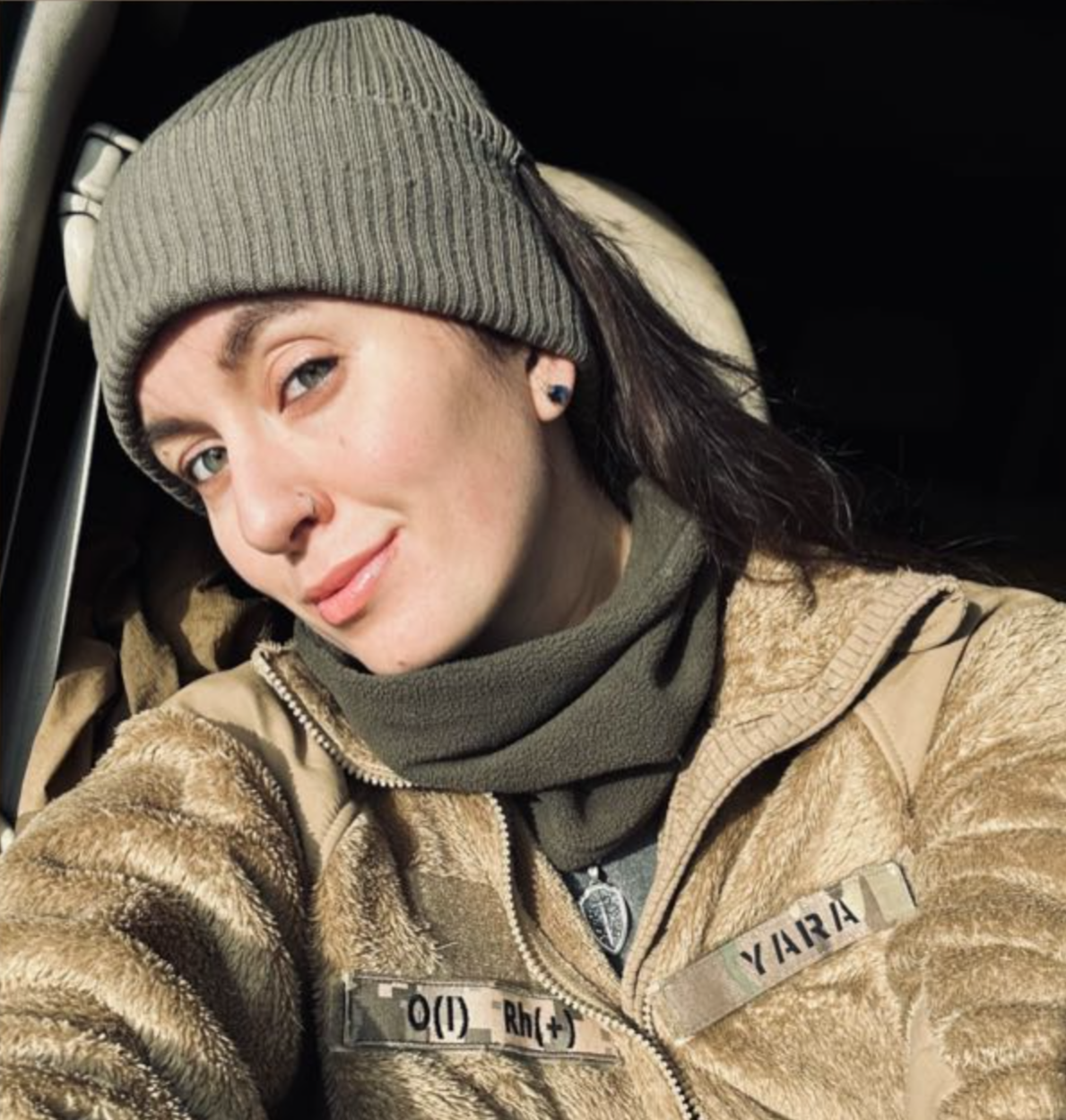
Poet and social activist Yaryna Chornohuz / Ярина Чорногуз was born in Kyiv in 1995 and earned a master’s degree from the Faculty of Humanities of the National University of Kyiv-Mohyla Academy. She participated in the Revolution of Dignity in 2014. Chornohuz has served in the Ukrainian armed forces since 2019, first as a volunteer combat medic on the front lines and now as a strike drone operator. She is the author of the poetry collections Як вигинається воєнне коло (How the War Circle Bends) (2020) and [dasein: defense of presence] (2023). In 2021, she was included in Focus Magazine’s list of 100 most influential women in Ukraine, and in 2024 she was the laureate of the Taras Shevchenko National Prize of Ukraine, the highest distinction for a Ukrainian writer. Our conversation took place via Zoom on 18 October 2023.
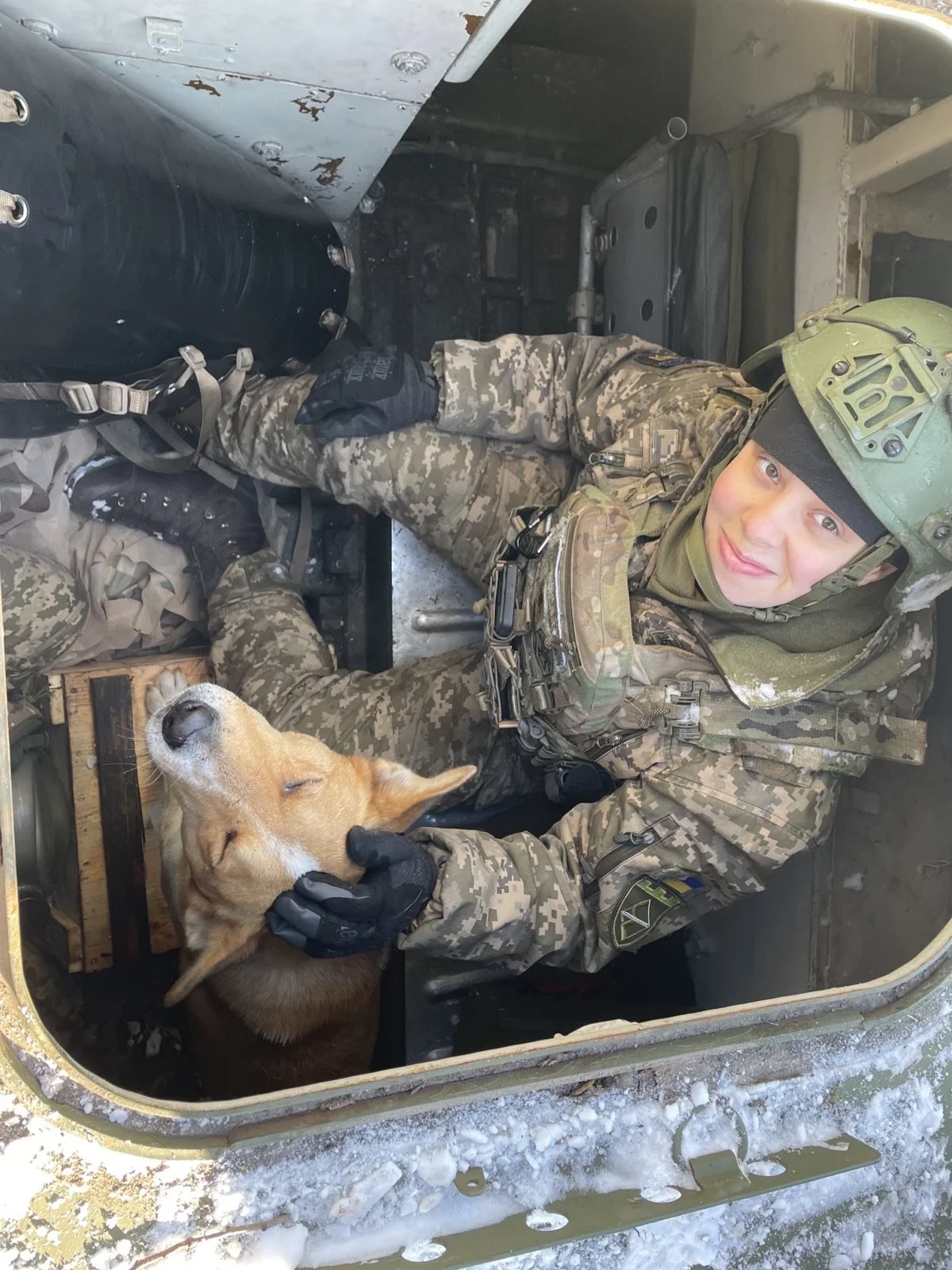
Poet and musician Yelyzaveta (Liza) Zharikova / Єлизавета Жарікова (born 1989) grew up in Luhansk Oblast and earned a master’s degree in Literary Creativity at Taras Shevchenko National University of Kyiv. An active participant in 2014’s Revolution of Dignity, Zharikova enlisted in the armed forces on the first day of Russia’s full-scale invasion and served as a combat medic. She is the author of two poetry collections, Ants of Johann Sebastian and Between Love and Love. Our conversation took place via Zoom on 15 May 2024 through interpreter Vira Hrabchuk.

Brent Shannon is a scholar of literature with thirty years of experience in higher education, most recently as an associate professor of English at Eastern Kentucky University. He is the author of The Cut of His Coat: Men, Dress, and Consumer Culture in Britain, 1860-1914 (Ohio UP, 2006) and has published extensively on British Victorian literature, masculinity, and material culture. In 2023, he began exploring Ukrainian poetry written in response to the full-scale invasion, and he has interviewed over fifty Ukrainian poets, publishers, academics, and military members. Brent currently teaches and writes live in Liverpool, United Kingdom, where he lives with his wife.