
Featured Poets: Mary O'Malley and Abbie McCabe
Mary O’Malley
Ireland's Mary O'Malley registers our singularly sinister moment through sly indirection. The legs of a statue of Artemis, goddess of the hunt, become a distorted reflection of Rilke's archaic torso of her twin, Apollo, as they stalk their prey because it is what hunters are trained to do. O'Malley's imagination can veer to the comic: a photon races on a motorcycle while space warps and the "quantum angel watches" in the confines of a collider. "Wolfman" explores Irish versions of a figure usually linked to 20th century Hollywood. A legend about a priest's encounter with a talking wolf is pointedly contrasted to the story of the Fianna warriors who wore wolf-skins into battle: a wolf /breaking into language is not the same /as a man reduced to a single note,/a killer able only to moan and howl. The sequence ends with a rebuke delivered by an otter who knows what's what far better than most humans. All delivered in O'Malley's sensuously rhythmic lines.
Askold Melnyczuk
THE LEGS
After a photograph by Don McCullin
The legs from the statue of Artemis
are strong, short and muscular,
a huntress cut off at the knees. The legs
still stalk the dark all-night houses
where people sign torn confessions
in triplicate. No need to put down woman,
Muslim, Trans or Jew, or say Dog Fox Field.
The huntress finds your graven sins
were all a plot to overthrow the state.
And here’s the trick – the legs care nothing
about your faith or sex. They do this
because it is what hunters are trained to do,
twist poems and songs into death warrants.
None of it, the dawn raid, the frozen child
the entrails of your life scattered on the floor
is new, except the body of the goddess, missing.
IDEA II
Say Einstein had a box full of light.
One small photon escaped, lit out
on his motorbike at full joyous throttle.
The whole of space curled around him.
As he ripped down the cosmos motorway,
sparks flew. Time stopped when he roared
through the crossroads, broke the lights.
Space loves him but even a photon has to grow up.
There is a small explosion as he wraps
around another particle. The quarks
and sparks are all excited. Behind the scenes,
the quantum angel watches. Without her
nothing happens. The angel’s eyes zoom in.
Now look at that, she says. A collider.
WOLFMAN
About the wolfmen, the stories differ.
In one, a saint. The saint is frightened
when a wolfman stands before him on the path.
The wolf breaks into Irish to ask the saint
for the holy viaticum for his dying wife.
When she dies in grace, he takes
her wolfskin off, tenderly as you would
a child’s coat. He touches her human face,
and her human body, shrunken, lined, old.
Other books talk only of warriors
who would not bow to the new priests,
men so fierce that when they howled
to frighten them each wore the skin
of the last wolf he killed, the man
entering the wolf’s body
releasing on his death the wolf’s heart
and in that story five thousand of them
died prostrate before their stone god.
Which tells us nothing except that a wolf
breaking into language is not the same
as a man reduced to a single note,
a killer only able only to moan and howl.
THE OTTER
I read. Well, I don’t but I could.
That saint, you know I saved
his holy book, right? Well
my ancestor did. The reward
was that every otter can read
human books. I’m not interested.
I get by with my charts, the marks
behind my eyes. My fur is alive
with necessary information.
I know which way the river flows
and where it meets the tide, and when.
You’re up to no good down here.
It’s toxic beside the fish farms.
Salmon with three fins and some fish
glow in the dark if they hang around
too long. Write that on your human skin.
Abbie McCabe
Winter is etched into the soil/of summer's underside, writes Abbie McCabe. Acknowledging the impermanence at the heart of Nature's narrative, the poet remains poised, content to score the inevitable without grief, yet with a heightened attentiveness: It ends/the same: I die/alone.//The birds/breathe. Out./I listen. In. Listening to the nuances and observing the myriad charms of the natural world, she notes: Spiders draw curtains/across the windowless frames of trees. Like O'Malley, McCabe chaperones a menagerie of animals with unusual gifts. The rabbits her speaker pursues are not the same as those Alice followed but they're not your garden variety Leporidae either: The rabbit reads//the end of/the first sentence/I follow him to/the pages cliff. Grounded as these poems are in the delights and bounty of earth, there's a visionary gleam in the poet's eye as she acknowledges the possibility of a listening Elsewhere, registering too imagination's potential in crisp, clipped and piercing lines: My feet don't touch/earth, don't tread on/clovers which lie still.
Askold Melnyczuk
[Vanitas
Winter,
once, a rabbit
stops upstairs
to talk a while.
I find my mouth
has sealed
in sleep.
Chickadees
collect outside
my neighbor’s house
to chatter over birdseed.
The whole street joins
the conversation.
The rabbit
leaves
his tracks
pressed gently in
my stomach. Flattened
snow mourns what air
he released. It ends
the same: I die
alone.
The birds
breathe. Out.
I listen. In.
Vanitas I
The hillside
is patched in clover,
embellished with
a single stone
bench. Its polished top
glows. Nobody needs
to sit. Most prefer to rest
laying down. I could
sit a while atop
the mound
and visit. The valley
seems empty of all
but wildflowers.
The shroud it’s draped in
is hemmed with daisies.
Passing birds skim
the long grasses.
Breath-taking things
all find the way uphill.
The path is clear
of old scratches.
My feet don’t touch
earth, don’t tread on
clovers which lie still.
Vanitas II
Spring dies
by night. Bright moons.
Perennials, ever
brighter beneath them.
Night collects
flowers from spring
gardens, casts them
off to elsewhere.
The sea
laps petals,
lays spring
a soft bed
to die in. Heaven
knows I’ll die
swaddled in jasmine.
Filaments of roots
will knit me a body
to rest in. Incarnate
in spring phantasms:
formlike dark.
Night’s language.
My jasmine grows
pink stains upon
unclosing. Spring
ends days before
their natural ends.
Night happens
with no requiem,
favoring instead
a quiet descent.
Wanting for song, we
lay unopened flowers
in their own beds.
Vanitas III
This afternoon is seasonably warm.
Dragonflies ride dragonflies into
daylight, wings sweeping the face of
the sun. Eric and his daughters
gather wildflowers. Ladybugs,
which I once knew as ladybirds,
venture off together, somewhere
more intimate. I’ve come around
to summer. Its lazy pulse settles
into mine. Spiders draw the curtains
across the paneless frames of trees.
Summer is too lovely to withstand,
nearly. The sun strains to hold me
and I turn over my daydream. How
sweet. I want David to wake me–
his hands at my arms, shoulders,
ribs. Sun rests its weight on Rachel,
Sophia, Taylor, Carrie. Ailinn.
They thin their bouquets to petals,
raining over my chest. My feet stir
about the air for ground
they have not breached. Oaks
slow the summer down, move
evening into position. The stars
iron my spine straight as a stem.
The night tastes faintly of violets.
Violets collect inside my mouth.
Amelia withdraws their petals and
my breath follows. I won’t
chase it down. This evening,
she can’t keep me from shivering
free of this body. Not now. Eyes
can’t see, if they are open,
how winter is etched in the turf
of summer’s underside. Night
contracts from evening into
winter. The earth amasses
every undead root and speaks,
I see, of elsewhere.
Vanitas IV
Worms commute
in tunnels cored
by old roots. A rabbit
wriggles, silent,
through soil,
eyes latched shut.
I hear his approach.
Eyeless, we
read the name
of winter, and all
the names beneath it.
The rabbit reads
the end of
the first sentence
I follow him to
the page’s cliff,
its fence illuminated
in flowers, wrapped
in sunny gilt. Our eyes
proceed upward
with the narrative
thread. We follow,
together, and read
the first sentence.
Vanitas]
Flowers crowd
down holes
the rabbits open.
Worms write dirt
new roots and stems
in the flowers’
language. A robin
hears. Listens.
His undereye
feathers, mottled
almost gray,
articulate like
worms moving.
Avian kin appear
to sing bouquets.
Bees appear
to brush up on
flowers, absorbing
brand new words
in pollen. They hum.
They warm up
their voices, which
will find them.

Mary O’Malley was born in Connemara, Ireland, and educated at University College Galway. She has published ten books of poetry. She has also worked on poetry translation from Irish, Spanish, Portuguese and Catalan. She writes for RTE Radio and broadcasts her work regularly. She lectures and teaches widely, in the U.S. and Europe, particularly in Paris and in various parts of Spain. Her most recent collection, ‘The Shark Nursery’ for which she won The Walcott Prize along with Teresa Lola, was published by Carcanet in Summer 2024. She is working on new poems and a collection of prose and translations from the Spanish poets Jiminez and Machado.
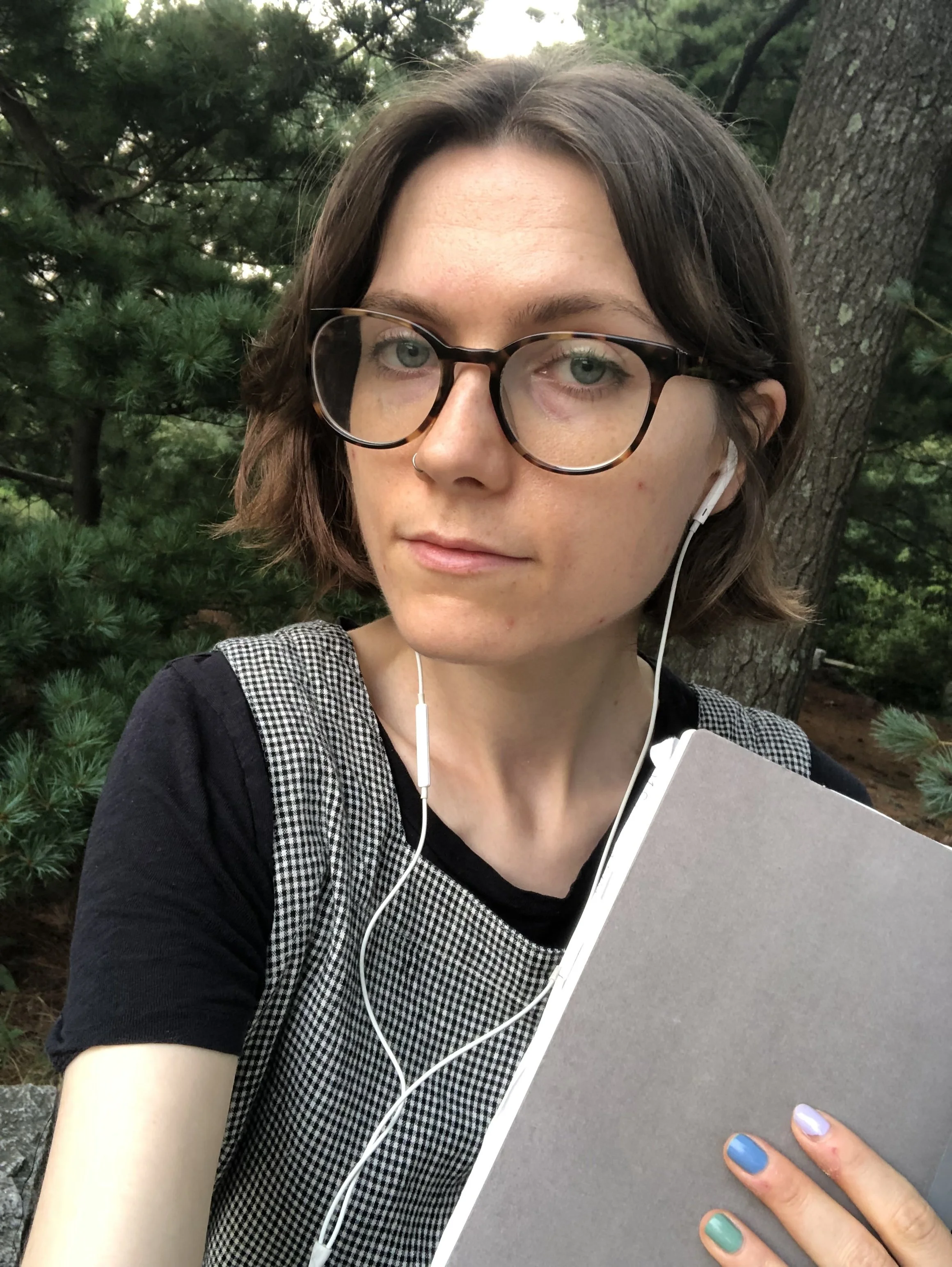
Abbie McCabe lives, writes, and teaches in Boston. Her work listens for the language of nature and the nature of language. Her poetry and translations can be found in Mantis, Quarter After Eight, Red Ogre Review, and elsewhere. She is an incoming Ph.D. student in English at the University of Notre Dame.