
In Defense of Language and Democracy: An Interview with Ellen Hinsey
September 24, 2026
One of the most knowledgeable experts on European democracy is neither a politician nor an academic. Ellen Hinsey is a poet. For more than three decades, she has researched and written extensively about Poland, Hungary, the Czech Republic, East Germany, and Russia as they emerged from the rubble of communist rule and struggled to re-establish or build constitutional governments. Her body of work—which includes six prize-winning poetry collections, a volume of essays on illiberalism, book-length dialogues on totalitarianism, and numerous reports for The New England Review as well as other publications—explores, among other themes, the ways in which autocratic regimes are assembled and dismantled, with insights gained through firsthand research.
Born in Boston, Massachusetts, Hinsey moved to Europe in 1987 and was present at the fall of the Berlin Wall, an event that ushered in new, fragile democracies in the former Eastern Bloc. She settled permanently in France, teaching and traveling by train to Central and Eastern Europe, dialoguing with constitutional scholars, historians, and civil society activists as well as with fellow poets such as the Lithuanian writer Tomas Venclova. In 2001, she attended trials at the International Criminal Court, and heard witness testimonies about atrocities in the former Yugoslavia. In 2012, she reported from Moscow on the decisive presidential election and its aftermath, the subsequent crackdown on civil society. She monitored the constitutional crisis in Poland and, most recently, observed the 2026 Hungarian parliamentary elections unfold in real time, which culminated in the end of Victor Orbán's illiberal government.
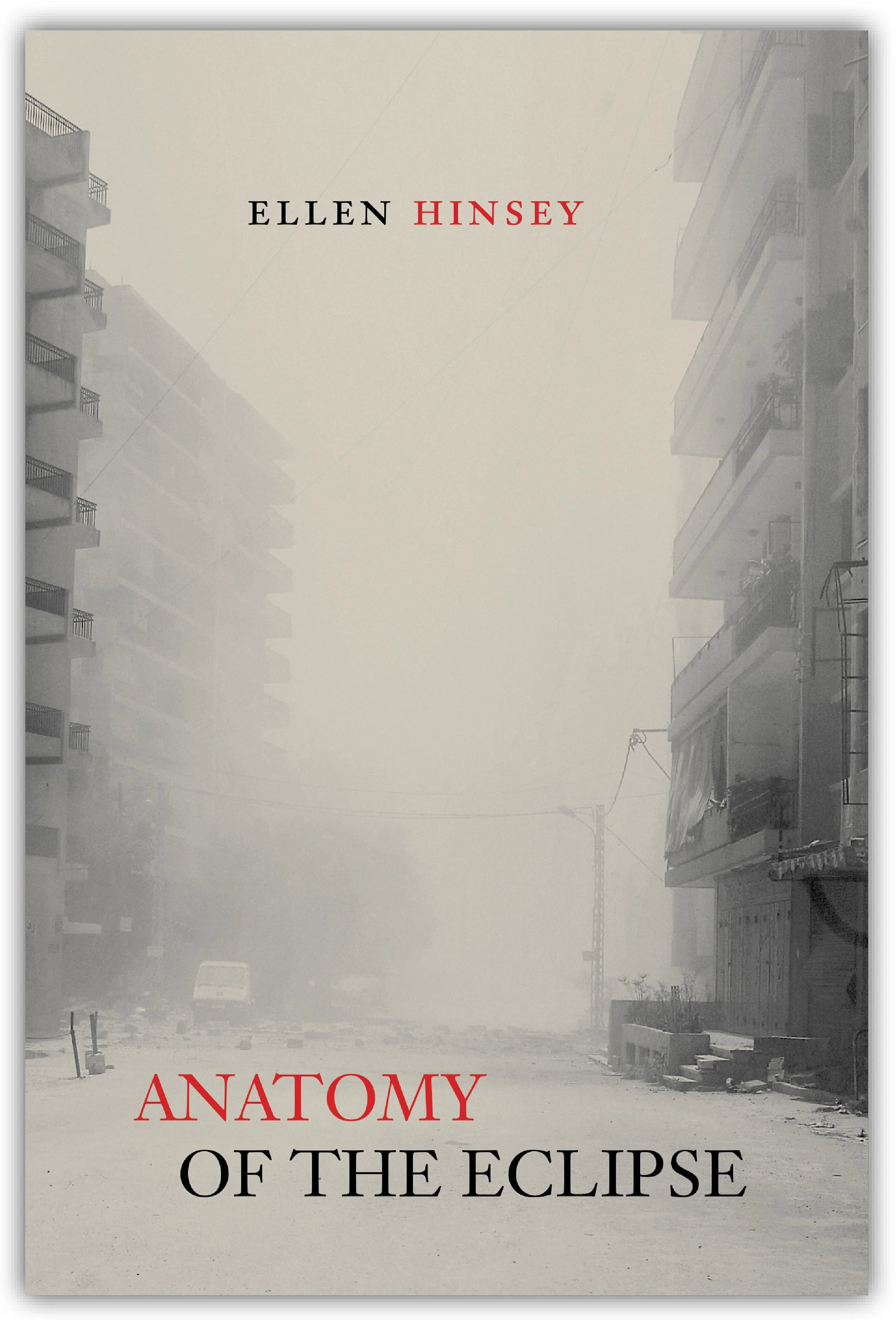
Hinsey's latest poetry collection, Anatomy of the Eclipse, is a continuation of her work and a warning about the persistent dangers of illiberalism and growing anti-democratic sentiment. While framed outside a specific time period, conflict, or context, her poems chronicle a world slipping into autocracy and political violence. “And so it all now returns: the detentions, the abductions –/ the unclear jurisdiction of truth.” Anatomy highlights just how easily peace can collapse into chaos, how quickly good neighbors can be turned against each other. While the breadth of Hinsey's poetic output also includes lyrical works on the contemplative life, in this volume she continues her project of what she calls "anti-lyrics." One of Hinsey’s strongest gifts is that of precision. She wields each word with devastating accuracy, hyper-aware of language’s ability to oppress through mendacious opacity or liberate through clarity.
I first met Ellen in early 2026 at a Parisian café in the eleventh arrondissement. On my way, I passed the green patina of the Bastille’s column, a monument that commemorates France’s revolutions and the onset of democracy. At the time of our interview, many European countries were threatened by “democratic backsliding.” In Hungary, then President Orbán had rewritten the constitution, consolidated power, and cracked down on the media. Similar strategies had been implemented by Poland’s Law and Justice Party from 2015-2023. The war in Ukraine was about to enter its fifth year, and abroad, President Trump continued to question the integrity of elections by challenging the results of the 2020 race and requesting state voter registration records. In short, there was much for Ellen Hinsey and I to discuss.
In the busy café over hot drinks, amidst the chatter of Parisians, we opened up the topics of Hungary’s Fidesz Party, drone warfare, and Russian’s neo-Eurasianism, among others. Our subsequent conversations spanned eight months. When we met most recently in September, much had changed in the world. In April 2026, with an impressive democratic display, eighty percent of Hungarians had turned out to vote, ending Orbán's reign. Hinsey had been reporting from Budapest on post-election constitutional developments, having observed as Hungarians took to the street to celebrate, likening the change to a “political earthquake.”
That last lunch with Hinsey was characterized by laughter and guarded optimism, as well as discussions about the elections in Germany and upcoming midterms in the United States. The outcome of shifting political tides will not change the urgency of Hinsey's poems. Whatever happens in the future, Hinsey’s oracular verses will remain necessary, as violence is not only part of humanity’s past but its present, and its future. The darknesses she describes—the eclipses—must be acknowledged to clear a path for light. “For it is said: there is no moment in God’s kingdom when a record will not be kept,” she writes in Anatomy. For her part, Hinsey has succeeded in keeping an essential record on earth, and readers are fortunate to receive her testimony.
Let’s begin at the beginning. When did you commence your work on Anatomy of the Eclipse, and how did it start?
The book was written over the last decade. The process of writing the sequence, however, was very particular. Over time, poetry for me has evolved ever more towards what Osip Mandelstam once described as a “listening into time”—something for which poetry is perhaps uniquely suited. I cannot say this is a choice; it certainly isn’t an aesthetic choice. But in the history of poetry this is not necessarily uncommon; each century has its examples of it. For the Romantics, this special “poetic hearing” attempted to distill languages beyond our grasp—the secret language of nature, the Word of the infinite. Poetry leans into the hearing of the unsaid and the unarticulated. But for Mandelstam, his listening into time involved hearing the terror and blood of his century.
I don’t believe one intends to possess such a type of hearing. Rather it is, more often than not, a type of affliction. This certainly was the case for Mandelstam. Specifically, as concerns Anatomy of the Eclipse, working on this book was very complex in this regard. Even more than my other books that precede it in the trilogy—Update on the Descent and The Illegal Age—I experienced certain poems as a sharp form of dictation, like a cardiograph. That said, I know I am hardly alone to have perceived the gradual, but insistent, descent into the irrationality, civic strife, and violence that we are now witnessing around us.
How does the sequence of the book relate to what you just mentioned? Did you always know Anatomy would be structured the way it is?
Anatomy emerged as a form of witness to the epoch we are currently living in. At the risk of being reductive, the first section, “Approach” deals with what we have just been speaking about: the gradual erosion of civil society and institutions. The second section, “Night,” deals with a return in Europe to the barbarism of war on a large scale. Finally, the third section, “Eclipse,” is about the risk we face if we accept all this, and the Faustian pact of those who would offer us the primitive solutions of hatred and division—in their own drive for power—which in fact will only result in taking away our chance for democratic self-governance and interpersonal compassion. Others have lived through such periods of autocratic “edge-light,” and they have warned us about them—as Akhmatova did in her great poem Requiem. We ignore this at our peril. Perhaps all this doesn’t sound very poetic, but it is, in its own way.
Following up on this, the first section of Anatomy highlights the critical role that language, rhetoric, and silence play in oppressive regimes. You write that “what stands to be gained by the few, requires the language capture of many.” What is it that is so powerful about language, and how is it used to prop up political agendas?
Since classical times it has been observed that anti-democratic movements often start, or are accompanied by, distortions of language. Thucydides famously described this. Such discourses might develop slowly, introducing words or concepts that begin to alter how people perceive the reality around them, progressively inciting and instrumentalizing their base emotions. But again, in the end this is not for the benefit of “the people.” It is rather for the purposes of power itself, for—tragically it seems—it is never the poor “who shall inherit the earth.” In time, these rhetorical distortions can lay the groundwork for even more dangerous developments. For once you separate neighbor from neighbor, once you declare who is worthy—and who is not—of basic rights, you open the door for what Hannah Arendt called the killing of “the juridical person” within us. Which is to say, the process by which human beings are stripped of their fundamental rights. And in societies that no longer respect fundamental rights, no one is ever safe from arbitrary violence.
To counter this, we must keep hold of our language—in order to ward off intellectual manipulation and social destruction. We need to preserve, for ourselves, our understanding of "normality" as regards justice, compassion, love of one’s neighbor, and our belief in fair societies. We need it to maintain our sense of reality. For it is through language, written and spoken, that each day these things are affirmed anew. Language cannot do everything, but it is our vehicle for orientation. In times when language is under siege, it paradoxically takes on an even greater role in our lives. We must renew our relationship to it as a way to steady ourselves—and in this, poetry can play an important role.
Zooming in on language, one particular term I’d like to highlight is “illiberalism.” In your nonfiction book Mastering the Past, you covered the rise of illiberalism in Central and Eastern Europe. Many readers might conflate illiberalism with autocracy, totalitarianism, or a dictatorship. What makes illiberalism different or similar?
As we have been discussing, articulating and naming the present moment is a complex affair. Oftentimes it is only decades later that this occurs. Totalitarianism was not an accepted term immediately after the Second World War; that came later. During the war, and in the immediate postwar period, scholars such as Ernest Frankel, Carl J. Friedrich, and Hannah Arendt struggled to understand what had happened, and attempted to define the nature of totalitarianism in order to warn against it for future generations. If we take the case of Friedrich, however, his early approach—as with many in his generation—was typological, which is to say, he attempted to reduce totalitarianism to its base components. But this approach, which has been carried over into our own time, has turned out to be problematic: often a handicap, perhaps even a danger.
For illiberalism, first and foremost, is not an ideology. It may parasitically use certain tropes, but it has no philosophical basis. Nor is it stable: this is of equal importance. It is the gradual erosion of democratic norms. After 1989, parliamentary democracy in the West was understood as the only viable system, and so anti-democratic actors rhetorically attempted to appear as if they were still upholding this—even if progressively governments became only a facade. This happened over time and was characterized by different stages. Thus after 1989 we began to see a proliferation of what is called "democracy with adjectives," terms such as "hybrid regimes" and “neo-patrimonial democracy,” etc. If we take, for example, the case of Hungary, over sixteen years the country’s institutions were gradually eroded, and civil liberties restricted, until the country approached the edge of soft autocracy, or what in 2022 the EU finally termed “electoral autocracy.” This designation implies, however, that there still remains a possibility that an electorate might overturn a regime through elections and reinstate democracy. And that is what Hungarians did this spring.
How did illiberalism unfold in the rest of Europe? Do you see similarities between Europe and the United States?
Through my essay work, I have seen firsthand how this process—although different in each case—unfolded on the ground in Russia, Poland, and Hungary. I have had the honor of speaking with hunger-striking Hungarian journalists in subzero weather in Budapest when the media was under siege, and of witnessing Polish civil society standing outside their constitutional court holding copies of the Polish constitution aloft in their hands when constitutional norms were being violated. By 2015 in Eastern Europe, democracy—which societies had waited so long to see return—was showing signs of the erosion of constitutional and legal culture. But it is important to also note that there was, and is, brave democratic civil society in all cases that opposed this.
As regards the US, it was clear that the spread of illiberalism would not be limited to the so-called “other Europe" of the post-Soviet states. Rather, it is a product of our time. And as we have now seen, it has, like an eclipse, cast its shadow across the democratic light of the West.
What do you think is behind this trend of illiberalism and anti-democratic sentiment?
Why has this happened after the great hopes of the democratic revolutions of 1989? No doubt historians—if they are freely allowed to practice their art in the future—will ponder this question for a long time. There are, of course, a million factors that shape an epoch. Many will cite abstract factors such as “globalization,” “technology,” “economics,” etc. But I think this approach is a veiled determinism—the claim that forces greater than us are dictating our time. To be truthful, my instinct is not to wander too far from the responsibility of individual actors. After 1989, at the same time as many brave and brilliant people strove to rebuild “the other Europe,” re-establishing parliaments and universities, writing noble constitutions and resurrecting civil society, other actors sought primarily to profit from this period of great affluence. Hannah Arendt described this dynamic as the “subterranean stream of Western history” that usurps “the dignity of our tradition.” So, rather than regulation and distribution of wealth, there were amassed great fortunes in the hands of the few.
It may sound simplistic, but after much reflection, I think the greatest factor in the rise of illiberalism has therefore not been “impersonal forces” but human greed, and the inability, or unwillingness, of our institutions to check this until it is too late. A drive towards state capture. And now we are currently witnessing this writ large, in a rush to seize planetary assets. For during the years after 1989 it wasn’t only “the other Europe” that went astray, using so-called populism for political advantage and personal gain. The West also bears a great responsibility in this: in its pursuit of profit rather than using the “peace dividend” to secure democracy everywhere for future generations.
Although much of our discussions and your writing is centered on the current epoch, Anatomy itself is a timeless text. You reference many ancient texts and thinkers in your epigraphs, including Seneca and Thucydides. What particular meaning do they have for Anatomy of the Eclipse?
In the end, it turns out there isn’t anything particularly novel about illiberalism. Polybius wrote of the cyclical nature of societies that moved through cycles such as democracy, oligarchy, and tyranny. What would he have made of the decay, irrationality, and grandiosity of 2026? He would have recognized them; there is nothing new under the sun, only murderous changes of scale due to technology.
The ancients also knew, however, of the Roman practice of damnatio memoriae: the erasure of the name of the tyrant from where it has been inscribed in stone. On the other hand, I was thinking the other day how it is love and respect that seals the name of a leader onto our hearts, from which it can never be removed. A leader like Martin Luther King is such a name, whose nonviolent struggle for social justice, love of one’s neighbor and respect for the Great Spirit moved millions in their hopes for a just society. It is this type of memory, I believe, that still resides in the hearts of many, in both the US and Europe. Yet we also see that populations are vulnerable and can easily be manipulated. And perhaps I am naive, but I do not believe that everyone has given up on the democratic project. In the US, I think there are many who, were it not for fear, would like to “reach across the aisle,” believing that the United States can emerge from this strange period, regain its path and shake off this—one hopes temporary—period of civic darkness.
But this will also depend on a generosity and grandeur of spirit. What are we looking for? Can we still invest with hope in some kind of vision of a shared, generous future? A love of that type of justice that belongs to no one, so as to ensure justice for all? Things look uncertain indeed, but unlikely things have happened before—why can’t they come again? Look at what happened in Hungary. A resurgence of democratic lucidity, forged in the hours of the country's eclipse. Even in my darkest hours, I still hold out hope, even optimism, for renewal—as the human spirit is unexpectedly resilient. And I believe the spirit can, as it has in the past, and as it will in the future—rise to the challenge.
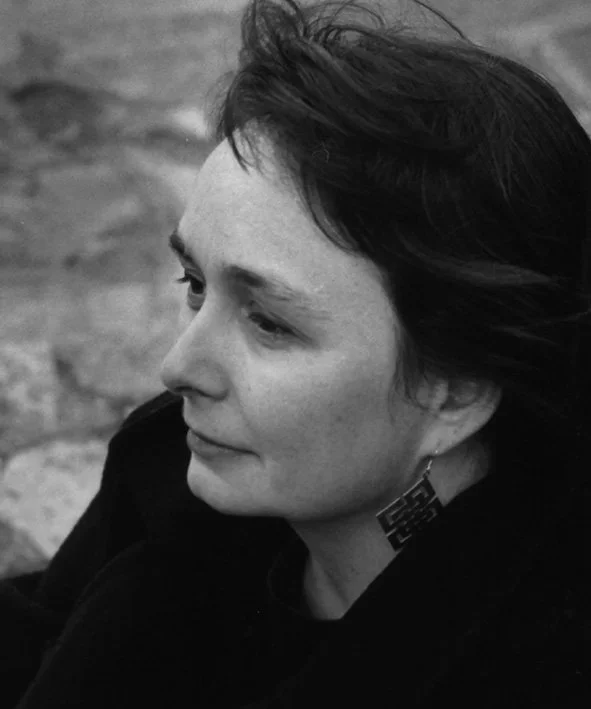
Ellen Hinsey is the author of ten books of poetry, essays, dialogue and literary translation. Her volumes of poetry include Anatomy of the Eclipse, The Invisible Figure, The Illegal Age, Update on the Descent, The White Fire of Time, and Cities of Memory, which received the Yale University Series Award. Her essays on democracy are collected in Mastering the Past: Contemporary Central and Eastern Europe and the Rise of Illiberalism (2017). Her book-length dialogue with Tomas Venclova, Magnetic North, explores post-war Eastern European culture and ethics under totalitarianism and was a finalist for Lithuania’s Book of the Year. Hinsey’s work has appeared numerous publications including The New York Times, The New Yorker, The Irish Times, Paris Review,Poetry, The Southern Review and Der Tagesspiegel, among others. A former Berlin Prize Fellow of the American Academy in Berlin, she has most recently been a visiting professor at Göttingen University. She lives in Paris.

Anna Vallée is a writer living in France. Her writing has been published in Arrowsmith Journal, Brattle Street Review, MicroLit Almanac, and Poetries in English. A semifinalist for The Adroit Journal’s 2025 Anthony Veasna So Fiction Scholars and a participant at the 2026 Bread Loaf Writer’s Conference, she also won a Tucson Festival of Books Literary Award. She holds an MFA from the University of Massachusetts Boston and an Ed.M from Harvard University. When she is not writing, she is the coeditor of Literally lit mag. www.annavallee.com, Instagram:@avallee.writes