
Notes from the Bardo
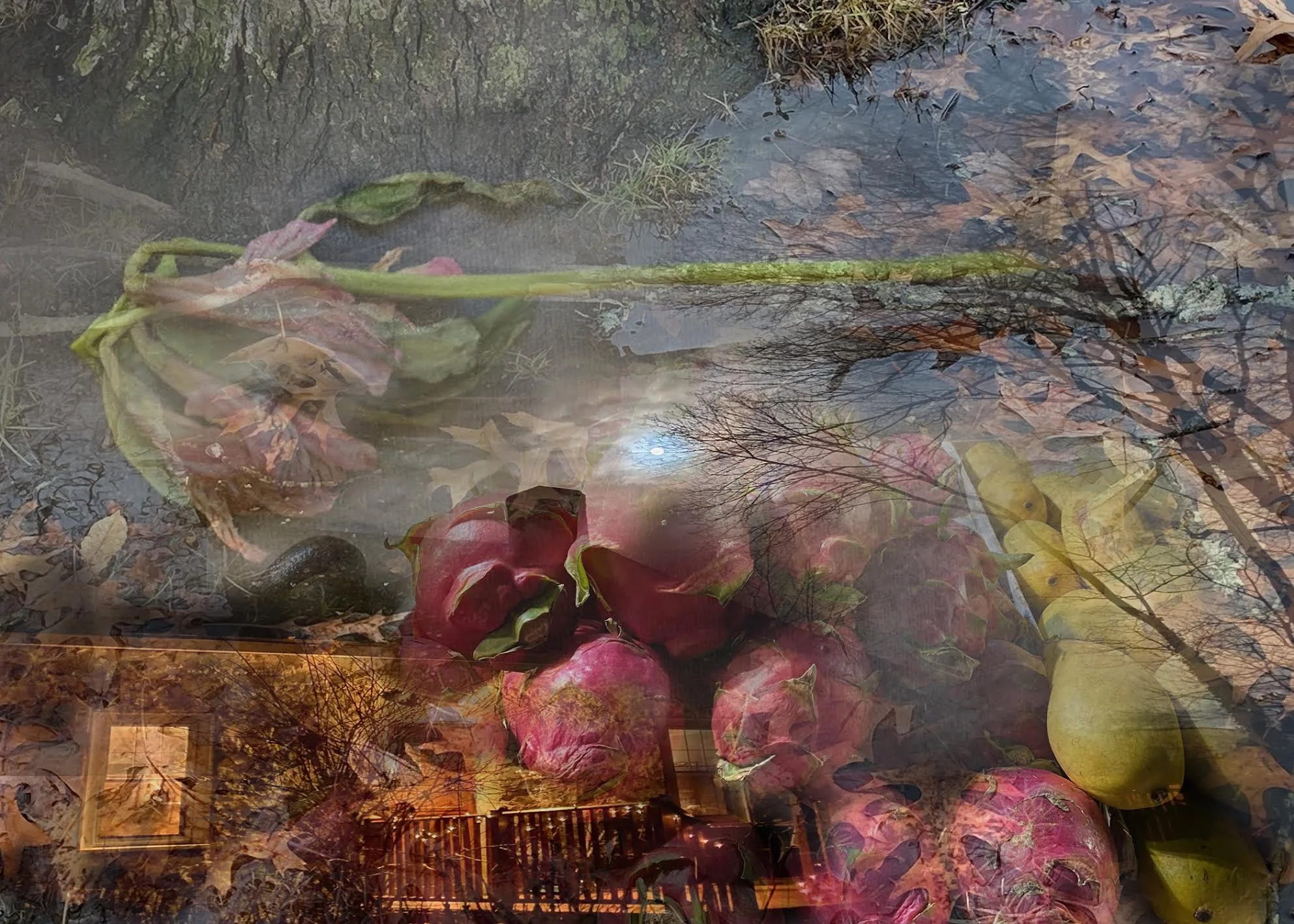
Photomontage by Karen Carr
Tonight, before going to bed, my mother said she doesn't know why she has to endure this slow death and why she can't just die. But then she said she isn't ready to die and feels there are many things she still needs to do—writing; painting; playing the piano. We tried to talk about her funeral plans, but she still can't think about it. She suggested leaving it up to us again and I stressed why that would not be a good idea because it would burden us. She seems to understand that cremation is the better environmental option, but she saw a show in which Frida Kahlo's cremation was depicted (!) and it horrified her. I tried to talk with her about the body not being "us" anymore after death. It was close to bedtime, so we decided to stop talking about it.
—
I couldn’t understand why Roland Barthes’ most sympathetic interpreters—including his brilliant translator, Richard Howard—didn’t see his Mourning Diary’s fragmentary nature as a type of whole, no less an achievement than the most trim and tidy four-square book. And I wondered if you had to be in proximity with death to appreciate this. In both the introduction to the Mourning Diary and the afterward, his interlocutors conclude that we are not presented with a completed book but “with the hypothesis of a book.” Perhaps I’m being too literal in my understanding, but doesn’t this sound like his readers understood the book as never having arrived? “It became, this multiplication of feuilles,” Howard writes, “a realization that yet another kind of utterance might, eventually, be constituted out of this desperation, this dispossession, this travail; such a book was never written, but the notes toward a notation of bereavement remind us forever of what might come to pass.” Why don’t his readers grant that a note IS complete in its incompleteness? Note: that which is completely incomplete. Each layer of mourning is a totality—much like a note, giving way to an openness, and closing off any chance for endless chatter. Being celebrated at a dinner party, Barthes isn’t ungrateful, but he notes most compactly and completely what the bereaved will surely recognize: “Any ‘sociability’ reinforces the vanity of the world in which she [his mother] no longer exists.” He doesn’t need to produce aphorisms to cultivate vision; he only needs to allow life’s sentences to move through him: “We don’t forget, but something vacant settles in us.” It’s an insight and a lesson that is utterly complete.
—
I don’t think they make notebooks like this one anymore: it’s a small six-ring binder, Marquette quality memo book, filled with 5-inch by 3-inch lined pages. I can’t believe I have to deal with this: the notebook belongs to one of my mother’s eldest sisters, who was a nun. This was one of the hardest jobs I had because, when my mother’s two eldest sisters Eleanor and Beatrice died, their respective religious Orders sent my mother home with their remaining things, about six large paper bags’ full, which my mother placed into a closet in her apartment at their times of death and never thereafter dealt with. Later and later, it gets harder and harder to endure the various stages of my mother’s disappearance in the form of her ever-diminishing things, and now, on top of it, I need to dispose of the material traces of her sisters. I believe I’m a devoted aunt, and my aunts were loving and groovy too, but it’s also clear to me that, for the most part and in the long run, unless a person has actual offspring who care, which I do not, and my aunts did not, most of one’s “things” are destined for a dumpster.
I’m ruthless with their blurry photographs and cassette tapes, their costume jewelry and diplomas, but I pause before my Aunt Eleanor’s notebook kept at the time of what appears to be a series of religious retreats. In perfect Palmer Method penmanship, she notes the importance of living in humility and in deference to her god; she explains the purpose of her religion’s requisite vow of chastity: “to have room for all and not just one particular person”; she gives ample room to the word “self-transcendence” on a page; she explains the patience required by her calling, “To invest in the future you will not live to see. We invest in our community and not see the fruits of it”; she gives herself perpetual directives, “Read St. Luke Gospel from beginning to end. Study and pray”; “Pray for forgiveness and being able to forgive. Pray for Joy.” She defines terms toward a deeper understanding, “GospelmeansGood News or better still, ‘GoodMessage,’ ‘Glad Tidings’ was used first. ‘Apostle’ means one sent. ‘Satan’ means adversary.” She records “facts”: “There were no witnesses at the Resurrection”; “The cross is about 6 feet high. Jesus was about one foot from the ground.” She relays an Account of the Last Supper. Luke 22: 14 to 38. “Upper room of rich man’s house. 13 couches and probably 3 tables. Ask God for what you want. Consider what all these men experienced those past months: the exorcisms, healing, calming of the storms, demons subject to them, instructions from Jesus. Deals are important things. Sharing a meal is a bond. Jesus knows that their faith has to grow. Jesus served the meal. Jesus has prayed for His disciples, and they will be strengthened. Pray to God, pray to Jesus, also Peter, and share the meal with the Lord.”
There are banal interjections— “Call Bebe [my Aunt Bea] Mon 3 pm”—and intimate disclosures:
“Who carries me to the Lord?” Sr. Joanne / Bebe / Joey and Jack / Fr. John
“Who do I carry to the Lord?” My students
“Where am I in Life? Still struggling. Fearful of the future.”
My aunts’ vows of poverty have made things easy. I keep this and throw out pretty much everything else. Its pages smell faintly of cheap perfume.
—
Usually my partner Jean and I took the train from Providence to Philadelphia to see my mother during which time I’d expect to enjoy the luxury of reading one of the books in my bag, but whose first three hours could easily be taken up with the task of consolidating my lists into one new master list then tearing the assorted slips of paper onto which these run-away lists were jotted into tiny pieces before depositing their confetti into the trash bin at the end of the car and adjacent to the bathroom. I used to enjoy the view—of waterways and reeds and quaint New England signage and graffiti, of osprey and egrets and heron, of people-less beaches and lived-in backyards, of long rippling ribbons of light and the short, stubbed pith of sleet against the window, but all of that stopped with the introduction of the mobile phone and its greasy screen beckoning with half-baked disaster narratives and doomsday summons, short takes on books and movies, tips for longevity or future purchases, and my favorite word game, “Spelling Bee” (the only game, a friend of mine remarked, that could assure you were a genius every single day), all of this garlanded and intercepted by the pings of at least three different messaging Apps.
Imagine how the philosophers we admire would comport themselves in the digital age. Do we really think the author of “The Death of the Author” would automatically post selfies of himself before each deliverance of a lecture before the Collège de France?
In the rooms of my mother’s bardo, I hid inside the shelter of a type of video game called Monument Valley, which, gorgeous as it was (it had even won awards for its beauty) induced a kind of mesmerizing stupor. Monument Valley was supposed to be a game I was introducing to my seven-year-old niece on the recommendation of a friend who always had the best suggestions for her precocity. I had only meant to “check it out” and discover if it was right for her when I got hooked. The game is made up of the most elegantly designed optical illusions navigated by a small, conically hatted figure on a quest through secret passageways and floating architectures whose solutions yield ever more glorious heights and doorways, ever-more-magical vantage points and impossible routes all of this accompanied by the soothing ebbtides of ambient music. The “girl” is caught in a narrative of faux portent whose intertitles and orienting questions become more and more obscure, but you follow them like a devotee of an arcane religion, intent on arriving, through the girl, to the next better, harder, more beautiful place. Mostly I needed to sleep, but I lay in the darkest hours of the night—my mother asleep, Jean asleep, the city sleep-waking with sirens and screams—moving from one chapter of Monument Valley to the next on the lambent surface of my iPhone. When my niece arrived at the scene, she proved herself better able to move from one level to the next with more speed, and dexterity, and vision, and aptitude. We should have been visiting with my mother, whose days were numbered, but here we were playing with this game. “What are you doing?” my mother asked, while we hovered collectively over Monument Valley— “let me do it, no, me, I got it, let me…” Monument Valley wasn’t something my mother could “see” let alone access at the time. She’d never been one to fritter away a day. For me, its other-worldly precincts, equipped with a puzzle I could potentially solve, served as the most innocuous drug. I only stopped playing when its effects began to scare me: stepping onto the actual streets of Philadelphia, I found myself confusing its buildings for those in its portal. Instead of seeing them for what they were—mounds of immovable concrete hurtling skyward—I started to imagine they had movable hidden hinges, each building a box, the discovery of whose secret button would give way to an invisible axis enabling a reconfiguration of the building entirely. As their subject, like the girl in the game, I could walk sideways or upside down on their surfaces. When I realized the further implication—that there were no other people but myself on these streets, when, in reality, there were, and, remembering what a sucker I’d always been for the magical mystery tours promised by most of the world’s religions, I went cold turkey and removed the game from my phone.
—
When I think about the things upon which memory fastens, I remember my mother as the classic example of that famous definition of a writer as the person on whom nothing is lost. While my mother’s memory was as selective as anyone’s, I have come to believe that she must have had a photographic memory since she seems never to have forgotten anything she’d read—from the details of a life (George Sand’s, Antonio Vivaldi’s, Leo Tolstoy’s), to not just one verse, but five or six or seven of every song for which she’d bought the sheet music across the years, in short, hundreds. After my mother died, I happened upon five DVDs of an interview that a University of Pennsylvania student carried out with her, throughout the course of which my mother shares her vast storehouse of knowledge around the things she feels most passionate. Vivaldi, aka “Il Prete Rosso” (The Red Priest, because of his red hair), wrote some of his greatest music for the girls left in a Venetian orphanage, saved when their mothers tried to drop them into the lagoon. An unusual place, the Ospedale della Pietà offered some of the girls who lived there the opportunity to study music which they performed to rapt audiences always behind the convent’s grate. Some became virtuoso vocalists and violinists, their surnames replaced by the instrument they played (e.g., Anna Maria dal Violin, who achieved international renown and for whom he wrote the Concerto in Violin for B Minor/RV 387, one part of which he transformed into a famous aria, "Vedrò con mio diletto," for his opera Il Giustino). Why has no one made a movie about this place? (My mother had written a play). George Sand inspired Dostoevsky, who called her the mother of his writing, and Whitman wrote Leaves of Grass after reading a Sand book, a favorite of his mother. My mother delivers these mini lectures in an uncharacteristically gentle and unassuming way, perhaps so as not to embarrass the Ph.D. student who is perpetually inclined to say, on camera no less, “I didn’t know that” or that or that or that or that. The woman was getting a separate education in my mother’s living room.
As for my own brain, I can’t remember more than five words of most songs, and if I’m being interviewed even for a book I, myself, have written, I have to re-read it, then study my notes, to remember what I wrote. Like my mother, I have a strictly analogical mind, finding resemblances among random things like “a” and “l” and “z.” I have a penchant for patterns and connections—the more far-flung the better—but cannot easily board a logical train of thought, which doesn’t mean I can’t interpret things, but only through types of what Jean would call “bewitching logic,” like that of psychoanalysis finding its impetus in dreams. The only math that made any sense to me were the abstract and sinuous linkages of Calculus, and to this day, I don’t think understanding fractions is as important to a developing mind as reading is. Unlike my mother, I don’t think I’m much of a storyteller, and I probably mistrust my narrative sense enough to speak in sentences I start by writing in my mind.
When my mother was dying, my brother, Joe experienced a sudden surge of music in his head—all the songs he learned on the piano from a teacher who came to the house when he was a teen, the songs, he said, he learned with our mother by his side, they flooded his head, and it was pleasant but strange, and it went on day and night until one day it suddenly stopped. I envied him such access, wishing I could find a switch that would open the dam to let memory come surging through, whereas all I saw or heard for a very long period during this time was the sound of my mother’s fresh groan, the burden of caretaking, the sad fact of a skeleton where flesh had been, the trauma of my witnessing nothing that was out of the ordinary, but just life’s natural state of affairs: a long course through illness to death.
—
In death’s aftermath, do you sprint, walk, or jog in the direction of your own remaining days on the planet? Do you amble? Does a day beg to be emptied or filled? Is now the time to “put things in order,” to anticipate arrangement, or to disassemble and be still? Dolce far niente—the sweetness of doing nothing—was one of my mother’s favorite phrases: it was a state she aspired to when she was alive and that I believe she occasionally inhabited even if she also had a tendency toward achievement, accomplishment, arrival, doing. Writing and artmaking are forms of work, to be sure, intensive, painstaking, laborious even, but to be in the space of that making is to drift inside a self-forgetting vast and pure. Life’s difficulties fall away—they can wait even when they can’t—and your only problems now are those whose patterns you cannot anticipate even if you pose as their ostensible author. Sometimes you can see the whole thing in front of you—say of a book, a chapter, or a paragraph; other times, you let the material work on and through you, an aimless, open wanderer, a hapless supplicant who knows that language as the way will find its way and orient you. You don’t really know what you’re doing, but you do it anyway. You have no sense of how or if it will matter and to whom, but you persist in this activity, the more convincingly meaningless, the better, for to mean is a burden, to mean is to tax and to aim, to conquer and vanquish, when the whole point of writing is to liberate.
—
See Emily Hogstad, “Vivaldi’s Internationally Renowned Orphanage Orchestra,”Interlude, October 2, 2017.
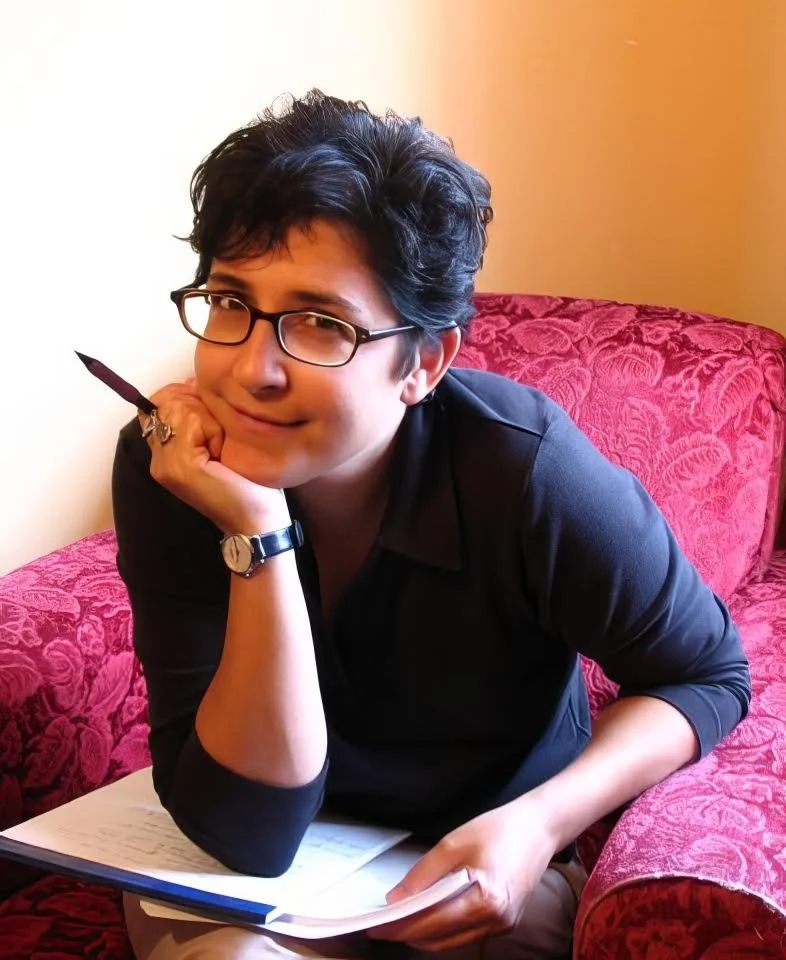
Mary Cappello works in the vanguard of the essay, literary nonfiction, memoir, and experimental prose, on the page and in performance. Her eight books include a memoir based on a twinned legacy of violence and creativity in her Italian American family; a breast cancer anti-chronicle; a Los Angeles Times bestselling detour on awkwardness; a lyric biography of a medical pioneer and his cabinet of aspirated and swallowed things (set in Philadelphia’s Mütter Museum); the mood fantasia, Life Breaks In; and most recently a speculative manifesto from Transit Books on the lost arts of the lecture, the notebook, and the nap. A Guggenheim and Berlin Prize Fellow, as well as a former Fulbright Lecturer at the Gorky Literary Institute (Moscow), she is Professor Emerita of English and Creative Writing at the University of Rhode Island. A new book, Frost Will Come/essays from the bardo appears this October from the University of Wisconsin Press. Find her at www.marycappello.com.