
What Did Buddha Say?
Reading the Buddha’s Discourses in Pali: A Practical Guide to the Language of the Ancient Buddhist Canon by Bhikkhu Bodhi. Wisdom Publications, 531 pp., $49.95
Buddhism and Pali by Richard Gombrich. Mud Pie, 2018, 118 pp., £8.99
The Authenticity of the Early Buddhist Texts by Bhikkhu Sujato and Bhikkhu Brahmali. Oxford Centre for Buddhist Studies, 2014, 158 pp.
S.N. Goenka: Emissary of Insight by Daniel M. Stuart. Shambhala, 2020, 352 pp., $26.95
A Dictionary of Pali by Margaret Cone. Pali Text Society, Vols. I–III (a–bh), £55.00 each
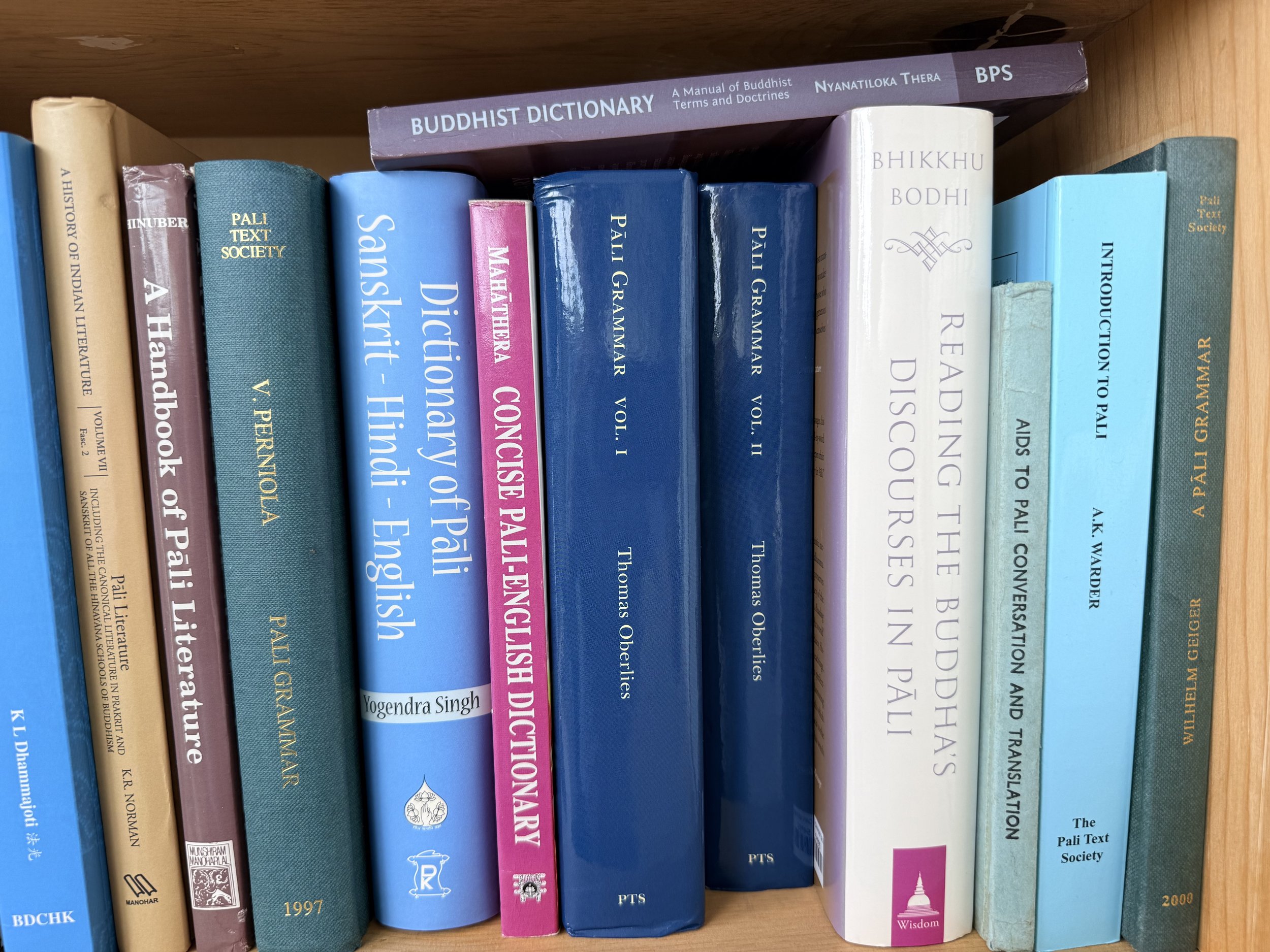
The author's Pali shelf
The training of a Zen Buddhist monk is an amorphous and mysterious affair, hard to explain to outsiders and only slightly easier to explain to oneself. At its culmination, it involves a series of medieval rituals, dating to thirteenth-century China, that have remained largely unchanged in the centuries since. One involves taking a piece of white silk about six feet long and, using a small brush, writing a series of names in black ink. At the bottom of the silk is the monk’s own name. Above it, the name of their teacher. Above that, their teacher’s teacher. And this series continues, generation by generation, until, at the top, the name of the Buddha. Each name is connected to the next by a thin vermilion line, also drawn by hand, and the line extends back around from the Buddha’s name at the top to the monk’s at the bottom, forming a circle reminiscent of an ensō, the circular brushstroke that in Japanese Zen represents both enlightenment and emptiness. That circle of names is, in effect, their authorization to teach. The historical Buddha trusted someone sufficiently to grant this authority to him; that person trusted someone else sufficiently to grant it to another; and this process continued, across roughly twenty-five centuries, until someone conferred that authority upon the monk who now holds the brush.
This lineage is the most fundamental credential; those names are the guarantors of authenticity. And here is what surprises many students: there are only about a hundred names. Some are famous, like the Buddha’s most senior disciple, Mahākassapa, or Bodhidharma, the fabled Indian sage who brought Zen to China, or Eihei Dōgen, the revered Japanese master who brought this tradition to Japan. Others are more humble and largely anonymous today. But only a hundred or so ancestors separate a modern-day Zen master from the historical Buddha. If all of them could stand together in one place, holding hands, that human chain might just barely span Trafalgar Square. That same chain, begun on the San Francisco side of the Golden Gate Bridge, would not reach even the first tower, nowhere near the other shore.
The lineage chart certifies that the Buddha’s teaching has been passed down, person to person, in an unbroken chain. But what, exactly, was passed down? What did the Buddha actually teach? What did he say? And in what language did he say it? These are the questions that Bhikkhu Bodhi’s Reading the Buddha’s Discourses in Pali asks the reader to confront, and they turn out to be harder than they look.
The most important living guide to these questions in the West may be Bodhi himself: an American monk, born Jeffrey Block in Brooklyn in 1944, ordained in Sri Lanka in 1973, who has spent the past half century producing translations of the Pali canon that are widely regarded as the finest in English. His edition of the Majjhima Nikāya (the “Middle Length Discourses,” completing a translation left unfinished by Bhikkhu Ñāṇamoli) and his own translations of the Saṃyutta Nikāya (the “Connected Discourses”) and the Aṅguttara Nikāya (the “Numerical Discourses”) are the versions most serious students now reach for. When scholars or practitioners in the English-speaking world quote the Buddha, they are very often quoting Bhikkhu Bodhi.
In 2020, Wisdom Publications released his Reading the Buddha’s Discourses in Pali, a book that grew out of a two-year Pali course he taught at Bodhi Monastery in northern New Jersey beginning in 2014. It is not a grammar, not quite a textbook, and not a translation in the ordinary sense. Or at least, not just those things. It is something more unusual: a guided apprenticeship in reading. Bodhi selects twenty-seven suttas (sermons) from the Saṃyutta Nikāya and, for each one, provides the Pali text, a word-by-word literal translation, a polished English rendering, and a detailed grammatical analysis. (Because the subject here is the Pali canon, I use Pali forms such as sutta, dhamma, and nibbāna rather than the Sanskrit equivalents sūtra, dharma, and nirvāṇa that are more common in English.) The effect is something like having an extraordinarily learned and patient teacher sitting beside you, pointing at each word and explaining what it means, where it comes from, and why it matters. It is a book about what it takes to hear the Buddha’s voice across twenty-five centuries. The answer is a great deal of patience and a willingness to sit with uncertainty.
—
Before going further into what Bodhi has done, it is worth pausing over a question that his title raises. What does it mean to read “the Buddha’s discourses in Pali”? The phrase suggests that Pali is the language the Buddha spoke, and that these texts are his words written down. It is not clear that either claim is quite true.
To begin with, the Buddha himself wrote nothing down. He may well not have been literate; in fifth-century BCE India, writing was a specialized skill, like carpentry or weaving, not part of a general education. What we have instead are the recollections of his followers. According to tradition, shortly after the Buddha’s death his senior disciples assembled to recite his teachings from memory and agree on what he had said. Then they dispersed again to spread the word.
The historical Buddha, Siddhattha Gotama, lived in northeastern India in the fifth century BCE (or possibly the fourth; the dating is contested). He taught in the region of what is now Bihar and eastern Uttar Pradesh, an area whose local dialects belonged to the eastern branch of the Middle Indo-Aryan languages, the prakrits that descended from the Sanskrit of the Vedas. Pali, however, is not one of those eastern dialects. Modern scholarship has established fairly convincingly that it is a western Middle Indo-Aryan language, a composite literary dialect with features drawn from several regional prakrits but reflecting most closely the speech of western India.
The Theravāda tradition has long held otherwise. The great fifth-century commentator Buddhaghosa, writing in Sri Lanka, identified Pali with Māgadhī, the language of the kingdom of Magadha where the Buddha spent much of his teaching career. In his commentary on the Vinaya (the monastic code), Buddhaghosa called it Māgadhabhāsā, the language of Magadha, and went further: he declared it the “root language” of all beings, the natural tongue in which a child would spontaneously speak if no one taught it another. This is an extraordinary claim, and a revealing one. It tells us something about the devotional weight that has been placed on the language itself, the sense that Pali is not merely the vehicle of the Buddha’s teaching but in some way inseparable from it.
Modern linguists have been less reverent. The pioneering German Indologist Wilhelm Geiger, whose Pali Grammar remains foundational more than a century after its original publication, argued that Pali was based on a western dialect, and subsequent scholarship has largely confirmed this view. K.R. Norman, the eminent Cambridge Pali scholar who revised Geiger’s grammar for the Pali Text Society in 1994, put the matter plainly: Pali is not Māgadhī. It is a standardized literary language that was probably never anyone’s mother tongue. The relationship between Pali and whatever the Buddha actually spoke is roughly analogous to the relationship between classical Latin and the rustic dialects spoken by farmers in ancient Italy: related, overlapping, but not the same.
Not everyone agrees, however, and the most prominent dissenter is also one of the most distinguished Pali scholars alive. Richard Gombrich, the former Boden Professor of Sanskrit at Oxford and founder of the Oxford Centre for Buddhist Studies, argues in his short 2018 book Buddhism and Pali that the case against Pali as the Buddha’s language has been overstated. Gombrich examines the linguistic evidence afresh and concludes that it remains possible, even probable, that Pali preserves the Buddha’s own dialect more faithfully than the scholarly consensus allows. His argument rests in part on the observation that the features usually cited as “western” could equally reflect a prestige register that transcended regional boundaries, and in part on the sheer conservatism of the oral tradition. It is a provocative claim, and not all specialists find it persuasive. But Gombrich’s stature ensures that the question remains genuinely open. The relationship between Pali and the Buddha’s speech is not a settled matter; it is a live debate, conducted by a handful of scholars who happen to be among the very few people on earth qualified to have it.
There is a further complication. The oral tradition that began at that first assembly continued for centuries. Groups of monks specialized in memorizing different portions of the canon, and at periodic councils they would recite the texts together to ensure accuracy. This is an impressive feat of collective memory, and there is good reason to believe the tradition was highly conservative. But it was also, inevitably, a process of gradual standardization. Whatever dialectal variety may have existed in the earliest teachings was smoothed out as the texts were transmitted, translated, and harmonized into the Pali we now possess.
The texts were finally committed to writing in Sri Lanka around 29 BCE, during the reign of King Vaṭṭagāmaṇī Abhaya. The occasion was grim: a devastating famine had killed so many monks that the community feared the oral tradition itself might be lost. The decision to write the texts on palm leaves was understood as an emergency measure, a concession to human frailty. By that point, roughly four hundred years had passed since the Buddha’s death.
So when we speak of reading “the Buddha’s words in Pali,” we are speaking of a text that was composed in a language the Buddha probably did not speak, transmitted orally for four centuries by communities that continually shaped and standardized it, and written down on a distant island under threat of civilizational collapse. This is not a reason to dismiss the Pali canon. It is, by a considerable margin, the oldest and most complete record of early Buddhist teaching that survives. The parallel collections in Chinese translation (the Āgamas) and the scattered Sanskrit and Gāndhārī fragments confirm that the Pali versions preserve very ancient material. But “reading the Buddha’s words” requires an asterisk.
—
Why, then, would anyone learn Pali? And what resources exist for those who try?
Pali is likely the closest we can get. For all the layers of transmission and translation, the suttas of the Pali canon retain a distinctive voice, a style of argument and imagery and repetition that feels, across twenty-five centuries, startlingly alive. Even in translation, the Buddha of the Pali suttas is a vivid presence: precise, occasionally sarcastic, endlessly inventive in his metaphors, and relentlessly focused on the practical question of how to end suffering. Reading these texts in Pali does not magically strip away the layers of transmission, but it brings the student closer to the texture of the language itself, to the puns and resonances and rhythmic patterns that no translation can fully capture. The Pali word dukkha, for example, conventionally translated as “suffering,” carries overtones of wrongness, of a wheel that doesn’t sit right on its axle (its likely etymology), that the English can only gesture toward. To read dukkha in a sentence, to feel its weight alongside other Pali words, is a different experience from reading “suffering.” Or consider sati, the word now usually translated as “mindfulness.” In English, “mindfulness” sounds clinical and specialized, a term that was barely used outside scholarly contexts until a few decades ago. In Pali, sati simply means remembering, or presence of mind: a plain, common word that suggests a world in which paying careful attention was not a therapeutic technique but an ordinary part of being human.
Like many ancient languages, Pali resists easy translation. Converts to Buddhism are generally asked to recite the Three Refuges, beginning with the vow, “I take refuge in Buddha.” Studying Pali, one quickly learns the original formulation: buddhaṃ saraṇaṃ gacchāmi. Right away, one sees a problem: the Pali phrase only has three words! And the verb, gacchāmi, is a form of the verb “to go” and not “to take.” The prepositions and pronouns are bundled up with the nouns and verbs. So the sentence means something more like, “To-Buddha for-refuge I-go.” Or does Buddha actually modify refuge instead? Perhaps it’s, “To-Buddha-refuge I-go.” Either rendering feels more active than the standard English translation, which masks a series of choices that reading the Pali reveals. In Pali, the Buddha, Dhamma, and Saṅgha seem to become places we might go to in times of need, perhaps in the same way we might go to the hospital when injured or sick, or to a safe haven in times of war. Without studying the Pali, we may not know quite what we have vowed to do.
These are the kinds of discoveries that Bodhi’s book makes possible. But they require preparation. The standard university textbook for most of the past half century has been A.K. Warder’s Introduction to Pali (1963), a formidable and uncompromising work that I recently took from my shelf to discover the bookmark still on page 16. At the other end sits Lily de Silva’s slim Pali Primer (1994), gentle enough for absolute beginners but too brief to carry a student to actual canonical prose. The happy medium, and the book Bodhi himself recommends as preparation for his own, is A New Course in Reading Pali by James Gair and W.S. Karunatillake (1998), which was the textbook for his course at Bodhi Monastery. What Bodhi’s own book does is something none of these textbooks attempt: it takes the student who has learned Pali grammar and shows them how to read the suttas themselves. This is the transition that defeats most Pali students. They can master the declension tables and the verb conjugations but still find themselves baffled by an actual sutta. Canonical Pali is full of idioms, stock phrases, compounds, and syntactic patterns for which no grammar textbook can fully prepare them. Bodhi’s genius is to make this transition gradual and guided. His word-by-word translations function as a kind of scaffolding: he shows exactly how the Pali maps onto English, where the ambiguities lie, and which words carry multiple meanings.
—
Behind Bodhi’s book stands an institution that has shaped Western access to Pali for nearly a century and a half: the Pali Text Society. The PTS was founded in 1881 by Thomas William Rhys Davids, a man who came to Pali by one of the more improbable routes in the history of scholarship. As a young English civil servant in Ceylon (now Sri Lanka) in the 1860s, Rhys Davids was called upon to adjudicate a legal dispute involving a Buddhist monastery. To understand the case, he needed to consult the monastic code, which was written in Pali. He found himself fascinated by the language and the texts, and when he returned to England, he devoted the rest of his life to making them available to Western readers.
The Pali Text Society was modeled on the Early English Text Society, founded in 1864 to publish medieval English manuscripts. Rhys Davids envisioned a similar project for the Pali canon: a systematic effort to edit, publish, and translate the entire body of Theravāda Buddhist literature. It was an enormous undertaking, and in many ways it succeeded beyond what anyone might reasonably have hoped. Over the following decades, the PTS published critical editions of virtually the entire Pali canon, along with translations, grammars, and the great Pali-English Dictionary compiled by Rhys Davids and William Stede between 1921 and 1925.
That dictionary served as the standard reference for a hundred years. Its replacement has been underway since 2001, when Margaret Cone published the first volume of A Dictionary of Pali with the PTS. Cone’s dictionary is a monumental achievement: meticulous, comprehensive, informed by a century of scholarship that the Rhys Davids dictionary could not anticipate. Three volumes have appeared so far, covering the alphabet from a through bh. (The Pali alphabet follows the traditional Indian phonetic order, grouping consonants by where in the mouth they are produced, so that sounds like m, l, s, and h come at the end.) Cone has now retired, and the fourth and final volume is being prepared by Martin Straube at the University of Marburg. No definite publication date has been set. For letters beyond bh, we still rely on Rhys Davids and Stede.
The story of the PTS and its dictionary illuminates a peculiar feature of Pali studies: the smallness of the community and the consequent fragility of its institutions. A single retired scholar’s dictionary, decades in the making, remains unfinished because there are so few people in the world with the expertise to continue it. University programs in Pali have been declining for years. In the West, Pali is taught at perhaps a dozen universities, often as an occasional seminar rather than a regular offering. It is also worth noting how English this enterprise has been. From Rhys Davids through Norman and Cone, the center of gravity in Western Pali scholarship has remained in England, anchored by the PTS and the universities of Oxford and Cambridge. For more than a century, to study Pali in the West was, in practice, to look to England.
—
There was, for a brief period in the twentieth century, an attempt to revive Pali as a spoken language. The parallel with Hebrew is suggestive: here was another ancient tongue preserved for centuries as the language of sacred texts and liturgical chanting, seemingly destined to remain the property of scholars and priests. In 1881, the same year Rhys Davids founded the PTS, Eliezer Ben-Yehuda arrived in Jerusalem and began the improbable project of turning biblical Hebrew into a language people could use to buy vegetables and argue about politics. That project succeeded, spectacularly. Pali’s revival was more modest and ultimately much less successful, but it was real. Within living memory, Pali served as a lingua franca among Theravāda monks across South and Southeast Asia. The occasion was a particular historical moment: international travel had become feasible enough that a monk from Sri Lanka might find himself in conversation with a monk from Burma, but English had not yet emerged as the default common language. Pali was what they shared. The high-water mark of this tradition may be A.P. Buddhadatta Mahāthera’s Aids to Pali Conversation and Translation, published in 1951, and now nearly impossible to find. (I discovered a copy at a used bookstore in Düsseldorf after several years of searching.) Its opening conversational lesson begins: Tvaṃ Pālibhāsaṃ jānāsi? (“Do you know Pali?”), followed by Sakkosi tvaṃ pālibhāsāya sallapituṃ? (“Are you able to converse in Pali?”) and the modest reply, Ahaṃ thokaṃ sallapituṃ sakkomi (“I am able to converse a little”). Subsequent chapters cover conversations between farmers, merchants, and schoolboys, and include such useful phrases as Suppabhātaṃ! (“Good morning!”), Svāgataṃ bhavato! (“Welcome!”), and eventually Ahaṃ satthena tattha gantvā bahūni anaggha-kojāvāni oṭṭhesu āropetvā ānesim (“I went there with a caravan and brought many carpets with the aid of camels”). It is a strange and moving artifact, this phrasebook for a language whose native speakers, if they ever lived, died twenty-five centuries ago. The spoken revival, such as it was, has quietly given way to the digital one.
The most significant digital development may be SuttaCentral, a website co-founded by the Australian monk Bhikkhu Sujato that presents Pali texts alongside English translations, with parallel passages in Chinese, Sanskrit, and Tibetan marked for comparison. Sujato is also the co-author, with Bhikkhu Brahmali, of The Authenticity of the Early Buddhist Texts (2014), a systematic argument that the Pali canon and its Chinese parallels reliably preserve the Buddha’s actual teachings. Drawing on comparative textual analysis, linguistic evidence, and the sociology of oral transmission, Sujato and Brahmali make the case that the early texts are not the product of centuries of creative elaboration by anonymous monks, as some scholars have suggested, but represent a remarkably faithful record of a specific body of teaching by a specific historical person. The argument is not uncontested, but it has been influential, and it has drawn many new students to Pali.
Sujato’s own translations, completed in 2018, cover the four main nikāyas and are freely available on SuttaCentral. The existence of two nearly complete, high-quality English translations of the Pali canon, Sujato’s available free online and Bodhi’s in print from Wisdom Publications, is an extraordinary resource that would have been unimaginable a generation ago.
Perhaps the most innovative digital resource is the Digital Pali Dictionary, created by the scholar-monk Bhikkhu Bodhirasa. Pali, like Latin or Sanskrit, is a heavily inflected language. A single noun can appear in dozens of forms depending on its case, number, and the phonological changes (sandhi) that occur when it meets the words around it. A verb can appear in hundreds. The student who encounters an unfamiliar form in a sutta must work backward through these inflections to find the base word, a process that can be painstaking even with a good grammar at hand. (I find a single sentence takes an hour to work out.) The Digital Pali Dictionary short-circuits this entirely: its lookup table contains over a million inflected forms, each linked to its headword and grammatical analysis. It also decomposes the sandhi compounds that are among the most formidable obstacles to reading canonical Pali, where two or three (or more) words have fused into a single orthographic unit with their boundaries obscured. I have used it extensively in my own work on Pali texts, and I can report confidently that it resolves all but a few thousand of the roughly 127,000 unique word forms in the entire canon. It is perhaps the tool that Rhys Davids would have built if he had been born a century and a half later.
These digital developments have reshaped the sociology of Pali study. For most of the twentieth century, learning Pali required either enrolling in one of a handful of university programs or joining a Theravāda monastery. Now it is possible to study the language seriously from anywhere with an internet connection. The students who take advantage of this are a different population from the traditional university cohort. They are often meditation practitioners, dharma teachers, translators working in Buddhist communities, and curious laypeople. No small number of them come to Pali through the Vipassanā meditation movement founded by S.N. Goenka, whose ten-day silent retreats have attracted an enormous and eclectic following, from Silicon Valley engineers to Wall Street bankers to yoga practitioners to college students on summer break. (If your otherwise straight-laced colleague or cousin confesses that they have just been to a ten-day silent retreat, it is most likely one of these.) Goenka’s retreats include chanting in Pali, and Goenka himself regarded Pali not merely as a scholarly interest but as, in his words, “the mother-tongue of Lord Buddha.” His organization, the Vipassana Research Institute (VRI), has published not only Lily de Silva’s Pali Primer but also a comprehensive digital edition of the entire Pali canon, freely available online and now used as a source text by scholars and digital projects worldwide. VRI’s sister press Pariyatti has even made gestures toward reviving Pali as a spoken language: the Burmese scholar-monk Janakābhivaṃsa’s Kathāsallāpasikkhā (“Exercises in Pali Conversation”) revives the conversational tradition of Buddhadatta’s 1951 phrasebook, with dialogues set in a Burmese monastery. But the effort seems half-hearted. Goenka’s retreats are not conducted in Pali; they are conducted in Hindi, English, and dozens of other modern languages, via translated recordings of his own lectures.
There are several ironies here. The first is that Goenka was not, by his own account, a Buddhist. Asked directly in an interview with Inquiring Mind, he was unequivocal: “I’m not a Buddhist.” He argued that attaching any sectarian label to the Dharma distorts it into something the Buddha never intended. “As long as you keep Buddha’s teaching as dhamma, it remains universal,” he said. “The moment you say that it is ‘Buddhism,’ it becomes sectarian.” Daniel Stuart’s recent biography, S.N. Goenka: Emissary of Insight, traces this stance to its roots. Goenka was born into a conservative Hindu family of Burmese-Indian merchants. He came to meditation not through any attraction to Buddhism but through chronic migraines, and he was initially deeply skeptical of Buddhism and Buddhists alike. His teacher, the Burmese civil servant U Ba Khin, taught Vipassanā initially to other government employees as a universal technique, not a religious practice, and Goenka carried this framing further than anyone. He addressed the United Nations, built a massive pagoda in Mumbai to house relics of the Buddha, and devoted his life to a practice rooted entirely in the Pali canon, all while insisting that none of it was Buddhism. The result is that one of the most vigorous engines of Pali study in the world today is a movement that explicitly rejects the tradition to which Pali belongs. The language is flourishing, in part, because it has been untethered from the religion it records.
The second irony cuts deeper. During his lifetime, Goenka recorded all of his teachings on video. Since his death in 2013, the retreats have continued exactly as before, with his recorded lectures played each evening to rooms full of silent meditators. No living teacher “teaches” in the conventional sense. There has been no real transmission in the sense of a passing of authority, no lineage of the kind those silk charts trace. Goenka himself broke ties with all other Vipassanā teachers working independently, even those authorized by his own teacher, effectively rejecting the very basis of lineage and transmission. But there has also been no drift, no debate about what Goenka actually said, no centuries of oral reshaping. His words are preserved with a fidelity that the Buddha’s followers, chanting from memory in the centuries after his death, could never have achieved. It is the opposite problem from the one that haunts the Pali canon: not too much distance from the original, but perhaps too little. One wonders: if the Buddha himself had been able to record his teachings with the same precision, would Buddhism have survived as a living tradition? Would it have spread from India to Sri Lanka, to China, to Japan, to Tibet, and now to the West, adapting itself to each new culture and century? The monks who chanted the suttas from memory across four centuries before anyone wrote them down were not merely preserving a teaching. They were, inevitably, interpreting it, shaping it, making it their own. That process of imperfect transmission may be exactly what allowed the Dharma to remain alive. Every act of transmission is also an act of interpretation, and every attempt to eliminate interpretation is also an attempt to stop the teaching from growing.
This tension between preservation and interpretation runs through the history of Pali studies itself. The academic tradition, rooted in both nineteenth-century European philology and British colonialism, has always maintained a certain cool distance from its subject matter. Rhys Davids was not a Buddhist or even a meditator, nor were the scholars he enlisted to help: Hermann Oldenberg, who edited the monastic Vinaya for the PTS; Viggo Fausbøll, who edited the Jātaka tales of the Buddha’s previous births; Wilhelm Geiger, whose grammar remains in use today. This first generation of Pali scholars was no more disciples of the Buddha than their pith-helmeted contemporaries excavating Karnak were followers of Amun-Ra. They studied Pali as scholars study any ancient language, with interest and respect but without personal devotion. The new wave of Pali students, by contrast, often comes to the language with deep personal investment. They are not studying Pali to understand an ancient civilization; they are studying it to deepen a living practice. Bhikkhu Bodhi himself straddles this divide. That an American monk has become the preeminent Pali translator in the English-speaking world, stepping into a role long held by British scholars and Oxbridge dons, is itself a measure of how thoroughly the field has changed. Listen to his audio lectures and the Brooklyn is unmistakable: he sounds less like a monk expounding ancient scripture than someone who could be selling hot dogs on Coney Island. His book reflects the shift: it is rigorous in its scholarship but animated by a monk’s conviction that these texts matter, that they are not merely historical curiosities but living instructions.
—
I should confess, at this point, that my own interest in Pali requires some explanation. I am a Zen Buddhist priest, ordained in the Japanese Sōtō tradition. I have inscribed my own lineage onto silk like countless monks before me. Zen comes to Japan through China, and its canonical literature is almost entirely in Chinese and Japanese. The sutras that Zen practitioners chant are Chinese translations of Sanskrit originals (or, in some cases, Chinese or Japanese compositions with no Indian original at all). The Pali canon is, strictly speaking, someone else’s scripture.
And yet here I am, with Warder and de Silva and Gair and Karunatillake and now Bodhi on my shelf, working through Pali verb forms like a Jesuit seminarian grinding through Greek. Why?
Part of the answer is scholarly curiosity. I spent years as a data scientist, and I retain the data scientist’s conviction that you should go back to the source data when you can. The Pali canon is the oldest and most complete record of what the historical Buddha taught, and if you are interested in what the Buddha actually said (as opposed to what later traditions said he said), Pali is where you have to look.
But there is a deeper reason, one that I think reflects a broader shift in Western Buddhism. For much of the twentieth century, the various Asian Buddhist traditions arrived in Europe and North America as distinct lineages, each with its own texts, practices, and institutional structures. Zen practitioners studied Zen texts; Theravāda practitioners studied Pali texts; Tibetan practitioners studied Tibetan texts. Many convert practitioners studied no texts at all. The boundaries were porous, but the gravitational pull of lineage was strong. In the past two decades, however, something has changed. More and more Western Buddhists have developed an interest in the earliest layer of Buddhist teaching, regardless of which tradition they practice in. The “early Buddhist texts” movement, as it is sometimes called, draws practitioners from Zen, Tibetan, and Theravāda communities alike. The underlying intuition is that the earliest teachings, however imperfectly preserved, contain something essential that later elaborations sometimes obscure.
This is not a claim that earlier is always better, or that the rich philosophical traditions of Mahāyāna and Vajrayāna Buddhism are somehow less authentic. It is simply an acknowledgment that the historical Buddha was a specific person who taught specific things, and that those teachings, filtered through centuries of transmission, remain accessible in the Pali canon in a way they are not accessible anywhere else. For a Zen priest, reading the Pali suttas is a little like a Catholic theologian learning Hebrew to read the Torah: the texts belong to a related but distinct tradition, yet they illuminate the common source.
—
Bhikkhu Bodhi’s book is ideally suited to this kind of cross-traditional exploration. The suttas he selects from the Saṃyutta Nikāya are among the most doctrinally important in the entire canon, covering the core teachings that all Buddhist traditions share: the four noble truths, the nature of suffering, dependent origination, the path of practice. His translations are precise without being pedantic, and his notes strike a balance between grammatical explanation and doctrinal commentary. He is not shy about pointing out where the Pali is ambiguous or where translators have disagreed.
The book’s structure is elegant. Each chapter takes a single sutta and presents it in four layers: the Pali text, a literal word-by-word translation, a polished English translation, and grammatical notes. The literal translation is the most valuable element for the student. It allows you to see exactly how the Pali constructs meaning, where it diverges from English word order, which words are implied rather than stated. Consider a simple phrase like sabbe saṅkhārā aniccā: “all formations [are] impermanent.” The Pali has no verb “to be”; the copula is implied. This is a small grammatical point, but it carries philosophical weight. In Pali, impermanence is not attributed to formations; it is simply named alongside them, as if the two concepts were inseparable. Bodhi’s literal translation makes this visible in a way that his polished translation, necessarily conforming to English syntax, cannot.
The book is not without limitations. It is not self-contained: a student who has not already worked through a Pali grammar will find even Bodhi’s careful explanations bewildering. And its exclusive focus on the Saṃyutta Nikāya means that students encounter only one style of canonical prose. The verse passages of the Dhammapada or the Therīgāthā, the narrative richness of the Jātaka tales, the legalistic precision of the Vinaya: these present different linguistic challenges that Bodhi’s selection does not address. The book received, as far as I can determine, only one formal review, by the linguist Niels Schoubben in the Journal of the Oxford Centre for Buddhist Studies in 2021. Schoubben’s assessment is largely positive, though much of the review is taken up with a forensic enumeration of the book’s typographical errors. This seems a remarkably thin reception for a work of such ambition and utility, especially one authored by the preeminent English translator of the Pali canon. Perhaps the explanation is simply that very few people in the world are equipped to review it. Schoubben closes with a wish for a second volume drawing on other collections and genres, the kind of criticism that is really a compliment. The hope is that Bodhi will do for the rest of the canon what he has done so well for the Saṃyutta.
—
There is still another dimension to this story. The Pali canon is not just a collection of philosophical teachings. It is literature. The suttas have a distinctive aesthetic: formulaic, repetitive, structured around dialogue and narrative. Repetition, which can feel tedious in translation, serves a mnemonic function in the original oral tradition, and it also creates a kind of incantatory rhythm. Stock phrases recur across hundreds of suttas, functioning almost like musical themes. The phrase evaṃ me sutaṃ (“thus have I heard”), which opens nearly every sutta, is attributed to the Buddha’s attendant Ānanda, who reportedly recited all the discourses from memory at the First Council after the Buddha’s death. Whether or not this tradition is historical, the phrase serves as a frame: it reminds the listener that these are remembered words, passed from one person to another across time.
Reading the suttas in Pali, even haltingly, even with Bodhi’s word-by-word assistance, brings you into contact with this literary dimension in a way that translation alone does not. You begin to hear the rhythms, to recognize the formulas, to anticipate the turns of phrase. You notice that certain key terms (dukkha, anicca, anattā, nibbāna) carry a density of meaning that no single English word can capture. You develop a feel for the language’s particular combination of precision and spaciousness, the way it can state a philosophical proposition in a handful of syllables and then elaborate it through pages of repetition and variation.
This is itself a form of practice. The Buddhist traditions are full of injunctions to pay close attention, to slow down, to examine experience carefully and without assumptions. Learning to read Pali is an exercise in exactly this kind of attention. You cannot skim a Pali sentence the way you can skim an English one (or at least, I cannot; perhaps Bhikkhu Bodhi can). Each word demands that you stop, consider its form, consult its possible meanings, and work out how it connects to the words around it. It is painstaking, sometimes frustrating, and deeply absorbing. In a contemplative tradition that values mindfulness, the close reading of ancient texts in their original language is not merely an academic exercise. It is a practice of presence.
—
Can we really hear what the Buddha said? The honest answer is: not exactly, or at least, not yet, but perhaps we can get close. Gombrich’s provocative case that Pali may be the Buddha’s own language remains open. And Sujato and Brahmali’s comparative study of the Pali and Chinese versions of the same discourses reveals a striking degree of agreement on core teachings, suggesting that the oral tradition was far more reliable than one might expect. What we can hear is the echo of a teaching as it was remembered, shaped, standardized, and eventually written down by communities of practitioners who cared deeply about preserving it. The echo has been remarkably well preserved. But it is still an echo, not a recording.
Bhikkhu Bodhi’s book does not resolve this fundamental uncertainty. No book like it could. What it does is something more modest and, in its way, more valuable: it teaches you to listen more carefully. By slowing the reader down to the level of individual words and grammatical forms, by making the process of translation transparent rather than invisible, it reveals the gap between the Pali text and any English rendering. And in that gap, something important becomes visible. You see the choices translators must make, the ambiguities they must resolve, the resonances they must sacrifice. You begin to understand that every translation is an interpretation, and that the original, for all its distance from the historical Buddha, retains possibilities that no translation can fully realize.
T.W. Rhys Davids spent his life trying to make these texts speak to English readers. His wife Caroline succeeded him as president of the Pali Text Society and produced translations of her own. Margaret Cone spent decades compiling a dictionary that she could not finish. Bhikkhu Bodhi has given the better part of his adult life to translating texts he believes contain the most important truths ever articulated. These are lives organized around a conviction that the words matter, that the effort of recovery and transmission is worthwhile even when the original is irrecoverable, perhaps especially then.
I think of my own halting efforts with Pali in the light of these larger labors. I will never read the suttas with the fluency of Bhikkhu Bodhi. I will never parse a compound with the precision of K.R. Norman. But each time I sit with a sutta and work through it word by word, I am doing something not unlike what I did when I drew those names on white silk: tracing a line back through the generations, trying to close the distance between myself and a teacher who lived twenty-five centuries before. The lineage charts tell me that only a hundred people separate us. The Pali texts are another kind of chain, longer and less tidy, copied and re-copied by thousands of hands across dozens of centuries. I cannot hear exactly what the Buddha said. But I can listen, as closely as I am able, to the language that carries what remains of his voice. And the listening itself, I have come to believe, is the point.

Dan Zigmond is a writer, Zen teacher, and computational scholar of Buddhist texts, with an MFA from Bennington College and an MDiv from the Shogaku Zen Institute. His research on the Pāli Canon has appeared in the Journal of the Oxford Centre for Buddhist Studies and the proceedings of the World Sanskrit Conference, and he is the author of Buddha's Office (2019) and co-author of Buddha's Diet (2016). A contributing editor at Tricycle: The Buddhist Review, he was ordained as a Sōtō Zen priest by Kobun Chino Otogawa Roshi in 1998 and serves as board chair of the San Francisco Zen Center.