
A Long Way Down
I might never have written a memoir about my mother if, fifteen years ago, I hadn't come across Peter Handke's A Sorrow Beyond Dreams, a stark reckoning with his mother's suicide. Handke was only twenty-nine when he wrote and published the book in 1972, and almost thirty years had passed since I first read it in college. My re-discovery of him in 2011 occurred in the World War II basement bomb shelter turned storage space that housed the spill-over books from the library of the American Academy in Berlin. I was there on a writing fellowship and felt rattled after the usual chaos of New York to be residing in the heart of German efficiency and order. So, when I straggled down into the basement, I felt oddly at home among the steel shelving and the damp chill and the vaguely urinous odor wafting from the bomb shelter's three-foot thick, concrete block foundation. I began to cast about at random among the books, spotted the Handke, and hunkered down to take another look.
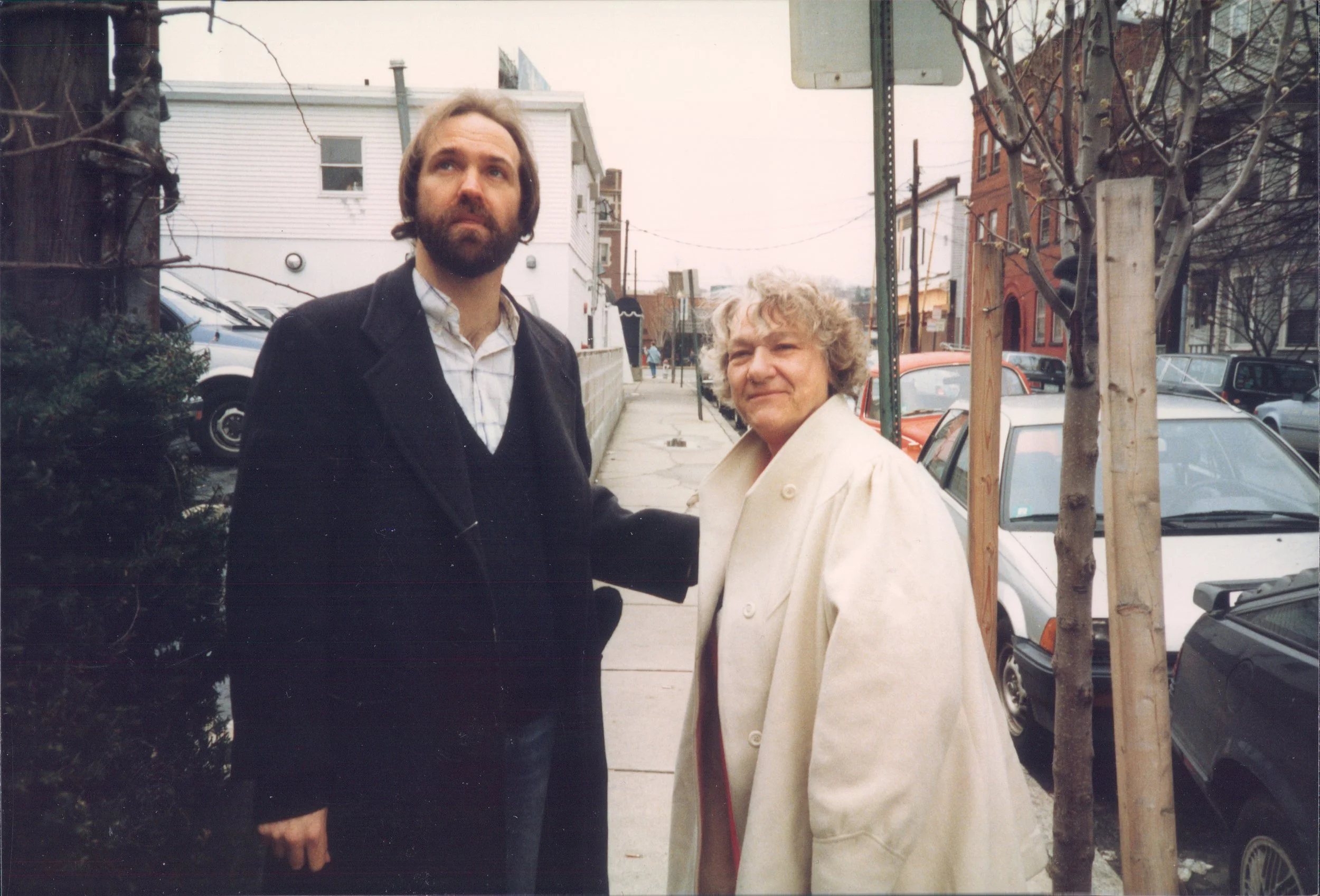
The author and his mother
Cambridge, MA
It's a short book, only about 70 pages, and it astonished me for its complete lack of sentimentality, for the way in which Handke fought shy of any kind of solace. To look for comfort would have been an affront to his mother's honesty, her strange form of courage in taking her own life when she felt there was no longer any reason to continue. It was also full of love for his mother, sharp-eyed and undeluded as love is at its most disinterested. And when I finished it, I knew that this was a book I'd been wanting to read my whole life long, and that at some point I would have to write a similar book about my mother.
I didn't know how my book would end until my mother died. The fact that she, too, would eventually take her own life— a decade later and under quite different circumstances—was a coincidence that doesn't feel like one. In Anglo-Saxon there is a concept called the wyrd, and not just in our contemporary sense of odd or quaint. It carries with it a deep premonitory unease, almost a sixth sense that heralds a disaster coming closer, one that can't be dodged, postponed, or avoided, leaving you no choice but to face it head on. As the Beowulf poet puts it in Seamus Heaney's translation, "Fate hovered near, unknowable but certain." And in another similar passage, "Fate goes as ever fate must."
If all those years ago down in that dank basement I'd been told that these would be the stark terms under which I'd experience my mother's death, I'd have scoffed at the notion as melodrama. But I realize now that the few hours it took me to read Handke's book were indeed touched by the wyrd: I couldn't shake the sensation that I was reading not only my own autobiography, but a spookily prescient depiction of my mother's life and death.
To add to that strangeness was the fact that Handke, since I'd first read him as a student in 1979, had become not only controversial, but a deeply disturbing figure, one accused of being an apologist for Slobodan Milosevic, the President of Serbia who was indicted in 1999 by the International Criminal Tribunal for Yugoslavia (ICTY) for genocidal policies toward Bosnian Muslims. In 1997, when Handke published A Journey to the Rivers: Justice for Serbia, a book about the Bosnian war—an ill-informed, obtuse, dismayingly blinkered book—he cast doubt on the facts of the 1995 Srebrenica massacres, in which more than 8,000 Bosnian Muslims were murdered by Serbian troops. True to his reputation as a contrarian, Handke accused Western media of exaggerating the Serbian push for "ethnic cleansing." This stance so outraged many of his former admirers that both Handke and his work became anathema.
Although the evidence was plain, Handke refused to accept it for reasons that had to do with the Serb's fierce resistance to Nazism during World War II. But what Handke failed to understand was that Milosevic was a Hitler-wannabe dressed in anti-fascist clothing. And so, he delivered a eulogy at Milosevic's funeral in 2006 (Milosevic died in prison, still awaiting the ICTY's verdict): “The world, the so-called world, knows everything about Yugoslavia, Serbia. The world, the so-called world, knows everything about Slobodan Milosevic. The so-called world knows the truth … I don’t know the truth. But I look. I listen. I feel. This is why I am here today, close to Yugoslavia, close to Serbia, close to Slobodan Milosevic." Unfortunately, Handke doesn't seem to have felt close enough to the Bosnian Muslims who were massacred.
As I said, some of Handke's admirers have fiercely disavowed both the man and his work. Some will say that the man and the work are two separate things. Others, like me, live in a state of unresolved tension, morally revulsed by his embrace of Milosevic when he was in his fifties, while still admiring the twenty-nine-year-old writer who could write such a painful, accurate, loving, and ultimately unforgettable portrait of his mother.
Which brings me back to my ma. One of the qualities I most admire in her—one that Handke's mother shared—is how she never shied from controversy. As my mother wrote in one of her journal entries, a journal I found buried under a jumble of half-empty pill bottles in her drug drawer just minutes after she'd died:
September 12, 2011
And this is the day after the current media frenzy centered around the tenth year commemorating the Tower attack. All the hoopla, the testimonials are well and good. Now tell me—what have we learned from Osama in ten years? Really very little. He's dead, and we have become infinitely worse: deadened in spirit, confused, angry, our insecurity masqueraded under religious zealotry, timid, unmoored... And yet...and yet...
And yet what? Well, my ma saw our public life quite clearly. Her description of 2011 seems prophetic of 2026 and the fractured, polarized nature of our public life. But it was always my mother's way to try to understand people in the most complex terms possible, including in the terms that they themselves might recognize. That said—and my mother would certainly have agreed—Nobel Prize for Literature or not (Handke received it in 2019), nothing excuses his sentimental whitewash of a mass murderer.
And yet...and yet...that Handke as a young man was capable of writing a truly great book almost universally praised since its publication forty-five years ago and of eulogizing a genocidal demagogue twenty-one years later when he was 56, requires you to hold two contradictory ideas in your head at the same time. No doubt some readers will find this detour into Bosnian history unnecessary. But given the ramping up of authoritarian impulses in our society and the world at large, I find my mother's lifelong embrace of complexity both heartening and inspiring.
Handke's mother and and my ma were exact contemporaries, both of them born in the early 1920s. And though one was Austrian, the other American, they'd both been raised as farmgirls in desperately poor circumstances. My ma's first house was a sod house, literally a dugout excavated in the prairie while Handke's mother's people were one step removed from serfdom. American or Austrian, they grew up under the thumb of their own local versions of peasant culture, always at the mercy of hunger, weather, and pests, and equally noxious, landlords, bailiffs, and debt.
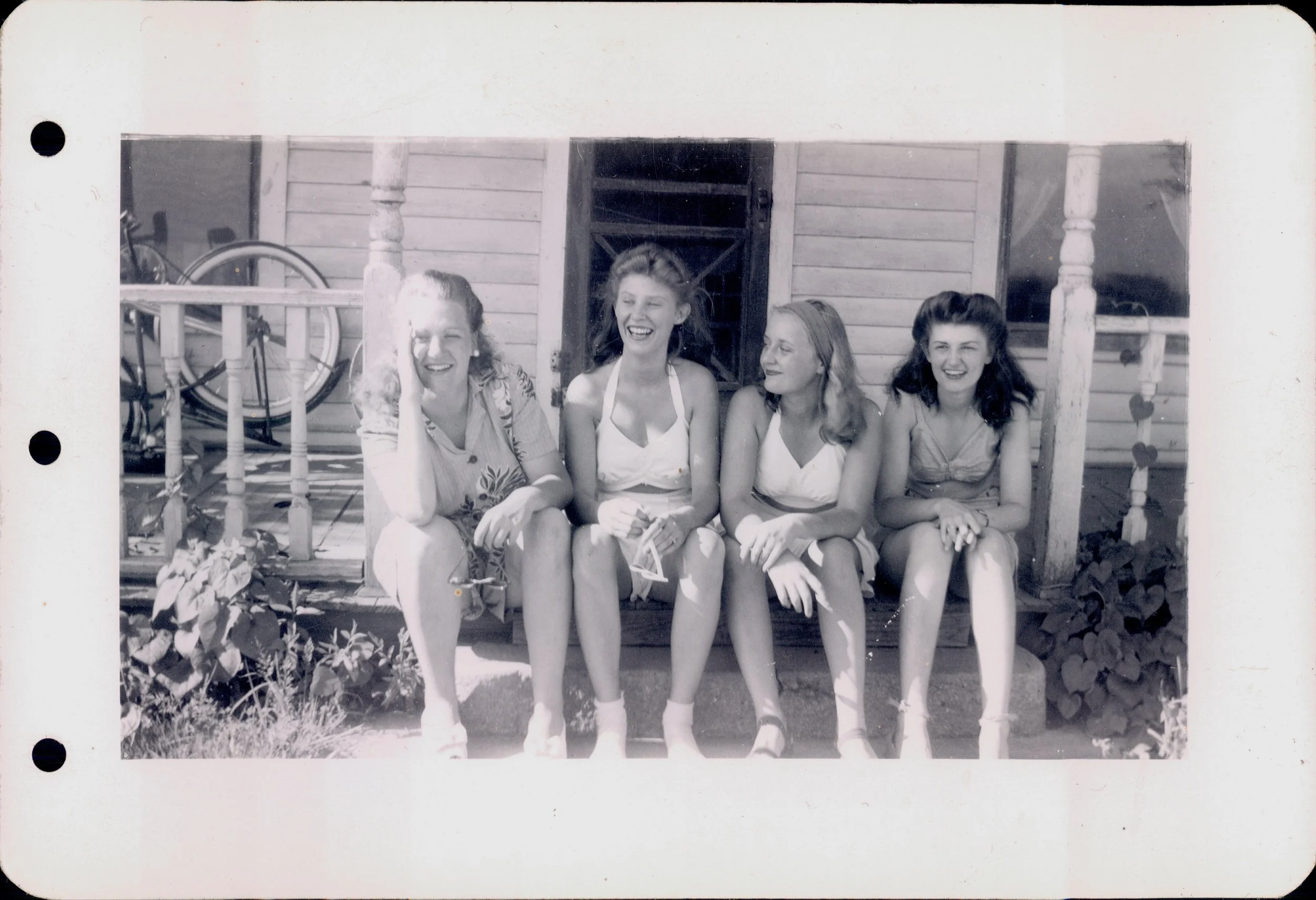
Rose Sleigh (left) and friends
Tribune, KS
Along with this came the village expectations and strictures that women were especially subjected to: you took care of your younger brothers and sisters, you cooked and cleaned, and when you weren't cooking and cleaning or caring for children, you worked in the fields. Your life from childhood to adulthood was work-work-work to exhaustion, producing your own children who wore you out even more, and if you reached old age, debility-sickness-death. That there was value in such a life Handke clearly understood. But the cost to a soul like his mother, an iconoclast to her bones, was profound. Likewise, my mother: I felt she was a kindred spirit to Handke's mother, both women of great intelligence who "refused to tame their own selves to fit in," as one of my mother's former students once put it.
My mother was desperate to escape the farm and saw education as her way out. Her intellectual brilliance created in her a fierce desire for a world beyond dirt farming, cattle, and driving the tractor, something she did for long hours from the time she was 11 years old. Encouraged by her mother, she became her high school valedictorian, won a small scholarship to Kansas University, and became the first person in her entire county, male or female, ever to go to college. Eventually, she became a legendary public high school English teacher—another reason I needed to write this book. She taught me to love words the way she loved words. And in our tangled history, no matter the deep tensions and estrangements that arose between us over her long life, it forged an unbreakable bond.
The end of my mother's story made me feel exactly as Handke did: "All at once, in my impotent rage, I felt the need of writing something about my mother." Handke's mother had killed herself because, as she wrote her husband, "it's unthinkable that I should go on living." And at the age of 97, my mother had a similar revelation forced on her by her cascading ailments, Parkinson's, neuropathy, congestive heart failure, stroke, blindness, and finally a deadly skin cancer. After she drank down what she called "the magic potion," a four-drug cocktail I procured for her so she could, as she put it, "do the deed", I held her hand and watched her go through all the physical stages of shutting down until her final snorting breath. Staring at her slack-mouthed, slack-bodied deadness, I knew with a sudden desolate certainty that it was now or never.
I'd spent most of my writing life as a poet, and to be sure, I'd been writing poems about her throughout the decade of her long, slow decline. Some of these would punctuate the book in the manner of a haibun. I had almost a hundred years of my mother's life to give shape to, and poetry had taught me how to compress a lot of material into a very short space. But the semi-autonomic nature of writing poems, in which you give language its head and follow the words wherever they take you, wasn't much help in figuring out how to structure a longer narrative. Besides that, I didn't really comprehend memoir as a genre—at least not the kind that focused on the writer's personal ups and downs. The ones that I did love, like Handke's, were rigorously focused on someone else. The narrator only emerges as the teller of the tale and was never the tale itself.
But knowing this abstractly and being able to discover it in the process of writing are two very separate things. In the beginning, there was an awful lot of me that kept getting in the way of my attempts to see my mother's life as not only separate from mine, but in terms that she herself might well have recognized. And again, Handke's example proved useful: by focusing so rigorously on how his mother's life had led up to the instant of her death, he taught me to shift my gaze away from my subjective feelings to the details of my mother's face and body, her clothes, her wigs, her fondness for high heeled shoes at a certain period of her life—in short, the complex of images that summoned up her physical being. Draft after draft of well over a hundred drafts, I slowly worked my way toward what Seamus Heaney called "the primal reach into the physical." And here is where extended narrative and imagistic compression met, in the task of feeling my way back into the physical richness and immediacy of the subject.
On the deepest level, I suppose you could say that my need to tell her story in minutely registered particulars was my way of keeping my mother near me. There were times when the process of writing grew so intense, when I was so absorbed in rendering her exact facial expressions or the subtle intonations of her voice, that I could almost fool myself into thinking that she hadn't really died but had crossed over in my words and come back to me.
That said, it was naive of me to think that just because my mother was dead that our relationship wouldn't keep evolving. As she had throughout my life, I could sense her presence looking over my shoulder—the skeptical narrowing of her eyes, her hands clasped in her lap, her head tilted to one side, judging, measuring, taking nothing for granted. Or her voice and mine would meld together into a kind of duet as she tested my words, her voice in my ear asking, just as she'd always done whenever I showed her something, "Really, Tom? That word? Don't you think that's a little hi-falutin'?" Or "This sentence gets a little woolly, don't you think? Try to find a way to make it more direct." And she was also tough on my tendency to generalize: She would often quote Hemingway's famous stricture, "Get out your shock-proof, CRAP DETECTOR!" Or she'd whisper in my ear Samuel Johnson's self-admonishment about the temptation to indulge in high-flown abstractions: "Read over your compositions, and wherever you meet with a passage which you think is particularly fine, strike it out."
But what most helped me write the book was learning how to get past my desire to find something therapeutically redemptive or consoling in the story. The whole "stages of grief" paradigm had nothing to do with the chaos of mixed feelings I felt. Once I realized this, the structure and subject matter of the book began to clarify. I had access to new registers of speech that I hadn't known I needed: mainly, the colloquial genius of my mother's casual conversation that could rise to heights of astonishingly original, plain-spoken eloquence. Throughout her life and again in her death, I was quietly dazzled by her vocabulary's off-kilter mix between the faux-naif of "honey" and "darn," the saltiness of "pissant," and her fifty-cent words like "pusillanimous" and "exsanguinate."
When I finally finished the book—which I very much think of as a collaboration between us, both psychically and literally in that it includes passages from my mother's journal that I discovered by chance just minutes after she'd died— I realized that my focus on the physical details of our life together was because I wanted to bring her back to life. Literally. Of course, the attempt was doomed: nothing I could write would compensate for having lost her. Yet it was the only ambition that made sense to me. If books can't bring the dead back to life—the way they talk, think, stand—at least for the time it takes to read them, what good are they?
I know for some people that writing a memoir helps them find closure on something painful. For me, it was just the opposite. I wrote Rosie to keep my mother near me—but when I finished, I felt as if I'd lost her a second time.
Handke, too, worried that by turning his mother into words, she would vanish into "art." I understand his fear. But for me it was the only way I knew how to honor what my mother had given me: writing was our bond. No matter how estranged or troubled or complicated things got between us, it always brought us, if not together, as close as we could come.
Which is yet another reason why I so love A Sorrow Beyond Dreams. Handke's obsessive particularity about his mother's life before, during, and after the war provides the shrewdest and most convincing refutation of the kind of banal generalities and abstractions that Handke indulges in his book about the Bosnian War. It is fiercely anti-fascist in that it refuses broad strokes, the Big Picture, for the intimate details in which an entire culture expresses its deepest, most contradictory beliefs. No other book I know of exposes with such minute clarity the psychological underpinnings and appeal of fascism and how it can take over a whole society—as his mother witnessed in Nazi Austria.
Instead of denunciations or slogans or moral bromides, Handke shows how Nazism manifested itself in the hats and shoes, the dresses and scarves, the parties and dances that distracted the members of his mother's generation from the murderous intent of Hitler's gradual take-over. In other words, Handke reversed the scale: World War II only becomes important for the fine-grained details of how it became a factor in his mother's suicide. This insistence on the particular, rendered with great clarity and directness, is a habit of mind that my mother would have approved of even as she exhorted me to go deeper, to go all the way to the bottom—and the bottom, as she never tired of telling me, "is a long way down."
In one of her journal entries about the myth of the unicorn and how royalty wanted to kill the beast for the magical properties of its horn, she poses a question that haunts every writer, especially one who is writing about an actual person: "The larger darker implications of the myth are notably complementary, but are they symbolically truthful?" In writing about her, was I simply making her into a myth, harmonizing "the darker implications" in our relationship, so that I could finally bury her for good under the rubric "Difficult But Beloved Mama?" A myth that I could live with, that I could control, but which might not be "symbolically truthful?"
That question hangs above everything I wrote about our life together, just as it hangs above Handke and his mother. When Handke wrote his apologia for Milosevic, my ma would have spotted right off how he'd fallen for his own authority as The Moralist, and how his genius for observing contradictory psychological minutiae had gotten crushed by his need to play what Seamus Heaney once called “The Absolute Speaker.”
The night before my ma took her own life, she asked me to read aloud to her (her macular degeneration made it impossible for her to read ) from Will and Ariel Durant's The Story of Civilization. It's an eleven volume work she'd read half a century ago and was now revisiting. Various readers had helped her work her way through prehistory, ancient Egypt and Sumeria, through the flourishing of the Greek city-states and the eventual war with Xerxes and the Persians, the early dynasties of China and Japan, through Rome's founding and the Carthaginian wars, and up to the moment when the Republic was in the balance and Julius Caesar was about to be assassinated.
I loved how she bent her head as she listened, fiercely concentrating, alert to every nuance in the soothsayer's prophecy that Caesar should "Beware the Ides of March!" She'd once left a cryptic message on my answering machine, saying "Beware the Ides of March, Tom! Beware! They have come but not gone!" laughing as she hung up. I couldn't help but see how she could see the grim humor of my reading to her about the fall of the Roman Republic even as she would bring about her own fall by noon the next day. Of course, it was more complicated than that: if she were Caesar, then she was also one of the conspirators plotting to kill Caesar. Which of course made me her co-conspirator, a role that fills me with disquiet to this day.
But for now, she was totally absorbed in the drama unfolding in Caesar's progress to the Senate. I could sense her tensing up, anticipating the moment when the soothsayer would try to warn Caesar, only to have Caesar dismiss him and walk on. She gripped her armchair as the conspirators surrounded him, and as one of them began to tear Caesar's toga from his shoulders—the agreed upon signal—they unsheathed their knives and went to work. When Brutus stabbed Caesar, my ma murmured the famous Shakespearean tag, "Et tu, Brute?" And as Caesar fell all bloodied by his wounds, she looked me in the eye and said, "Wooohooo! That's quite the tale."

Tom Sleigh is the author of eleven books of poetry including winner of the 2023 Paterson Poetry Prize The King’s Touch (Graywolf Press, 2022), House of Fact, House of Ruin (Graywolf Press, 2018), Station Zed (Graywolf Press, 2015), and Army Cats (Graywolf Press, 2011). His most recent book of essays, The Land Between Two Rivers: Writing In an Age of Refugees (Graywolf Press, 2018) recounts his time as a journalist in the Middle East and Africa. He has been a Guggenheim Fellow, NEA grant recipient, and winner of numerous awards including the Kingsley Tufts Award, Shelley Memorial Award from the Poetry Society of America, John Updike Award and Academy Award from the American Academy of Arts and Letters. His poems appear in The New Yorker, The Atlantic, Threepenny Review, Poetry, The Southern Review, Harvard Review, Raritan, The Common and many other magazines. He is a Distinguished Professor in the MFA Program at Hunter College and lives in Brooklyn, NY.