
In the City of Lions
“Let's rest for a moment and look behind us.
How good it is to gaze at the road we've already passed.
From afar the rusty trail of smoke torn by trees
marks the train's course against the sky.”
—from “Arrival,” by Maurycy (Mosze) Szymel (1903-1942)
Translated by Aniela and Jerzy Gregorek¹
May 2015
I am traveling to Lviv, in western Ukraine, researching the fate of a Jewish family from western Poland, who came to this city in September 1939, when Lviv was called Lwów, the name on most maps at the time. Josephine and Julius and their two teenage children, Peter and Suzanna, were among the thousands of refugees who trundled into Lwów every day during the very beginning of the war, carrying whatever earthly possessions they had salvaged from the homes and businesses they left behind. We do not know what the four-member family carried, but I’ve already imagined, for the novel I will write about them, that they provisioned rucksacks with great care and forethought.They traveled from Warsaw, likely via Lublin, passing by Otwock, Izbica, Zamosc. On my route from Kraków are towns I will read about much later—including Bochnia, Tarnow, Jaroslaw, and Przemýsl—places of various population densities and numbers of Jewish inhabitants, places that were bombed, invaded, destroyed. Places where Nazi terror was unleashed at the very outset of the war.
Coming out of all these towns along the way to Lviv—from the west and the north—were thousands upon thousands of people, most of them Jews, fleeing atrocities they witnessed or had heard reported by others. A river of humanity moving away from homelands poisoned with agony. Strange, I think, that many of the words used to describe the movement of people displaced by war are connected to water, even when their displacement occurs over land: as in a wave or flood or swell of refugees, who sometimes pour into a place. Wave suggests a perpetual churning curl and crash, while flood and swell conjure rising bodies of water. But instead of seas, rivers, or lakes, the bodies of water are those of men, women, children, all of them materializing from the dust on the road or the oily sheen on the macadam, crossing bridges and crowding streets. Unlike the salty froth of seafoam that dissipates in the air, these people become solid, walking ahead to this place or that, swallowed, as it were, by the landscape. It’s stranger still that one might say a wave or flood of refugees coming into Lviv in particular, as the Poltva River, which once flowed through this city, was diverted underground to prevent flooding.²
As Toni Morrison points out, “All water has a perfect memory and is forever trying to get back to where it was.” And the thing about Lviv is that it sits in a particular geography, at a crossroads between empires. The people who are pouring into the city at the start of World War II are likely the progeny of ancestors who came across these lands some centuries past on their own flights and searches for safety. Most of my own family likely came through this city several times, making their way to and from different parts of what is now Ukraine but has been divided—between the Habsburg and Russian empires, the Kingdom (then Commonwealth) ofPoland before World War I and the Republic of Poland after it, Nazi Germany, and the Soviet Union. Once I go to Lviv, I am completing an ancestral cycle, without realizing it at the time. Water seeking where it once was.
Here’s how the Polish poet Aleksander Wat described Lviv at the start of the war: “Lwów was mobbed with refugees.” Mobbed: now, there’s a word that muscles its way around. Like Josephine and her family, Wat came to Lwów after surviving the Siege of Warsaw; it’s possible that they crossed paths or walked upon the same ones. I like to imagine him having spoken with Julius, Josephine’s husband, in Brygidki Prison, where both men were initially interned.Because if the two men had met, perhaps Wat would have remembered Julius, carried his memory out of Lwów, where Julius was murdered, kept him alive for a little longer. In his oral memoir My Century, Wat tells us that by November-December of 1939, Lwów was a
city that had lost its beauty, a city besieged by fear. [Before the war] Lwów was one of the loveliest Polish cities in the sense that it was a merry city. Not so much the people but the city itself. Very colorful, very exotic. It had none of the grayness of Warsaw, or even Kraków or Poznań. Its exoticism made it a very European city. Vienna, of course, had influenced Kraków, but its influence made Kraków an Austrian bureaucratic city, a city with an Austrian bureaucracy and an Austrian bureaucratic university. Lwów was a bit more like the Vienna of operetta, the Vienna of joie de vivre. [...] Well, the Soviets had barely arrived, and all at once everything was covered in mud (of course it was fall), dirty, gray, shabby. People began cringing and slinking down the streets. Right away people started wearing ragged clothes; obviously they were afraid to be seen in their better clothes.
I am traveling to Lviv in a car driven by a retired Polish Army colonel named Kris. He’s been all over the world, and now he guides and assists people traveling to destinations in Central and Eastern Europe. He drives with hands positioned at ten and two, posture perfect, his eyes bright in that telltale way of an alert and curious man. He likes opera and show tunes and listening to the music, I alternate between looking out the window at the expanses of bright yellow rapeseed and closing my eyes, not really asleep but wandering in the liminal space that travel allows you to inhabit.
From time to time, we talk. I ask Kris about words on signs and vehicles and buildings, and he translates. His sense of order—from the spotless interior of the car to his disquisition on why a slower driver should not be in the lane designated for faster traffic—endears him to me; I call him The Colonel. He’s earned this title from all the peace-keeping tours he’s made, from Asia to the Middle East and, too, from his commanding demeanor. He tells me he was born in Szczebrzeszyn, and when he encourages me to try and pronounce the name, I fail, and we both laugh. His town is famous because it stars in a well-known Polish tongue twister. “W Szczebrzeszynie chrzaszcz brzmi w trzcinie,” he says, which I don’t even attempt, and which translates as, “In Szczebrzeszyn a beetle buzzes in the reed.”
Later, I will think of beetles buzzing in the reeds, wondering if they could be heard when Julius and Josephine and their children passed by Szczebrzeszyn en route to Lviv. Did Peter and Suzanna—he almost seventeen, she thirteen—try to outdo one another saying the tongue twister? Did their mother tell them to hush and did their father smile inwardly?
As we motor along, I think about a conversation with Kris when we first met in Vienna, several days earlier. “There’s a Polish saying,” he had said without any hesitation after surely counting the number of bags next to me on the sidewalk outside the hotel. “Better to carry than to ask.”
Traveling abroad for the first time in over two decades, I was unsure what to pack. And my compulsion is to leave home with enough of whatever it is that might be needed, all contingencies—social, weather, health—considered. By the time Kris arrived to fetch me, my belongings had multiplied to include food procured for the eastward drive to Krakow, Lwów, and Cieszyn, and gifts purchased in Vienna for people I’d be meeting along the way. Thus, something on the order of eight bags. Maybe ten. As soon as Kris says the words better to carry than to ask, I feel the stirrings of my partially Polish self, a hint, I think now, that I belong to this story and it to me in ways I cannot yet understand, though I know that the narrative and its making has permitted me entry into the realm of unexpected synchronicity and that associations such as these often supply keys to other geographies of thought. I have not yet learned how many such synchronicities will surface as this project blossoms, but each time one occurs, it is as if a message has been delivered, one with no words, rather, the feeling of being in the right place at the right time. I make note of the adage because I know, too, that it will be important to the book I am preparing to write.
Kris and I are traveling in a vehicle packed with belongings and provisions and are on our way east. But mode of transport and relative volume of portage are the only things we have in common with the refugees who fled to Lviv from the west: there is no comparison between the tragic flight from Poland and our engagement in this errand, commissioned by Julius and Josephine’s grandson. In the autumn of 1939, the German Army advanced at a speed made more rapid by clear weather, a poor military defense strategy on the part of the Polish Army, and the nonexistent (though expected) support from England and France. Communities in the direct path of the Germans were razed, and the civilians who fled—for the most part, Jewish refugees, but also other ethnic and political minorities—witnessed every kind of insult and injury, from the destruction of synagogues, businesses, and homes and theft of property, to arrest and subsequent deportation, public assault and murder.Those who fled took only what they could carry as they haltingly advanced along congested roads, under low-flying Nazi bombers. They faced the requisitioning of their vehicles by the Polish Army, and anyway, very soon petrol was unavailable. They hid in ditches and fields and woods. Some sought and received shelter in farmhouses. Some were separated from their families, friends, and other traveling companions. If they weren’t injured or killed, they made it to the next minute, the next hour, the next day, and if they were very lucky, from one week to the next. “We were afraid for tomorrow,” wrote one boy. This minute-to-minute life endured for more than six years, and only those who were in exactly the right place at the right time did not perish.The odds of surviving were not even knowable at the time, and no one had time to second guess what would happen next. And, who would want to contemplate such probability?
The lives of those in the path of the Nazis had gone from pre-war tense but relatively normal to anxiety-ridden and extremely unpredictable. Within one week, western Poland, including the region known as Upper Silesia (where I will travel after visiting Lviv), was under German occupation. The Nazis marched into and claimed Warsaw on the twenty-seventh of September. In eastern Poland, the Soviets—who had a secret nonaggression pact with the Nazis which carved up Poland between the two countries—invaded on September 17. The Red Army and NKVD (Soviet secret police) proceeded to settle in, which meant requisitioning apartments, emptying all the shops, posting decrees, and imposing their will.
The city went from merry to emptied, drab, and dangerous in a matter of weeks. Winter was coming, and no one could yet see what the next twenty-one months would be like or how that period would end with the Soviets retreating as Nazis advanced into the USSR in the summer of 1941. So much murder was committed in these places where the Soviets and Nazis overlapped that historian Timothy Snyder christened them the Bloodlands.
[As of this writing—January, 2026— Lviv is once again a city of refugees, who have the distinction of being internally displaced persons, meaning Ukrainians who fled westward to escape the advancing Russian assault. When I was in Lviv sixteen years ago, the war was confined to eastern Ukraine, and Zelensky hadn’t yet won the election against Poroshenko, a billionaire oligarch.]
Kris and I depart Krakow after lunch, and although the drive to Lviv should take just under four hours, a three-hour delay at the border puts us in the city after dark. I traveled to Ukraine only once before, when it was still part of the Soviet Union, and in its sluggishness, this border crossing is reminiscent of the slow, gray crawl of Communist bureaucracies. Which is likely why Kris shifts in his seat and shuffles our passports as we wait and wait and wait: for over half his life and until 1989, he lived under the Soviet shadow, and although the brand of Communism in Poland was more of a socialist experiment (private farms and businesses, the presence of the church, Kris tells me) and quite different from the Stalinist USSR, I picture him waiting on a variety of iconic lines throughout those times. Kris’s parents survived the war and its aftermath, which is to say Nazi occupation and Soviet politics. He was born and came of age in the Polish People’s Republic; his elders who survived the war talked little about what they had witnessed or experienced. Stoically silent, I think, which describes not only the family I am writing about but also my own ancestors, who fled their homelands under different yet similar circumstances and then never said a word about the worlds in which they once lived.
To arrive in Lviv at nightfall is to be swaddled in shadow. Later, I will appreciate the symbolism of arriving in the dark because so much is still invisible to me in the narrative to come out of these travels. For now, I concentrate on shuttling my bags into the lobby of the Hotel Leopolis and checking in. Before saying goodnight, Kris reminds me to lock my door. In the elevator, I think of his promises to protect me in Ukraine, a country whose relationship with Poland has been contentious for centuries, whose economy is crashing, and whose borders to the east are at the center of what will become another ache of war that lasts seemingly forever.³ Now, however, he is chiefly concerned with his vehicle; the hotel doesn’t provide a secure parking facility. During our stay here, Kris will wake at five each morning to check on the car.
Housed in a UNESCO World Heritage Site building, the Hotel Leopolis is a reminder of the “merry city” Aleksander Wat remembered, when Lviv was called Lemberg, a destination in the Habsburg Empire’s eastern reaches for intellectuals and patrons of culture and a stopping point for travelers coming from near and distant lands. The city was home to a large Jewish population, some of whose families had settled there at the invitation of the fourteenth-century king, Casimir the Great. By the twentieth century, Lviv was a center of advanced study and artistic pursuits. Members of the Polish School of Mathematicians met at the Scottish Café to discuss and solve problems.Hersch Lauterpacht and Rafael Lemkin studied law here, when the city was called by its Polish name, Lwów. The legal work of these two men, before and during the Nuremberg trials, gave the world terms such as genocide and crimes against humanity. The Jewish philosopher Martin Buber lived here as a boy; the writer Stanisław Lem lived here and survived the Shoah; the poet Zbigniew Herbert was born here and secretly sat his Matura exams under Nazi occupation. Echoing in my mind are these lines from the poet Adam Zagajewski, who was born here at the end of the war and knew the city by its Russian name, Lvov:“To leave / in haste for Lvov, night or day, in September / or in March […] But only if Lvov exists, / if it is to be found within the frontiers and not just / in my new passport.”
The Leopolis staff (attired in black and white, their grooming impeccable) and the somber but plush décor speak to a bygone time, and like the now-popular vintage aesthetic, reflects our human urge toward nostalgia, to return, and in this case, to a past when a certain decorum was still valued, even if it belied the truth, that human rights were not universally recognized. The desk clerks and bellhops speak English and French, but it’s not hard to imagine them over a century ago, speaking German, Polish, and Russian, too, languages spoken now with an undercurrent of disdain.⁴ They’ve been meticulously trained to smile and be inscrutable, efficient, and discrete, an absurd blend of luxury-hotel customer service and residual but still potent Iron Curtain menace. To stay here, you might never know about particular instances of the past—the executions by the Soviets as they retreated, the continued violence by the invading Nazis. And because the hotel belongs to a time before those brutal years, the present is absent, too, and thus you might not realize how devalued the Ukrainian hryvnia is, or that a war continues in the eastern part of the country, or that rampant corruption will prompt the election of a lawyer-turned-comedian to the presidency in a future one cannot yet know.
The building, too, belongs to another time, when the people at the center of my narrative were still young, before their trajectories were diverted by the war that fragmented their family. At the start of the war, Josephine and Julius and their two children, Peter and Suzanna, lived for a brief time in Lwów, though not in the manner to which they had been accustomed. I know they came to this city, not from anything they told their children or grandchildren, nor from any written chronicles or oral testimonies they left behind, but from an unpublished autobiographical account of the war years by one of Julius’s employees, a young man named Eric, whose cousins I will meet in several days when I continue my travels in Poland.⁵
As I stand at the front desk at the Hotel Leopolis, I can picture Josephine standing here in the 1920s, newly married, hair smartly bobbed, her tall and angular frame perfect for the modern-woman fashions of the times. She waits in the lobby for a porter to take her trunk to her room. Her cheeks are slightly flushed, from walking, or the heat, depending on the season, and perhaps she’s looking forward to attending a ballet at the Grand Theatre,⁶ a building completed the year of her birth and crowned with its winged bronzes depicting Glory, Poetry, and Music. Maybe she and Julius have seats at the Colosseum Theatre,⁷ where they’d take in a comedy or an operetta.
I’d love to have talked with Josephine, but not as I picture her in the prewar and thus nevermore past, where she lived and made memories that were stolen from her. Rather our conversation should take place after she settled into a new life in England, when she is older, in her sixties, perhaps, a woman who, in sitting down to talk to me, decides, as she never did while alive, to finally unburden herself of the secrets she carried during her six-year passage through the uncertainty, trauma, and sorrow of the war.
In these, my daydreams, the city is not important, for she has lived in and visited many, but the Central European ambience is critical because it defined Josephine’s tastes and cultural inclinations. Thus, we sit in a café, a thin light filtered and dimmed by gauzy white curtains, banquettes upholstered in dark crimson velvet. Josephine holds a cup of coffee in one hand and looks me straight in the eye.
“Oh yes,” she says, “my life changed dramatically in Lwów.”
In my imagined exchange with her, she wouldn’t refer to the city by its Ukrainian name. She might have called it Lemberg, from its tenure as a territory of the Austria-Hungarian Empire, but more likely, she would have used the Polish name she knew it by when she came here during the interwar period and then for the last time in September 1939.
No matter the name she uses for this city, her face, one I will spend hundreds of hours scrutinizing in hundreds of family photographs, materializes. She is coming alive more and more in my mind, and I am certain she is on the brink of telling me something about those war years, the ordeal, she might have called it privately. I’ve come to Austria, Poland, and Ukraine to find out more about her and her family. All we really know at the outset of this project is this: Fleeing the advancing Germans, Josephine and her family come to Lwów as refugees and leave as prisoners. Here, I’ll learn, her husband is arrested, imprisoned, and executed by the NKVD, and here she and her children are taken in the middle of the night to the train station, loaded into cattle-car wagons, and deported to a forced-labor camp eight hundred miles north of Moscow in the Mari El Republic.
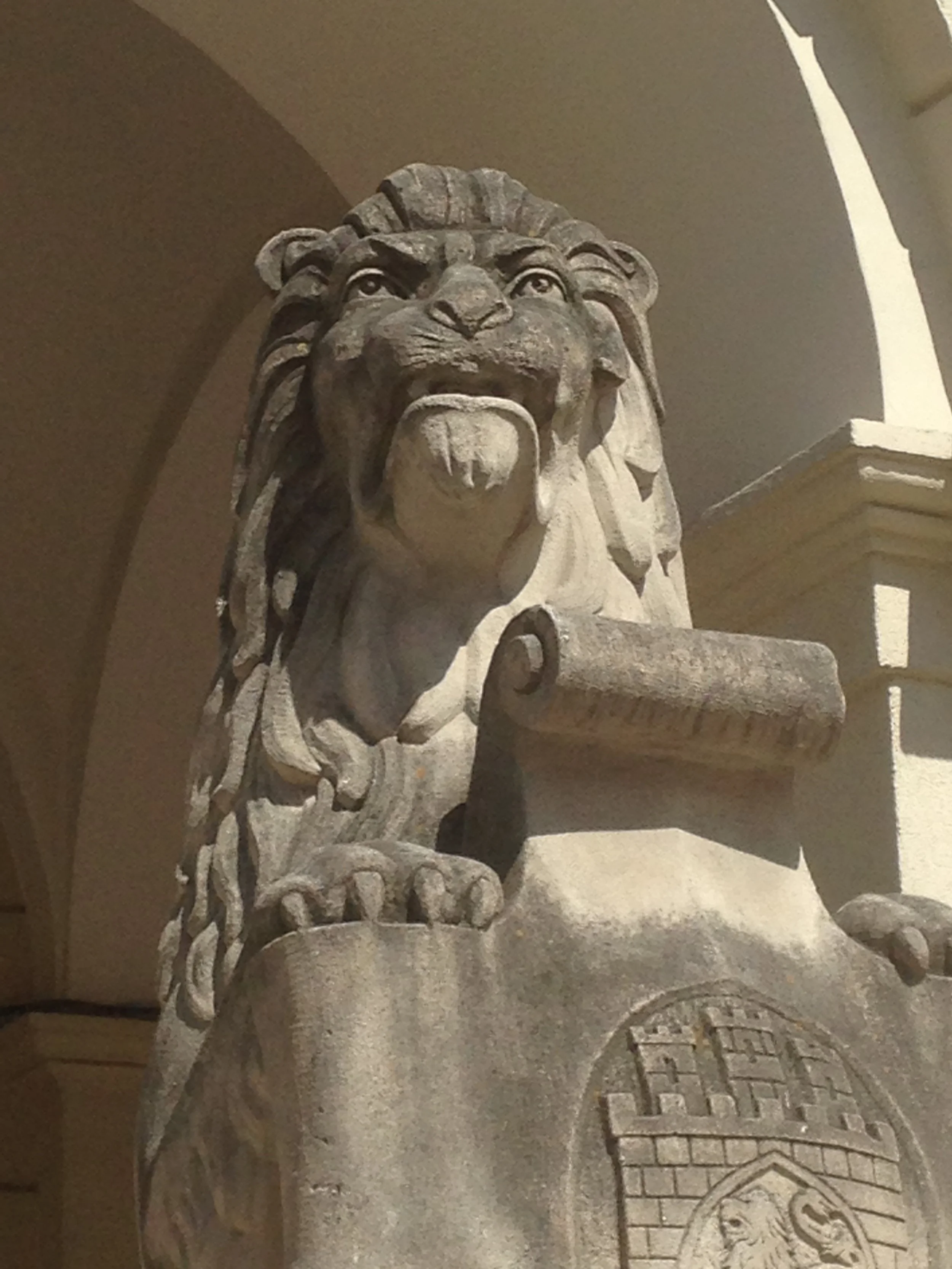
But before Josephine tells me what I need to know, the daydream dissolves. I will have to rely on what I see and read and imagine in the present. Eventually, the research will uncover some of the specifics of where and when. For now, however, walking the city will provide other details. The first morning in Lviv, I wander from Market Square, past the Postal Museum, to the St. Eucharist Church and Dominican Monastery and the park at Muzeyna Square. The trees in the park, their green vibrant in the May light, lean a little, and I wonder if Josephine and her family might have walked here. Lviv is a city of small museums, several bookstores, statues of Greek and Roman gods, fountains, and intricate architectural details in older doorways and windows. Lions are everywhere, a homage to Lev, son of the thirteenth-century ruler Danylo Romanovych who founded the city. The lions stand in front of buildings and are carved into doorways and atop windows; they grace porticos, decorate fountains, stand guard over the city.More than four thousand lions can be found in Lviv, in public spaces and shops, cemeteries, churches, courtyards. I don’t have enough time to see them all, and this thought causes a kind of nostalgic melancholy for a city I never knew and cannot know during such a short sojourn. Still, I wonder, whose hands touched those lions before the person they were attached to, a resident of the city or a refugee flooding it, were dispatched into the future? Which children lingered in front of one or another before being whisked away to tragedy? What small possessions—hair ribbons or books or spoons—fell out of their pockets at the foot of these lions?
Lviv also offers the inevitable retail aimed at those sojourning briefly: cheap gag souvenirs, reproductions of religious icons, and in a nod to its moment as the capital of Austrian Galicia, it is a city enamored of fine coffee. I explore Federova and Arsenalska boulevards and then Staryevreiska (Old Jewry) Boulevard and what was once the Jewish quarter. I eat lunch at the Café at the Golden Rose where there are no prices on the menu and one bargains with the waiter. Eventually, he’ll make you sing a song. For a rendition of “Hava Nagila,” I procure a menu. The café’s name commemorates what was once the largest synagogue in Ukraine, and I imagine Josephine and her family walking by it and thinking about their own house of worship back home, destroyed by the Germans in the first days of the invasion. “All that remain are fragments,” I read in an informational sign. Just like the family I am researching, whose wartime story comprises fragments, which are dispersed across the world.
In the afternoon, I set off looking for places mentioned in Eric’s autobiographical account of the early days of the war. My first stop is Brygidki Prison, where Julius was originally incarcerated by the Soviets. Ukraine’s oldest prison is located in a former Bridgettine nunnery, named after Bridget of Sweden, a fourteenth-century mystic and saint. Founded in the seventeenth century as a convent for the daughters of noble families, Brygidki was made into a prison in 1784 and is still in use today as a penitentiary, though plans to move it outside the city have been entertained but not yet realized.
“A short time after returning from Zloczów, Julius was arrested and incarcerated at Brygidki Prison in the center of Lwów,” Eric wrote. “Prisoners in Brygidki included bourgeoisie, capitalists, officers, officials of the Polish Army and government, and politicians—executions occurred at night without explanation.” Twice a week Eric delivered a change of clean clothes for his former employer. “The package would be accepted by the guards,” he wrote, and “one day, the usual change of clothes was turned away by the prison guards, and nothing was heard of Julius again.”
The four-hundred-year-old building on Horodotska Street in Lviv has been a prison for most of its life.If you didn’t know this fact or never looked up to the brambles of concertina wire, you’d still feel something here that told you this was a place from which few people returned. Virginia Woolf says every house has its season. For Brygidki, it is always just before the end of winter, when you think you can’t possibly take one more day of damp cold or gray slush, and a storm deposits a foot of snow that you no longer have the energy to remove. Brygidki is too crowded—historians will tell you that the prison’s capacity has always been exceeded—and the residue of suffering hangs in the air, threatening, like an infection. One year after the next, the prisoners in this edifice experienced execution and the threat of death, torture, violence, neglect, corruption, starvation, disease, apathy, disdain, humiliation, and, too, because they were human, all-too brief moments of something like joy (the singing from cell to cell of Christmas songs one night during the war) and even something like salvation (a seventeen-year-old girl buried with her prayer book).
To read accounts of how prisoners were treated in Brygidki or Zamarstynyvska⁸ forces you to contemplate unbearable outrages against humanity. The only hope you feel after learning how disgracefully people acted—and it is on purpose that I do not repeat the horrific details here, so as to stave off the viral capacity such details possess—is knowing that, as one prisoner put it, “the human organism can survive anything”.⁹ But what does that survival cost? Silence, certainly, and the repression- and suppression-related toxicity-to-self it engenders is one price. Retributive brutality and violence is another. And if resilience is the ability to spring back into shape, recover quickly from adversity, what is the nature of antifragility, that capability of thriving as a result of chaos, uncertainty, and trouble? And what is the genesis of such fortitude, or, for that matter, of ethical character? These are questions I will consider in writing about this family.
I spend several hours hoping to find a clue as to where the Café de la Paix was located, an establishment where, in the autumn of 1939, you paid one zloty for a seat and where refugees gathered during the first years of the war, a place the characters in my novel will visit because Eric’s autobiographical account tells us that the real people they are based on came here, too. How I long to enter this café that no longer exists, where intellectuals and poets once sat, exhausted but still mostly whole, wanting to believe that some residue of their spirits might remain in the furniture and walls in the way that water is recycled over time. In the general vicinity of present-day Miskevycha Square, where I think the café is located, I find only a restaurant on the second floor of a building. When I enquire as to whether this was the location of the Café de la Paix, no one can confirm because no one I ask has ever heard of it. In this bubble of forgetfulness resides the genesis of History, the cry to never forget, and all the complications in between. In the center of the square, a neoclassical column commemorates the Polish Romantic poet Adam Mickiewicz. The monument is another schism in time, a piece of the almost 500-year-old fabric of Polish history that undergirds this Ukrainian city. Dusk is falling as I take the photograph of the eatery’s neon sign, which says, simply, “Restaurant” (in Ukrainian), a picture that is out of focus. Later, I am not surprised that the image is blurry. Everything is.
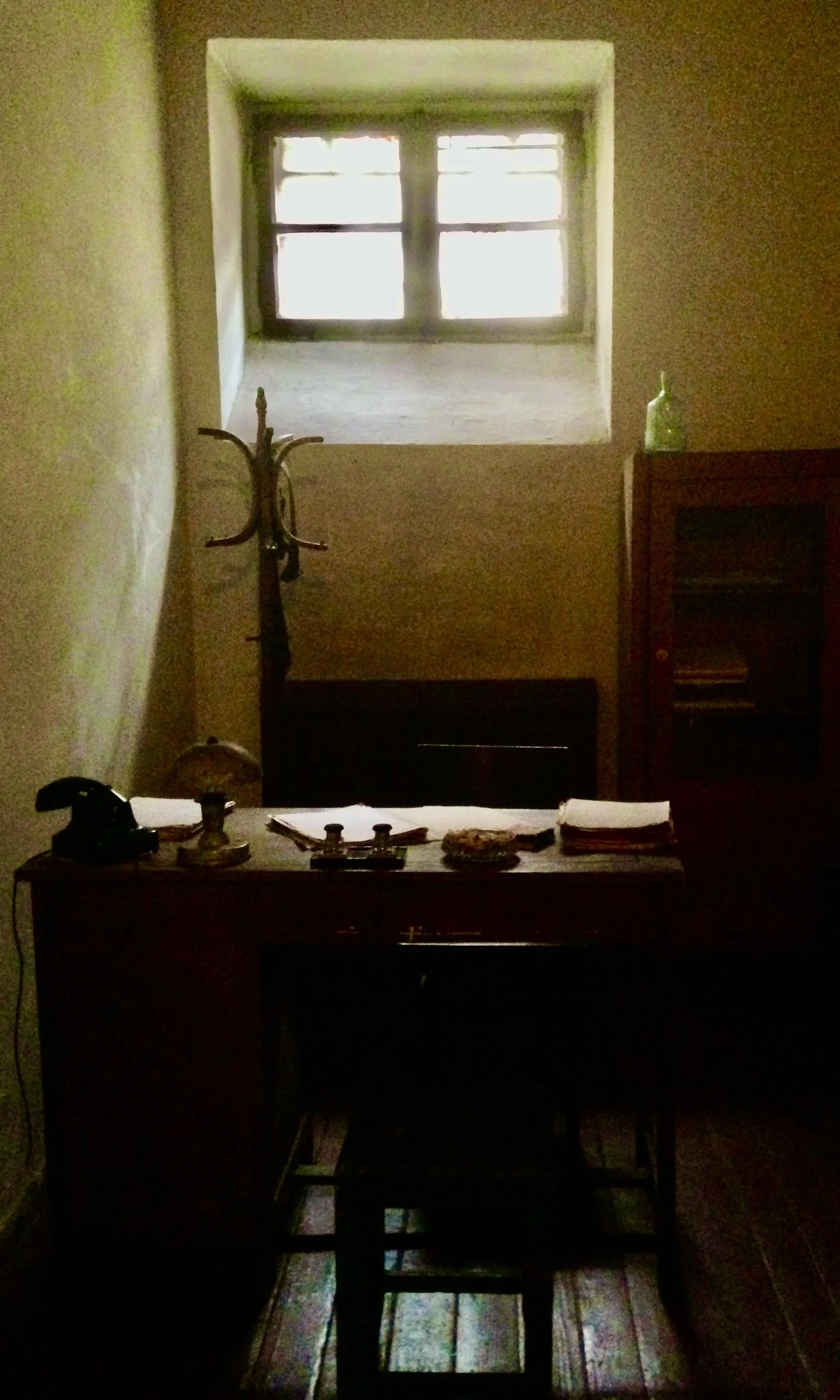
Intake room at the Lonskoho Street Prison
Before departing Lviv, we stop at the National Memorial Museum of Victims of Occupation Regimes, housed at the former prison at Lonskoho Street. Here the permanent exhibit includes the intake and interrogation rooms and prisoner cells. Contemporary exhibitions feature photos of people who survived the Communist penal system, memorials to those who died here, a video installation. As we tour this small museum, I don’t yet know that Julius was brought here first before his internment in Brygidki and subsequent transfer to Zamarstynyvska (known colloquially as Prison No. 2). But it is because of the museum—more specifically, because of a historian named Igor who works here—that we learn exactly what happened to Julius.
How Igor and I meet is one of those happy accidents. Kris and I get to talking with the woman who works the museum’s entrance. There is a man who works here, she tells us; his English is better than hers, and he is a historian. She leads us to his office on the second floor, which he shares with colleagues. Igor is tall and wears glasses. He seems nervous to me, in that way of people who read a lot of history and hear its echoes across time. He is the kind of thin that defines a man who would rather spend his evening hours in the library instead of having dinner. I tell him what we know—that Julius was in prison in Lviv, that his wife and two children were deported into the Soviet Union. He explains that a member of Julius’s family must write a letter requesting a search in the archives. He promises to handle the search. He accompanies us downstairs, pointing out the room, preserved as it is, where prisoner intakes were conducted.
“Your Julius,” he says, “likely sat in that room.”
Kris, Igor, the woman, and I chat before taking leave of one another. “Dziękuję,” I say, using the Polish word for thank you but meaning to say the Ukrainian Дякую (dyakuyu), and before I can attempt to correct my mistake, the woman’s face sours. She turns to walk away, and Igor explains to her that I didn’t mean anything by it, and she softens just an iota, and we all say goodbye and I say thank you in English. Meanwhile, I am wondering what it must be like to work in this building, where so many lives were altered, most of them ruined or ended. Or what it means to live in a city where the language in which a foreigner says thank you may be insulting.
As I try to see what Josephine and her family saw in this city, it is impossible to comprehend the dimension of the refugee swell that poured into Lwów, the transformation from plenty to penury ignited by the occupying Red Army, the start of a hunger that begins as an unpleasant emptiness and develops into an agonizing hollow, the smell of fear and uncertainty as pungent and wretched as the foulest odor. But I am certain that I feel the residue of despair as I walk here. I say I have come in search of a Jewish family from western Poland, but perhaps what I am really looking for, as Walt Whitman called it, is “what deepest remains,” the deposits of memory that endure after war and its tragedies have inflicted a learned forgetfulness, a necessary denial requisite for survival. I think about the river in Lviv, forced underground. And the flood of people above the Poltva then and now, stopping to look at or touch, even briefly, an unexpected lion, forging a memory that floats and returns, like water, a thing you can see and feel but cannot hold.
“Maurycy (Mosheh) Szymel was born into an Orthodox family in Lwów, where he graduated from high school. He made his literary debut in Chwila in 1925, initially writing poetry for children. From the beginning of the 1930s, he participated in Warsaw’s Jewish literary life, publishing a manifesto on Polish Jewish poetry in the weekly Opinia (1933) and writing for the Jewish press in Yiddish and Polish. In 1939 he returned to Lwów and published Yiddish works in Soviet literature. During the Nazi occupation, Szymel worked as a clerk for the Judenrat in Lwów. He died at the Janów labor camp” (The Yivo Encyclopedia of Jews in Eastern Europe).
The river flows directly beneath Lviv’s central street. In 1839, the river was diverted and incorporated into the underground sewer system. When the Nazis invaded the USSR in 1941, Jews hid in this sewer system.
I am referring to the Russo-Ukrainian War, which began in February 2014 and was escalated in 2022 with Putin’s genocidal invasion of Ukraine.
In Lviv, as in other parts of Ukraine, Poland and Russia have oppressed Ukrainians, and the Germans manipulated this history to tragic effect, especially for the Jews who lived in this region.
Eric was Julius’s apprentice at the family’s leather-tanning factory in Cieszyn (aka Teschen). Eric’s father, Jacob, was a butcher who perished in Auschwitz with his wife. Eric survived the war after escaping to the USSR, moving from one republic to another, and finally emigrating to Australia.
In Polish, Teatr Wielki; in German, Lemberger Oper.
The Colosseum Theater, also completed the year of Josephine’s birth, 1900, was a Jewish cultural institution where intercultural programming included cinema, theater, and vaudeville acts performed by Jewish, Polish, and Ukrainian performers.
Colloquially known as Prison No. 2, Zamarstynykska was, like Brygidki, converted in 1784 from a monastery to a prison. After a time in Brygidki, Julius Kohn was sent to Prison No. 2, and this is why packages sent to him were no longer accepted by the guards at Brygidki.
The Dark Side of the Moon, p. 87.
Kim Dana Kupperman is the series editor of The Best American Essays, the founder of Welcome Table Press, and the author of Six Thousand Miles to Home: A Novel (2018), The Last of Her: A Forensic Memoir (2016), and I Just Lately Started Buying Wings: Missives from the Other Side of Silence (2010). Research for this essay (part of a book-in-progress) was generously funded by the Suzanna Cohen Legacy Foundation.