
Queer Belonging and Ukraine
With curiosity and respect, I watch my fellow citizens observe their national traditions similarly to how I watch heteronormative families perform their familial rites. I see myself reflected in neither. The nomenclature of Ukrainian folk songs (shchedrykivky, haiivky, koliadky, vesnianky, and a dozen others) remains somewhat obscure to me, and so does the distinction between wedding and engagement rings, not to mention the finger they should be placed on. I can’t describe my relationship with Ukraine as anything but queer.
Some Ukrainians are compelled to embark on an archaeological journey to dig up the eternal roots of their national belonging. If the eternal is not available, generations-deep is second best. Sometimes, they succeed and discover hushed family histories of repressed grandmothers from the Ukrainian intelligentsia, traces of the Ukrainian language spoken and forgotten by their fathers who had moved from villages to cities for education and career prospects, or the ultimate evidence of vyshyvankas on sepia wedding photos.
Such finds help Ukrainians restore what was stolen from them by Russian colonialism. My compatriots feel vindicated in their sense of belonging. However, there is room for more ambiguous scenarios. Some of my fellow citizens uncover family traditions that are not Ukrainian but Jewish or Polish; others find out they descend from ethnic Russians and there is no ancestral vyshyvanka to cover their shame.
Amidst the ongoing genocide, this desire to ground our nationality in inherited characteristics is understandable. One wants an endangered identity to be innate and inseparable from one’s core self. If one’s family tree has borne blue and yellow fruit for centuries, if every molecule of one’s body has been inscribed with a little golden trident, never again can a re-education camp or a fit of colonial propaganda take away their nationality without also taking away their life.
Likewise, many queers rely on essentialist explanations of their sexuality as preordained by natural, physiological, or psychological factors. The way they hold on to determinism is also understandable: an inborn dissident desire is less likely to be discarded as transient, its repression to be treated frivolously. And yet, starting with the work of Michel Foucault and Jeffrey Weeks in the late 1970s, a constructivist perspective has emerged that views sexuality as a product of social, cultural, and political practices. This view has always resonated with me: an identity that is less nature, more culture, less fate, more choice.
I was born in the Russified south-east of the country three years before the collapse of the Soviet Union and grew up speaking Russian and surrounded by Russian speakers. If an enthusiastic ethno-nationalist were to assess my family tree, my claim to Ukrainian belonging would not hold water. Two Russian grandmothers, one Jewish grandfather, and only one Ukrainian granddad make up a less-than-flawless origin story. I was never taught how to be Ukrainian. When the time came, I taught myself.
My national consciousness was dormant until age 25 when I found myself singing the national anthem at Kyiv’s central square—the Maidan—amidst the Revolution of Dignity. From November 2013 to February 2014, Ukrainians rose up against police violence and the authoritarian rule of our then pro-Moscow government. Eventually, we succeeded in ousting the corrupt president-thug Viktor Yanukovych to Russia, the ultimate sanatorium for deposed cannibalistic regime leaders, which has also opened its doors to Syria’s Bashar al Assad.
When I joined the protests, it was to defend the rights and freedoms that Russia would annihilate if my country were to succumb to the Kremlin’s political will. At the Maidan, I met my fellow citizens of all ages and backgrounds who stood up for their right to define their country’s future. Warming up by the fire during freezing winter nights, we debated our visions of that future. We affirmed what Ernest Renan, in an essay ‘What is a Nation?’ (1882), called a ‘clearly expressed desire to continue a common life’.
The revolutionaries were ready to act together based on that desire, to fight and die for the cause. And they did. The first three protesters killed by the government in the centre of our capital were of Ukrainian, Armenian, and Belarusian origins. A hundred more deaths followed, but Ukrainians stood their ground. This choice, this stubbornness, and this resolve mattered more than their creed, lineage, or colour.
Our national identity is a choice we continue making daily. To get up after a sleepless night of bombings and stand our ground against Russia’s war of erasure. To nourish our culture on the stories of distant and not-so-distant past—to weave it like a camouflage net that protects us from the enemy, embroider it like a vyshyvanka that interlaces symbols old and new. To dare reinvent ourselves: because we are fierce, fearless, and free.
This consequential political choice was made in the past by Ukrainians who did not seamlessly belong to the nation. An icon of Ukrainian feminism Olha Kobylianska was born to a Ukrainian father and a Polonised German mother in Bukovyna, at the outskirts of the Austro-Hungarian empire, where Kobylianska started her literary work in the German language. A key author of the Ukrainian avant-garde thriving in Soviet Kharkiv in the 1920s was Maik Johansen who descended from Baltic Germans and wrote his first poems in German and Russian. Switching to Ukrainian, the language of a nation with no state, was a choice that, for Kobylianska, led to her marginalisation and delayed literary recognition and, for Johansen, to his murder during the Stalinist terror of the 1930s.
My national identity is incongruous. It’s constructed from the smell of dry grass in the southern Ukrainian steppe, now maimed and mined by the invaders; from unlearning my mother tongue, which Russians have weaponised against me; from the countless parcels, messages, and roads to and from the front; from keeping the wills and funeral playlists of my friends; from the choice to return to Ukraine at the dawn of the all-out war after living abroad for years.
My national identity is but a choice. What can be more powerful than that?
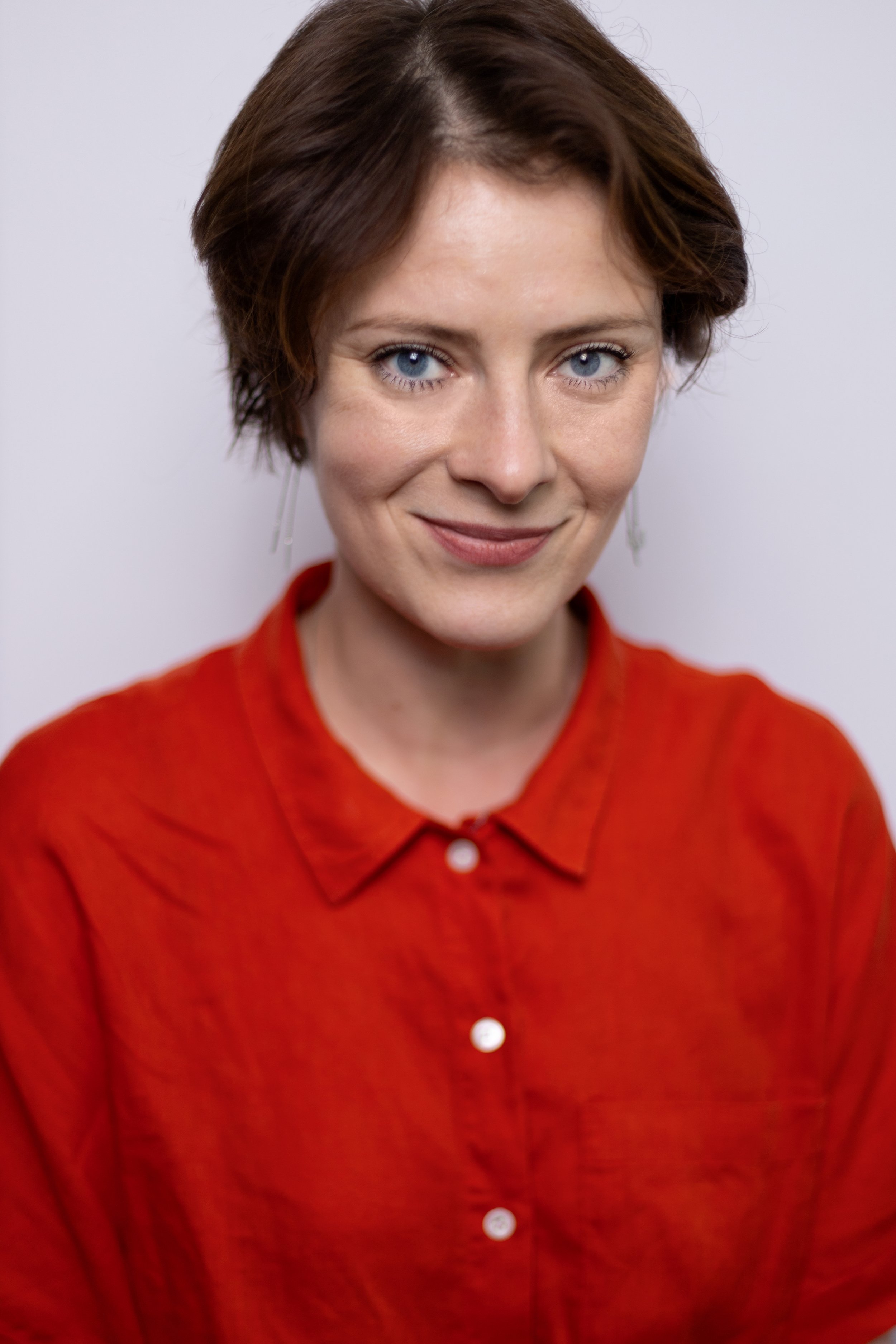
Sasha Dovzhyk is the head of INDEX: Institute for Documentation and Exchange, writer, and editor. She holds a PhD in English and Comparative Literature from Birkbeck, University of London, where she taught English literature for a number of years. She also worked as a special projects curator at the Ukrainian Institute London and taught Ukrainian literature and culture at the School of Slavonic and East European Studies at University College London. After nine years in London, she returned to Ukraine to lead INDEX — a cultural and research institution based in Lviv and dedicated to the documentation of wartime experiences. Dovzhyk remains the editor-in-chief of the London Ukrainian Review journal.