
Featured Poet: Vasyl Makhno
Intro
About a Crow
Mom returned from a trip and says:
“I barely opened the gate. But the house key
was in its place – it’s just more rusted.
And how about you?” She went to look
at our family cottage, which has been empty
for about two decades.
“Here,” I say, “the ocean has changed its color, and
I’m translating Carver.” Mom replies
that she has never seen the ocean and never heard of Carver.
“The ocean,” I say, “cannot be seized by the eye,
and Carver is an American prose writer and poet.”
“Don’t make things up,” says mom, “you’re always making things up.”
I imagine she didn’t go through Chortkiv,
but through Buchach - a nicer road, less damaged
by trucks. Then she approached the gate.
No, first, she must have taken her cane,
because she managed to say the acacia seeds,
that float in from the other side of the road
were sprouting around the barn. "They reach," she says,
“up to my waist." “What about the fence?” I ask.
“Yes,” she says, “everything’s collapsed and there’s no one
to talk to: those who are at the front are at the front,
and those who aren’t are hiding. You understand,
the war.” “I understand,” I say, “the war.”
“But everything else is in place?” I ask my mother.
“Where would it go? And Horb-Dolyna,
and Ta Hora, and the Dzhuryn, and everything that was
ours is in place, don’t you worry. And the lid
of the sky, and the Dzhuryn’s weeping, and the smell
of burning potato stalks, and the war.” And my mother sighs.
“If you want, I’ll read you my translation,” I say.
“Is it long?” “No,” I say, “It’s short. It’s called ‘My Crow.’”
“About a crow?” “Yes,” I say. “About a crow.” “About an ordinary crow?”
“Why are you surprised?” “Because when I was walking along
the wood, in front of the road sign, crows
were walking on the road and picking up grain.”
A day later I talk to my childhood friend.
"I'm going,” he says, " to prune the acacias."
Like my mother, he rarely visits his family places.
He probably remembers the sound of the Dzhuryn
the wormwood smell of clay pits, swallows before the rain,
our childhood rambles, our swims in the river.
What's the point then of visiting often
if you carry everything in your memory like a matchbox,
just in case? "Half of the houses," he says, "are empty.
The smithy has collapsed. The old clubhouse has collapsed.
And how about you?" he asks. " I’ve translated a poem by Carver."
"What poem?" "About a crow." "About an ordinary crow?"
he wonders. “Yes,” I reply. “Don’t crows have a place in poetry?”
“In those acacias,” he admits, “there are so many crows’ nests.”
I imagine how he’ll be cutting the gnarled branches
with a saw. How the crows’ nests will fall to the ground,
how he’ll pull them to the shed, for they’re good for kindling,
and in the spring, the crows will weave their nests again,
but not in the acacias. Smart fellows will find other trees.
Females will lay eggs in the nests,
elongated eggs, as if smeared in clay,
and in the summer, they’ll fly in flocks along
the horizon towards Pozhezhe. “Maybe it’s because of the war,”
mother said after hearing the translation,
“that there’re so many crows in our sky?”
A Nut Tree as a Deer
Geese flew over the roofs. And from the ocean
a helicopter rumbled. Snow clouds were gathering,
the wind was howling. I pulled out a shovel and leaned
on the handle, looking for another goose flock,
which I didn’t see. I heard it, though.
Perhaps the nut tree saw it, because it's tall.
Letters collected in the computer
I haven't replied to for a week, so back home,
I breathed on my frozen fingers
and read bold subject lines.
I forgot to ask the nut tree about the geese:
where did they go? It certainly saw them.
But maybe it won't tell me, because who am I to it?
In the summer I sit in its dappled shade.
In the fall I complain about the red tiles of its leaves.
In the winter, what about the winter? Well, I ask it about geese,
about the brooding sound of the ocean, and its silent
coexistence with the house.
The nut tree often peeks into my window on the second
floor and even leans down to the cellar windows.
From its trunk, two thick boughs spread
in opposite directions like the antlers of a deer.
I tell it that it is a deer because its antlers
sweep away hanging snow clouds like a rake.
“I am a nut tree,” it replies, “what a silly comparison.”
It will stay offended until the next morning
when the snow settles on its branches
and makes it as white as my head.
It will be proud of this sheepskin coat:
“To wear such a sheepskin coat –
it will say, “one must stand all night in the snow,
and you couldn’t do it.” I’ll hear its boasting,
as I clean the snow again and
shiver a little, but the tree will be in a sheepskin,
and I only in a coat, quite worn out in fact.
“This is how life passes,” I will think, “together with
the winter.” “Why so blue?” the nut tree will ask,
take my sheepskin,” and with its whole deer body
it will shake on me a thick blanket of snow.
It will shake it down – and seal my eyes and mouth,
it will shift its burden onto my shoulders,
it will cover the path I’ve just walked.
My waterproof sneakers are getting wet,
my Bologna jacket and knitted gloves are getting wet,
my lips are getting dry. I pick up the shovel again,
and again move the snow feeling
some right behind my collar. And the nut tree
has already turned into an orchestra, for the ocean winds,
catching on its branches – the deer antlers –
play both the zither and the bandura.
“Write your letters,” I hear from behind, “the snow
will be falling all night. Don’t struggle, you won’t win.
And the geese you were looking for are still flying,
one can hear the limbar swish of their wings, trust me.”
“I can’t hear it,” I say. “Perhaps you can’t, but they
are still flying. Come closer and you’ll hear them.”
I put down the shovel and walked to the trunk –
I stroked it like a deer. A long winter ahead –
we’ll have many arguments
with the nut tree. But why this problem
with being
a deer?
Towards Homeland
I went down to the ocean, everything’s as usual:
cormorants and martins on the stilts,
the tide – so-so, but windy.
On the wet sand – thousands of footprints.
They walk and walk, despite the bitter wind,
but they wrap themselves in jackets and hoods.
I took a picture on my phone, sat on the trunk
of a fallen tree. I thought about a poem:
“I’ll probably start a line with martins
when I return home” – and I forgot about it,
because I was gazing at the white speck of a yacht
dissolving in the blue next to a dark tanker.
Then I heard a single-engine plane.
It rumbled, choking, overhead.
The martins, used to my presence,
soared from the stilts and alighted on the shore.
They must have expected to be fed,
but there was nothing in my pockets
apart from my phone and a paper clip
stuck in the seam. If I only could find something:
guiltily, I stood in front of them,
spreading my arms. Suddenly, on the sandy
path overgrown with all sorts of bushes,
five adults with three children appeared.
The children rushed towards the martins which flew
back to the piles. The adults sat down
on the sand, the children stripped to their T-shirts.
“Hardened,” I thought, “or parents don’t care?”
The children were running along the shore. I snuggled in my jacket.
Where the yacht had vanished in the mist behind the tanker
was my homeland, or rather the direction towards it.
The wind was picking up. The sleeves of children’s
t-shirts flapped. The tanker was getting nearer.
Yes, yes, I often come here
to stand by the ocean and look towards
the homeland. Now the children were shouting,
kicking me out of my first line
of thoughts about homeland. I was angry
with them and their careless parents,
as if I had no other worries
but other people's children?
As if there were no homeland, only a direction?
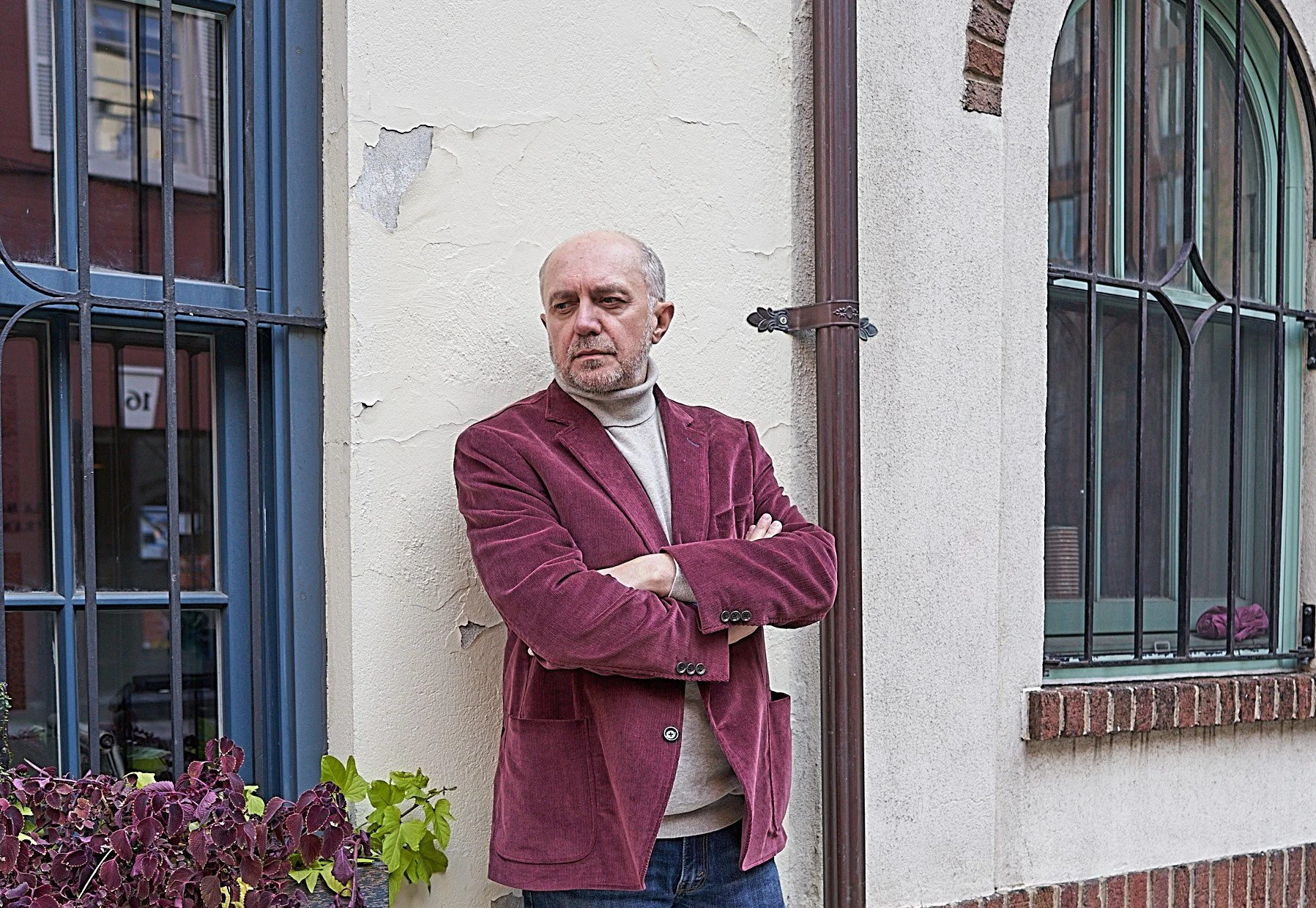
Vasyl Makhno is a Ukrainian poet, prose writer, essayist, and translator. He is the author of fourteen poetry collections, including Skhyma (1993), Caesar’s Solitude (1994), The Book of Hills and Hours (1996), The Flipper of the Fish (2002), 38 Poems about New York and Some Other Things (2004), Cornelia Street Café: New and Selected Poems (2007), Winter Letters (2011), I Want to Be Jazz and Rock’n’Roll (2013), Bike (2015), Jerusalem Poems (2016), Paper Bridge (2017), A Poet, the Ocean and Fish (2019), and One Sail House (2021).
He is also the author of the short story collection The House in Baiting Hollow (2015), the novel The Eternal Calendar (2019), and five books of essays: The Gertrude Stein Memorial Cultural and Recreation Park (2006), Horn of Plenty (2011), Suburbs and Borderland (2019), Biking along the Ocean (2020), and From Consonants to Vowels: An Encyclopedia of Names, Places, Birds, Plants, and Other Things (2023).
In 2024, the Lviv-based Stary Lev Publishing House released Makhno’s selected works in two volumes: Skhyma (Vol. 1: Poems) and Chickens Don’t Fly (Vol. 2: Essays).
Makhno’s works have been widely translated into numerous languages, and his books have been published in Germany, Israel, Lithuania, Poland, Romania, Serbia, and the United States. He has participated in international literary festivals in Germany, Poland, Nicaragua, Mongolia, Serbia, Turkey, and other countries.
He has translated poetry by Zbigniew Herbert, Janusz Szuber, Bohdan Zadura, and Anna Frajlich from Polish into Ukrainian. His honors include the Serbia’s International Povelje Morave Prize for Poetry (2013), the BBC Book of the Year Award (2015), and the International Ukrainian-Jewish Literary Prize Encounter (2020), among others.
He currently lives in New York.

Jaroslaw Anders is a Polish-born literary translator and critic specializing in East and East-Central literatures. He is the author of Between Fire and Sleep: Essays on Modern Polish Poetry and Prose (Yale, 2009). His essays and reviews appeared in the New York Review of Books, The New Republic, Los Angeles Times, and Liberties, as well as in several Polish periodicals. His translation of Vasyl Makhno’s collection of short stories The House in Baiting Hollow is forthcoming this year from the Harvard Ukrainian Research Institute (HURI).